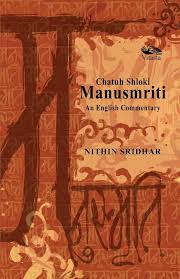
I have always wanted to get to understand firsthand what’s in the Manusmriti. It’s a text that is rarely read but frequently maligned. A topic that raises red flags and earns more brickbats than bouquets. So, when Nithin Sridhar informed me of his new book Chatuh Shloki – Manusmriti, I immediately got my copy.
Nithin is a Director at the INDICA centre for Moksha studies. He has authored six books and is a frequent speaker on Vedanta and Hindu philosophy. Now Nithin is a learned man. He goes deep into a topic – like a scientist he cross references and backs his statement with proof. This book is not a light read – and requires you sit with pen, pencil and highlighter to understand. For a common man this is a heavy read.
The book has received rare reviews from many scholars and seems to be an authoritative work on this subject. You can’t find many books on this topic.
The Manusmriti contains 12 chapters and 2685 verses. Nithin has focused on the first 4 verses and explained it in detail. One of the controversial parts of the Manusmriti is the section on the Varnas and Nithin has spent a lot of time explaining this lucidly. He references sections from the Gita and Rigveda to clarify that modern commentators have misinterpreted the meaning of the Varnas. The other controversy is around the role of women – the book does touch upon that also but in lesser detail.
I learnt a lot from the book, however I intend to get Nithin on my podcast to spell out clearly answers to a few more questions.
Who is Manu – why is he called Swayambhu Manu? Is he God or Man …. Is he the Adam of Hinduism. He got his knowledge from Brahma … so why are the great sages Marichi, Angirasa, Pulastaya, Vashishta, Bhrigu, Narada, Prachetas, Kratu …, great Brahmins coming to a Kshatriya King for knowledge on how to conduct life. Were they listening or was this a discussion where they formed a committee to debate and arrive at a set of guidelines. A modern women would ask – why was there no female representation in this committee.
Manusmriti – is not a constitution, it’s not a rule book – it is laying down conventions for society. Can Version 1 of Manusmriti written in the past be relevant today? Somewhere in the book Nithin mentions that Dharma is sacred and we cannot question it – I want to dig deeper on this.
I am sharing some interesting points from the book.
Page 120
Adi Shankara while commenting on the Bhagavad Gita Verse 4.13 says that a Brahmana is a designation given to one who has a predominance of Sattva Guna. Kshatriya has both Sattva and Rajas – Rajas dominates. In Vaishya Rajas and Tamas exists – but Rajas dominates, Shudra is one in who Rajas and Tamas exist – but Tamas dominates. Thus, with the different combinations of the 3 Gunas the different Varnas with distinct qualities emerge. Manusmriti 1.87 notes that for protection of the universe each of the four Varnas have been given different dharmas to pursue.
Now comes the contentious part – Janma , Guna and Karma form the three-fold criteria for determining Varna with Janma constituting the primary criteria. And all three are dependent on a person’s Prarabdha Karma ( karma from previous life)
Page 131
Manusmriti does not posit an egalitarian socio-political order where everybody is equal, where everyone has equal rights, where there are no gaps between the haves and have nots or where everyone is happy. That is a utopian idea. Human reality is that no two persons are the same. Diversity is very core to how nature functions.
Page 132
Manusmriti is not a law book in the sense of a constitution that was despotically implemented by a ruler. It is not a biblical commandment. Nithin explains that it is a Pramana Shastra that reveals knowledge about Karma and Karma Phala. What actions lead to happiness and sorrow. What duties apply to whom. He makes a strong case these texts remain valid today as they did in the past. He adds – whether we approach these texts for knowledge or to caricature them is upto us.
Page 147
Smritis are teachings based on Vedas and hence they are valid. Because Vedas came from God – they are the ultimate Truth.
Page 158
Manu was questioned by the great Sages. So this was not a one-way communication – it involved discussions.
Page 166
An interesting discussion on how the Varnas emerged from the sacrificial fire as explained in the Purusha Suktam (Rigveda)
Page 176
This is the debatable part in today’s era. Four conditions can be considered as necessary for classifying a person into a Varna.
- Person must be born of marriage and not outside it
- The marriage must be dharmically legitimate
- Both parents must belong to the same varna
- Mother at the time of marriage must be a virgin, excluding cases such as remarriage
So that explains why Karna was not a Kshatriya. But by this logic even the Pandavas were fathered by Yama, Vayu, Indra and the Ashwini Brothers – So how is it they continue to be regarded as Kshatriyas.
Page 185
Bhishma in response to a question tells Yudhishtra
For a Kshatriya and the others becoming a Brahmana is extremely difficult . That is the best state. If one is repeatedly and progressively cooked in the cycle of life one can be born as a Brahmana. Then Bhishma narrates the story of Matanga who was born a Chandala ( Shudra Father and Brahmana Mother) and wanted to attain through austerity the Brahmana status. Indira tells him that it is almost impossible inspite of all the austerities he may undertake. Matanga realizing that it was well-nigh impossible requests a different boon to be celebrated as a deity of metre.
Page 196 – 198
How did Vishwamitra achieve the state of Brahmana when Matanga failed. An interesting story is narrated on how this was achieved
Page 204
Manusmriti 2.103 talks of varna as a ritual state and if the Brahmana does not perform the mandatory Japa of Savitri mantra, then he loses the ritual state. He is only a Brahmana by name. This raises a lot of questions in today’s world.
Overall its an interesting topic to get educated on. And this is a well researched book. So do get your copy and read up. And very soon we will have Nithin on my Podcast to elaborate more on this topic
 A Few Good Things
Recent Comments