Tag Archives: How to plan a trek to Valley of Flowers

A Comprehensive Ladakh Travel Guide

28 Sep

For long I have had the perception that Ladakh was a land far far away with hostile environment and rough weather – a Holiday destination only for the tough & rugged. After this trip, I am glad I was proved wrong.

This BLOG is based on my 12 day solo trip to Ladakh in Sep 2021. It has all that you need to plan your trip. I need to thank Akarsh Pall of I Am Adventure (98118 29449) who helped me plan this trip. He is passionate, committed  and has extensive knowledge of Ladakh – without his help I would not have had a wonderful immersive experience to learn so much about Ladakh.

Why Ladakh – A Few Compelling reasons

  • EasyAccess – Fly into Leh or drive from Srinagar (You can also drive from Manali)
  • Language, No problem – everyone knows Hindi / English
  • Food, No problem – even in the remotest of places you will get piping hot Rice / Dal / Roti / Sabji and even Curd. Add to this Pizza / Pasta / local delicacies and of course the roadside Maggi.
  • Excellent roads – In 12 Days I would have travelled over 1250Km , over 90% of the roads were in excellent condition thanks to the BRO
  • Very Affordable – Excellent homestay at 1000 Rs / day. You can choose your accommodation from basis backpacker dorms & tents to Luxury 5 star hotels
  • Very Safe – In the middle of a remote road on our way from Dah to Leh a young muslim girl in hijab stopped us for a lift. In which part of India would a girl dare to take a lift from an unknown vehicle.
  • Lovely people – The Ladakhis are very nice people. They are warm and helpful. Never agitated always equanimous, following the middle path

________________________________________________________________

And most importantly, A Lot to experience – Ladakh has craggy snow capped mountains, glaciers, scenic river valleys, lakes, treks, orchards, meadows, deserts…. a lot of sightseeing a lot of adventure. The only thing it doesn’t have is dense forests

________________________________________________________________

Given the volumnous information I want to share I will structure this BLOG under 3 Sections

  • An Overview of Ladakh
  • How to manage Acute Mountain Sickness (AMS)
  • Planning your Trip – Travel TIPS

An Overview of Ladakh 

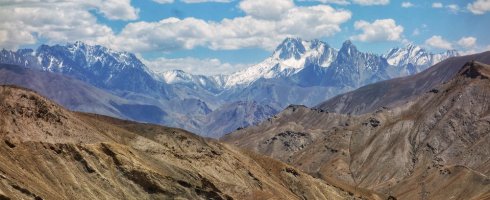
  • The word LA in Ladakhi means PASS – so Ladakh is the land of high mountain Passes. Khardung La, Fotu La, Chang La, Taglang La, Baralacha la …. etc. This is rugged mountain land, a cold desert where the altitude varies from 3000 – 5900 Metres. This is where the Great Himalayas originates. It is also the place of origin of the Karakoram and the Zanskar range of mountains.
  • Ladakh is huge – 59,146 Sq Km. That is bigger than Punjab & Harayana. The UT has two Districts – Leh & Kargil. Total population is less than 3 Lacs. Leh is predominantly Buddhist and Kargil is Shia Muslim. Leh is the 2nd largest district of India (Kutch is the largest & Jaisalmer the 3rd)
  • It is one of the coldest and most sparsely inhabited regions of the world. Yet it has a high density of armed forces. We have hostile neighbours and a long stretch of LOC with China and POK. At any point in time there are over 50,000 battle ready armed forces in Ladakh. Siachen & Galwan the hotspots of recent times are in Ladakh.
  • Ladakh was an independent country till 1834. It was part of the silk route and there is a lot of mingling of cultures. A strong Tibetian influence – The Ladakhi language is a modified Tibetan form and both share the same script. It also has influence from Iran ( Indo Iranian – Dard), Baltistan and people from Central Asia including Uighur’s. Interesting to note that the Balti’s a sect of Muslims in Gilgit – Baltistan follow the Persian Navroz New Year. The great general Zorawar integrated Ladakh with the kingdom of Jammu.
  • Its not just the land of lofty mountains but also the land of many rivers. The mighty Indus (Still called Sindhu in Ladakh) originates near Kailash and flows thru Ladakh before entering Pakistan at Batalik. There are many more rivers cutting deep gorges and creating fertile valleys – Zanskar, Shyok, Suru, Drass, Nubra, Shingo are some of the larger rivers – most of which are tributaries to the Indus
  • Ladakh is also the land of pristine high altitude lakes – Pangong Tso, Tso Moriri, Tso Kar etc. You may have guessed that the word Tso means lake in Ladakhi
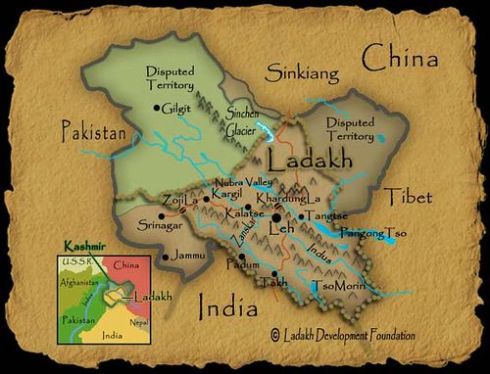
 

Given the size of Ladakh how much time will it take to cover everything

If you want to do justice and see all that Ladakh has to offer you must plan a 4 – 6 weeks trip. Or multiple trips of 2 weeks. Most people try to cover the key sights of Leh / Nubra / Pangong in 5 – 6 days. But that is just touching the tip of the iceberg. Dont do that – coming to a far away land spend time with the locals, immerse yourself with the culture and go back with knowledge and deep experiences of a lifetime.

This Link has a detailed explanation of all the regions of Ladakh and what they have to offer. Read at leisure. It will help you plan your trip. https://travelthehimalayas.com/kikis-guide-to-ladakh. 

How to Manage AMS (Acute Mountain Sickness) 

This is the first question that people travelling to Ladakh have. The city of LEH is at 11,500 Feet, Khardungla Pass is ~ 18,000 feet. During your trip you will be travelling between 9500 – 18000 feet. That is serious High Altitude and you need to plan to avoid AMS. I had learnt my lesson during my travel to Kailash Mansarovar and took all the necessary precautions this time – Within 24 hrs of landing I was fine and Ladakh felt like being in Bangalore.

  • Dont Take Diamox – Let the body adjust naturally. This was the best advise that Akarsh gave me. I was inclined to take Diamox – but he insisted against it.
  • If your travel plan can be from Srinagar that is ideal. Drive from Srinagar to Leh on NHI and on the way cover Sonmarg / Drass / Suru Valley / Dah – Hanu and then reach LEH. This is the best way to acclimatise as you ascend slowly and your body adjusts.  (Srinagar – Sonmarg : 84 Km, Sonmarg – Drass : 60 Km Enroute you cross the Zojila Pass 3530 M, Drass – Kargil : 55 Km , Kargil – Leh : 230 Km)
  • If you are flying into Leh then take the first 36 Hrs very easy. Do Nothing. Eat light. Drink a lot of stream water (Not Bisleri). Avoid Oily food / Rajma / Eggs – stick to Dal Chawal / Curd / Roti Sabji
  • Do a lot of deep breathing – better to start doing this months before your trip to Ladakh
  • Dont exercise or walk briskly – don’t do Yoga / skipping … any strenuous activity.
  • Your first getaway from Leh should be to a place of lower altitude. So head to Kargil / Drass / Suru Valley / Dah – Hanu etc. These are all places at 9000 – 10000 feet. Dont try going to Pangong ( 14,500 feet) or Tso Moriri (15,000 feet) on Day 2 of your trip – that is a recipe of disaster. Getting to Nubra Valley also means crossing Khardungla which is at 17900 feet.

If you are not Obese, your fitness levels are decent and you follow the above guidance I can assure you that your chances of getting impacted by AMS are rare

Planning your Trip 

What is the best time to travel to Ladakh ?

April 15 – May 15th and Sep 10th – Sep 30th is ideal. From Oct – March Ladakh is very cold and tourists may find many attractions closed. Roads / High altitude passes may also be closed. In Sep the crowds start diminishing and by Sep end you may get to see snow in the high passes. The fruit season may just be getting over and if you are lucky you may spot Apples in the orchards but the Apricot season may be over. Mid April is spring when the flowers in the valleys bloom. It will still be cold and there will be a lot of snow but Ladakh will be fresh, welcoming the seasons first tourists .

June – July – Aug is peak season and you may be disappointed with crowds everywhere. Ladakh is a place you want to enjoy in solitude. The tourist traffic in Ladakh is exploding – 2021 saw well over 300K tourists an all time high  – This inspite of COVID and no foreigners. The Govt is gearing up for 1 M tourists in the next 3 – 4 years. So dont delay your trip – visit Ladakh before it becomes Simla or Nainital.

How many days trip should I plan 

You first need to decide how many days you have at hand. You can work with your travel planner to maximise based on this. Here are some basic guidelines that may help you

  • I used a Hub & Spoke model.  Made LEH my Hub and retained a lovely homestay there for the entire duration of my trip. Explored the region by making 1 – 2 day trips
  • Did not do any long tiring day trips and was not on the road for more than 6 hrs any day
  • This ensures that you are not tired and you can get your laundry done at the homestay
  • Dont rush – enjoy the beauty of the place, talk to the locals , stay at homestays and villages, eat local food and get a cultural immersion.
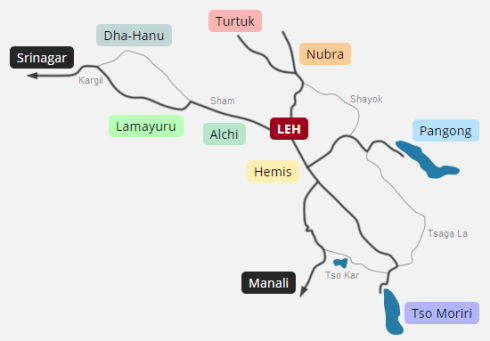
Approximate Indication of time & distance from LEH 

Section – 1 : Kargil / Drass / Suru Valley / Dah – Hanu (Budget 2 – 3 days) 

  • Leh – Kargil : 216 Km  – 4 1/2 Hrs  – NH 1 Excellent road, Kargil – Drass : 60 Km  – 1 Hr – NH 1
  • On the way to Kargil stop by at the Lamayuru monastery with its moon like rock formations. You can Explore the Kargil War memorial at Drass, There are Apple & Apricot orchards on the way to Drass at Karkichoo valley. Spend the night at Drass and visit the Tiger hill. Mushko Valley & Minamarg are the hubs for trekking to Gurez & Amarnath
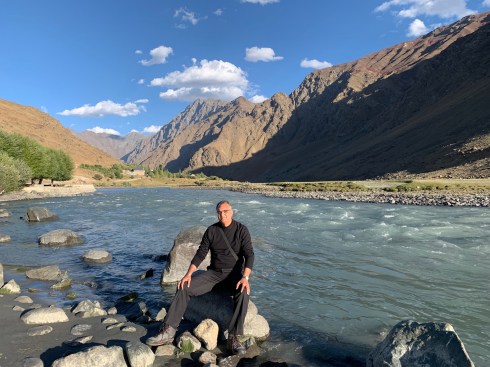
  • Kargil is the District HQ – nothing much to see there, but from Kargil you can explore Suru valley – best time to do that is in April – May when the flowers are in full bloom
  • As you finish this circuit and head back to Leh take a different more scenic route along the Indus via the Aryan Villages of Dah – Hanu. You can stay in a small hotel by the Indus River called the Aryan Residency or live in a Camp by the river. There are 3 villages here which claim to be descendants of Alexanders soldiers. They do dress up and put up a show if you are in a group (Not FREE)
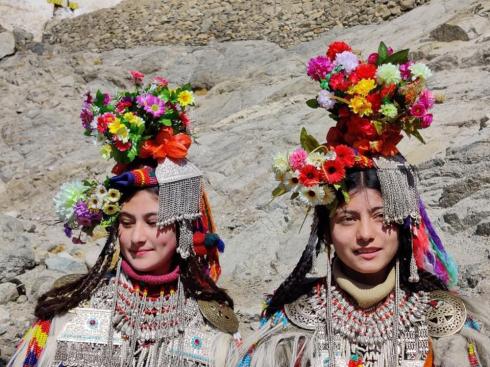
If you leave Kargil by 9 AM  you will reach the Aryan Village by lunch time – that gives you 1/2 a day to explore the place, sit by the raging Indus River and enjoy the peace and solitude. The next day after breakfast if you leave by 9 AM you can reach Leh by 3 PM  – with a stopover at Alchi monastery and lunch at a beautiful restaurant called Alchi village.

In a landscape that is vastly craggy brown mountain this sector is the green patch. Depending on time available one can also cover Zanskar from Kargil. Remember this is the place of the world famous Chadar trek on the frozen Zanskar river.

Section – 2 : Turtuk/ Nubra / Pangong Tso plan for 3 nights 

After you completed the 1st Phase of your travels take a 1 day break at Leh and enjoy the local sights and restaurants, then head to Turtuk.

To reach Turtuk you need to cross the famous Khardungla Pass. When we were kids that was the answer to a quiz question – Khardungla pass was the worlds highest motorable pass. It no longer is – but at 17982 feet it is impressive.
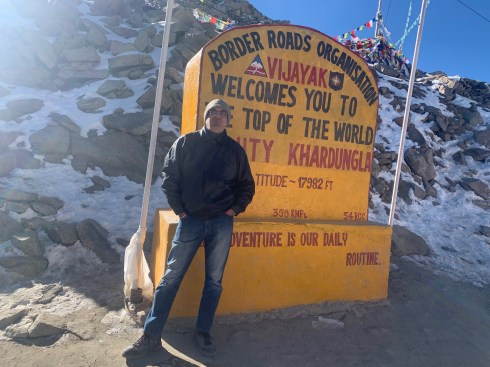
Khardungla pass is 39 Km from LEH. Start early to avoid the army convoys. You want to reach early and cross the pass early – don’t spend more than 15 Min at Khardungla. We left LEH at 7.15 AM and were at Khardungla by 8.15 AM It was empty. We were lucky to see snow in mid Sep – it normally starts snowing in early Oct and has over 6 feet of Snow from Nov to March.

As you descend from Khardungla you see many wild Yaks grazing and after a few hours reach a white sand desert called the Nubra Valley. On our onward journey we did not stop at Nubra and headed straight to Turtuk. On the way you see many army camps – this is the way to Siachen & Galwan. We reached Turtuk at 2 in the afternoon. This was the longest travel day for us
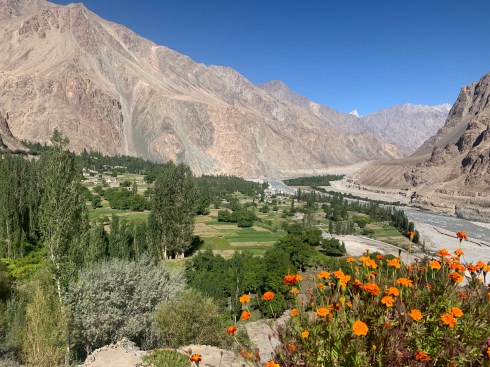
Turtuk is a Balti village. Most of Gilgit Baltistan is in POK. Turtuk and the adjoining villages were annexed from POK by the Indian army in 1971. Many claim that Turtuk is the Northern most Indian village – but there is Takshin and Thang beyond Turtuk. The last inhabited village is Thang from where you can see the Line of Control. I spent the night at Turtuk and enjoyed local Balti cuisine. The village is clean and is full of home-stays, restaurants and small museums. Its a pretty green village with streams and flowers and orchards. The Shyok river flows by from here to Pakistan.

At Thang do try and meet Gubba Ali. He has an emotional story to tell of 1971 when as a 5 year old he was separated from his parents who were in the next village in POK. The army did not proceed further as cease fire had been declared and the Pakistanis did not allow his parents to come back.
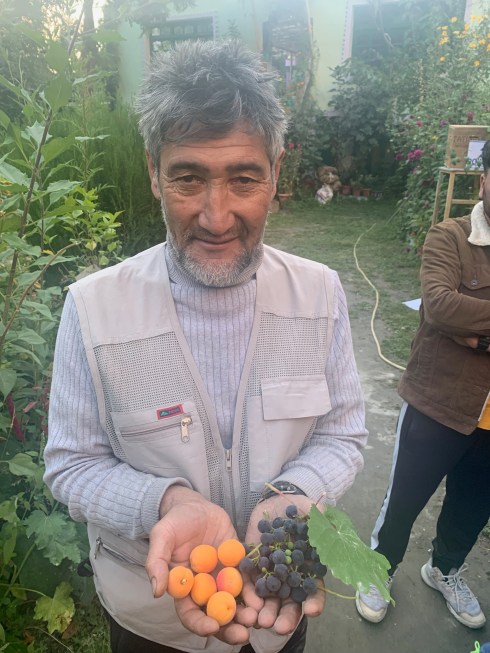
You need a local to take you for a morning walk down some pretty streams and trek up to a monastery for some fresh air and lovely views. Turtuk is a lovely place – dont do a rushed day trip from Nubra, spend a night here. 

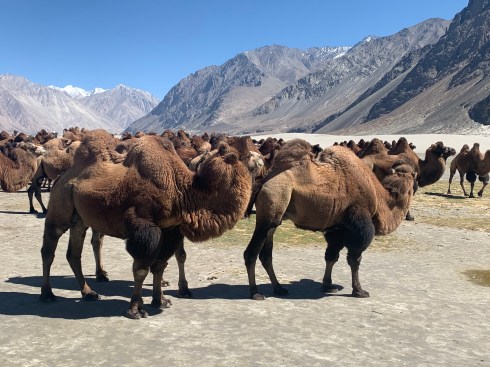
The next morning we left Turtuk after breakfast and a morning trek at 10.30 AM and reached our resort at Nubra by 2 PM. On the way we stopped by to meet the rare double humped Bactrian camels from Central Asia. The camels look healthy, strong and well fed.

Please note they head home for lunch at 1 and are back only by 4 PM – so time your travel accordingly. Along Nubra Valley there are many places where you can also indulge in ATV rides.
At Nubra we stayed at a nice resort owned by the Ex Mla of Ladakh. Osay Khar is a beautiful resort in the lap of nature with 21 modern cottages, an organic garden and a sprawling Apple orchard. They also rear their own cows. The owner Tsetan Namgyal is a wonderful man and his family offers you great hospitality. Incidentally Tsetan is royalty – his sister is married to the King of Ladakh. I am thankful to Tsetan for spending so much time and showing us the neighbourhood.
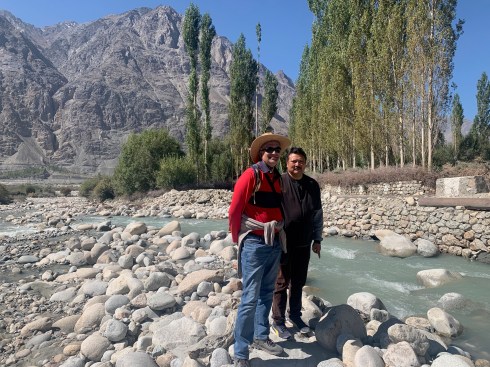
The drive from Nubra to Pangong Lake is about 6 hrs. There are sections where the road is not in great shape. Leh – Pangong – Turtuk is a bit like a triangle so it saves time to cover Pangong Lake from Nubra rather than going back to Leh.

Pangong Lake is at 14,500 feet. Its a the worlds highest saline lake. Its also 135 Km long and over 100 feet deep – 1/3rd in India rest in China Occupied territory.  The lake is serene and eerie. Inspite of being saline it freezes in winter. It is spotlessly clean and the water is sparkling. There is no permanent accommodation here. There are tented camps – some are canvas tents and some are log house rooms. Tents are decent – Western bathroom with running water. Electricity from a generator is provided from 6 – 10 PM and hot water at 8 AM for an hr.
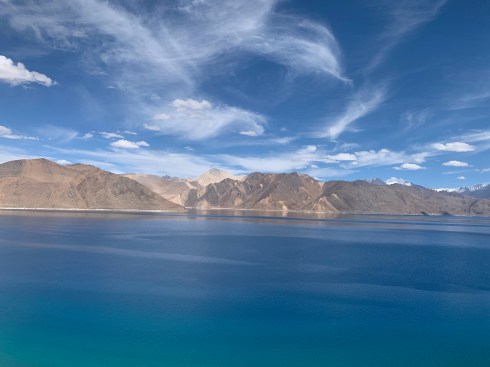
Most people tend to do a day trip to Pangong Lake from LEH. I would advise against this. 10 hrs of driving can be very tiring. The Lake is best enjoyed late evening and early morning. I was lucky to be here on a full moon night. Try and time your travel to a New Moon or Full Moon. Yes it is freezing cold in the tent and with 3 layers of sweaters, a thermal and 3 blankets I was shivering. The camps shut down in October as it becomes very cold.

Service is good and hot fresh food – Roti / Rice / dal / Soup / Kheer is provided. Tea / Coffee / Maggi / Snacks is also provided.

The next day we left Pangong at 8 AM after a hot breakfast and headed back to Leh Via Changla Pass – another high altitude Pass. the journey was smooth and we reached LEH at 12.45 right in time for lunch at the Gyalson Homestay – the lovely place which was my HQ.

All about LEH 

LEH was my hub. The Kushok Bakula Rimpochee Airport  is the 23rd highest commercial airport in the world at 10,682 feet. Its a small airport that is undergoing expansion. The flight to Leh from Delhi is scenic – remember on the Delhi – Leh route choose seat F (Window) and on the Leh – Delhi sector choose seat A. This will ensure you get the best views.

I stayed at the Gyalson Guest-house – a very comfortable and homely place. It is the home of a lovely Ladakhi family. Rooms are clean, hot water is available 24 by 7 and you get freshly cooked meals – with organic vegetables from the kitchen garden. It is also very affordable. (Contact Paale – 80823 46464). A big thanks to Megha & Yashwant for guiding me to Gyalson and also helping me plan the trip.
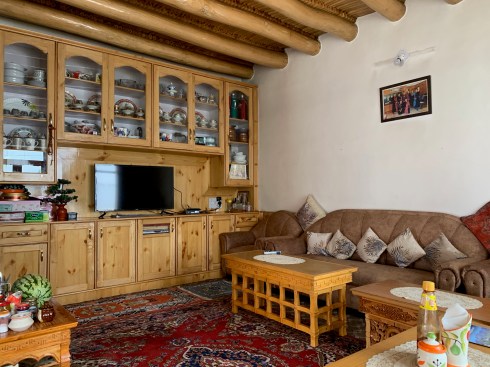
Located on Changspa Road the main hub of Leh its a short 10 min walk from the Leh Market. The Shanti Stupa is also a 10 min walk and can be seen from the balcony of the room.

Leh is a small town – but unlike other hill stations the roads are flat. There is no public transport – so your rented vehicle is your mode of transport. There is a wide variety of restaurants and shops in leh and you can get almost everything you get in a big city. Idli / Dosa / Pizza / Pasta / Local Cuisines …. you can feast at the local restaurants and cafes. many are vibrant with live music. Here is a list you may find handy of the 15 Best restaurants in Ladakh.  15 Best Restaurants & cafes in Ladakh. Inspite of its remote locations costs are very affordable.

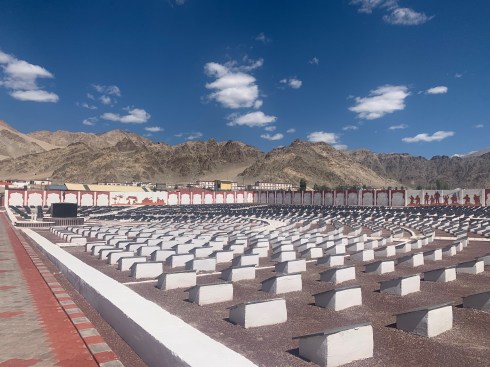
The key sights of Leh can be covered easily in 2 days. Shanti Stupa looks beautiful when lit at night. the Pathar Sahib Gurudwara has a lot of history associated with it and the Hall of Fame is a wonderful war museum and memorial. Dont miss the Light & Sound show at Zorawar Fort and Hall of Fame. Magnetic Hill, Leh Palace, Stok Palace, Central Museum, Sangam of Indus & Zanskar, Ghats of the Sindhu river, a few monasteries – that’s about all that there is to see in Leh

So what did I miss out this trip?

Tso Moriri is another beautiful lake. Less frequented by Indians. Thats another 1 night trip from Leh. Further ahead of Two Moriri is the village of Hanley which is home to a rare observatory that houses one of the worlds highest telescopes. Star gazing from here is supposedly out of the world. But this is a long long way away. Suru Valley is a must visit in Spring and one should plan a trip to Zanskar.

So I guess another 2 weeks are needed to cover Ladakh.

A Few More Points to help in your travel

  • The 3 most important accessories for this trip are Sunscreen lotion SPF 50, a Nice big floppy hat and sun glasses. At this altitude days can be very hot and the sun rays can be scorching.
  • Carry a lot of water – a good sipper with inbuilt filter is good to have – as you drive you can fill your bottle from the fresh streams.
  • Airtel Post paid connections work. The network is decent in most places. BSNL has the best coverage. In Pangong only BSNL works.
  • Innova’s and Mahindra XUV’s are the only vehicles you will find on the road. Dont overload your car with 6 – 7 passengers. Try to be max 3 – 4 / vehicle. There are no mechanics / repair shops Enroute so ensure that you have a good Vehicle
  • Most tourists are youngsters who rent a bike from LEH. A lot of young couples who come in groups. A lot of women groups. I spotted very few families ( maybe it was Sep and school time) – and some teenagers but no one below the age of 12 or above the age of 60.
  • Carry your medicines – after LEH you will not find any chemists / big shops
  • Ladakh is the biggest producer of Apricots – so if you want to drink fresh fruit of the land drink Apricot juice.
  • You will not find Bars / Pubs in Leh or in other locations. Liquor may be available on request. Best avoided. At Pangong Lake I was sitting with a bunch of youngsters from Jaipur who were enjoying a few drinks and the camp incharge advised them to stop. A few days back two youngsters in their 30’s had suffered cardiac arrest after drinking.
  • If you kids want luxury stay – yes there are some high end hotels , you may want to indulge in some of them during your travel. Luxury Hotels in Ladakh 
  • Credit card / Google Pay works in Ladakh – lots of ATM’s. But carry cash – outside of LEH cash is preferred. Your cash usage is limited if your travel planner has booked all your rooms. On a 12 day trip I did not need more than 10K in cash.
  • There are many monasteries – they are huge. I visited two of them Lamayuru & Aichi. They all feel the same. I could not sense the energy and vibes in the monastery that one feels in the ancient Chola temples.
  • The Inner Line permits that were needed till recently have been eliminated. Indians can travel to almost all of Ladakh without permits.
  • And last but not the least – Is Ladakh a destination for honeymooners ? No it isn’t

And one more thing. Ladakh is home to many regiments & battalions. Many a Braveheart has given up his life in the struggle to protect the motherland. Do visit the memorials and museums of the brave soldiers and understand the challenges that they face in the peak of winter when the temperature easily drops to (-) 20 degrees or lower.
 

Journey to the Valley of Flowers

14 Aug

Nature rewards you after hard work. Getting to the Valley of Flowers in the middle Himalayas is a very long journey – almost 3 days from Bangalore. Its a trip that requires planning and getting in shape – but eventually the reward is worth the effort. For anyone wanting to make a trip to Valley of Flowers and Hemkunt Saheb this Blog will provide all the details.

A quick Summary of the trip

  • The journey : Bangalore – Delhi – Dehradun – Haridwar – Joshimath (6050 feet) – Gobind Ghat – Pulana – Ghangria ( ~ 9500 feet) – Valley of Flowers ( 9500 – 12000 feet) – Hemkunt Saheb (14500 feet)
  • Almost 50 kms of trekking ( I did 35 by trek and 15 by Mule) which treats you to Fresh air & Divine views
  • 25 hrs of driving in the rugged Himalayan landscape – we travelled in the monsoon and witnessed at least 25 landslides – by divine grace we were not impacted by rain or landslides and sailed thru smoothly.

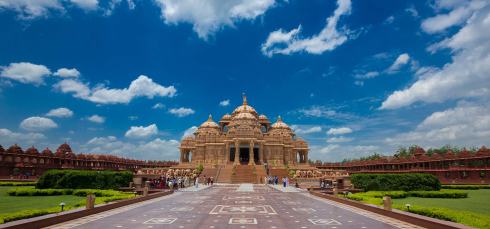
You can do this trip in 8 days but I decided to spend a few days at Gurgaon to meet friends and visit the Akshardham temple – A masterpiece where you can easily spend 4 – 5 hrs. Having travelled to Delhi so many times in the past 15 years this was one landmark that I had not visited. The story of the young sage Swami Narayan is fascinating and has close similarities to that of Shanakrachary. We missed the fountain and the light show in the evening – but I am sure I will come back to this well maintained energised place.

Swaminarayan Akshardham, New Delhi

Day 0 : Bangalore – Delhi – Haridwar 

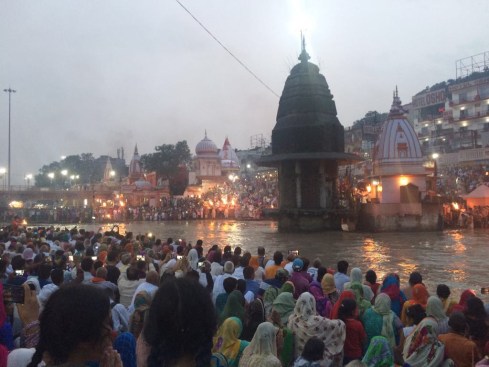
My friends house at Gurgaon is also a temple – so much of peaceful energy, and it was a great start to an exciting 8 days ahead. He was kind enough to drop me at Platform 16 Ajmera Gate, Delhi Dehradun Shatabadi. This is the last platform – so if you get dropped on the other side of the station its a very long walk . I reached Haridwar at 11.45 and was in my Hotel by 12.45 ( Regenta Hotel – Royal Orchid on the Haridwar Rishikesh Road). My friends from Bangalore had taken the morning flight and they also reached the hotel by 3 PM. That evening we stopped by the Sapta Rishi Ashram and the Adhbut Mandir on the way to Har Ki Pauri to view the Ganga Arti. Aug is not busy season, because of monsoon and the “kavad” season is over  – the Ganga was in spate, frothy and muddy. Haridwar is a chaotic place and the Ganga Arti at the Har Ki Pauri  was a shade compared to what I had seen in Varanasi or even Rishikesh. (Lord Shiva and Lord Vishnu are believed to have visited the Brahmakund in Har Ki Pauri in the Vedic times). For all the noise we make on Hindutva it would be good if Indian temples and places like Haridwar , Rishikesh and Varanasi are kept as clean as the Vatican or the Golden Temple. On our way back we had a tasty dinner and had an early sleep (Given the long travel ahead I made it a point to eat light and avoid gravy / spicy food all long )

Day – 1 : Haridwar – Joshimath (278 Km – 12 hrs drive) 

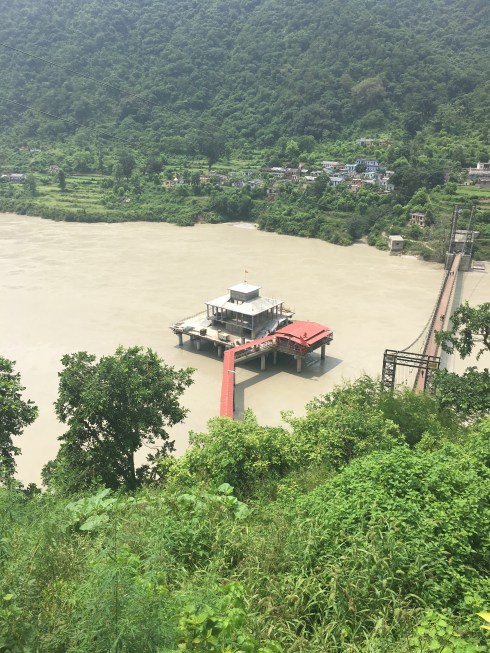
We left our hotel at 6 AM and reached Joshimath at 5.30 PM. The journey was pleasant – our 14 seater Tempo Traveller had only 9 – so there was enough space to stretch your legs. Enroute we crossed Rishikesh – Dev Prayag ( Bhageerathi & Alaknanda confluence) – Srinagar – Rudraprayag ( Alaknanda – Mandakini Confluence) – and finally Joshimath and checked into Auli – D. A decent hotel with basic functionality – neat rooms , geyser, decent food. The weather was hot and humid all through and only near Joshimath did we start feeling pleasant. The road is good – you ascend from the plains to 6050 feet over 278 km so the ascent is smooth – no sharp U bends. We stopped for breakfast and lunch (No branded restaurants on the way – food is decent but the ambience and cleanliness of the dhabas is sad, toilets are disappointing, big challenge for women travellers who comprise almost 50% of the Trekkers to the Valley of flowers)

Day – 2 : Joshimath – Gobind Ghat – Pulana – Ghangria 

After a breakfast of Aloo Paratha, Poha and Chai we left at 7 AM by the Tempo Traveller. Our next stop was Govind Ghat – 20 Km ( 45 min). On the way we stopped to admire the Vishnu Prayag – the confluence of Bhuyandar & Alaknanda – a place where sage Narada is supposed to have meditated.

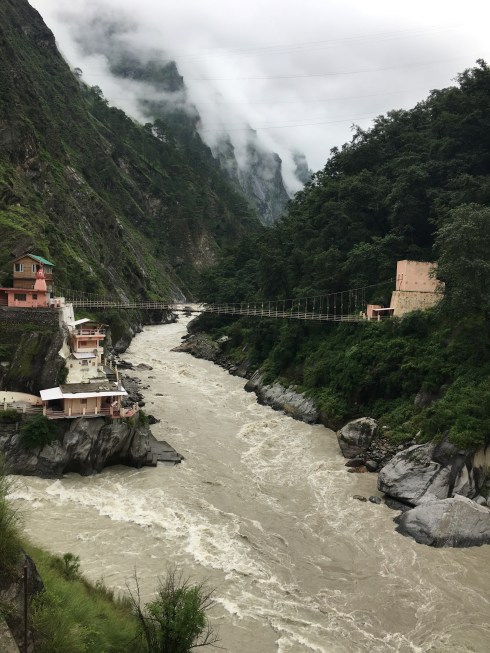
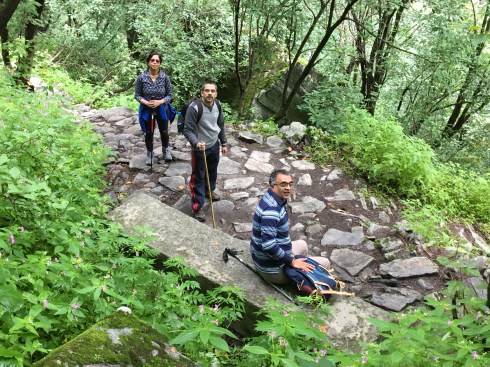
We reached Govind Ghat by 8.30 AM and had to stand in a Q to complete the registration process. We unloaded our luggage and took a Jeep to Pulana – 4 km away. From Gobind Ghat you will lose Mobile Connectivity – all you will have is very sporadic BSNL land line connection at Ghangria. The trek to Ghangria starts from Pulana – its a 11 Km trek , not very steep. If you walk at a relaxed pace it will take you about 4 – 5 hrs. We started at 9.30 and reached our room at Ghangria by 2 in the afternoon. You also have an option of riding a mule for Rs 850/- or be carried in a basket by a Nepali Sherpa or to take a chopper from Govind Ghat ( 5 Min – Rs 3500, Operates only if weather is good) . Most people walk – the guide had loaded our luggage on mules so that was easy. This is the first trek – energy levels are high – and I strongly advocate that you walk this stretch. There are nice views of forests , waterfalls , gushing springs. the pathway is cobbled – lots of shops on the way to stop for lemon juice or food or snacks. Keep your rain cover handy in your small backpack – the weather is very unpredictable. It did rain after almost 3 hrs of trek and the rain did slow me down.

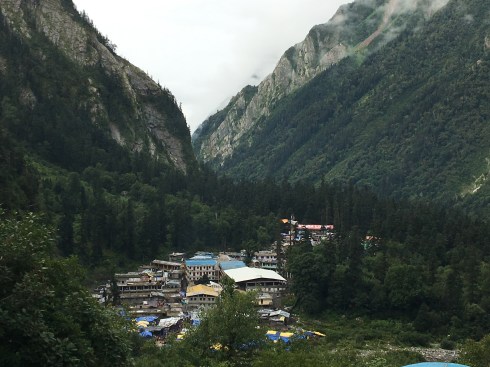
Ghangria is the base camp for both the Valley of Flowers and Hemkunt Saheb. Located at 9050 feet its a small hamlet that operates only for 4 months from June to Sep.

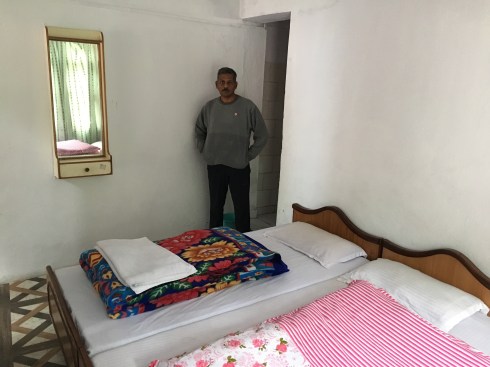
You have an option of staying in a small basic functionality hotel or in tents. The Tents may have better views but not electricity and running water. Blue Poppy the company that had planned our trip had booked us at a small inn called Krishna Place – its the type of room I may not have stayed even when I was in college. Small , Cramped, Basic , the quilts and bedsheets were dirty, the limited staff were stinking  – two of us stayed in a room designed for 3 – we used a bed for keeping our bags , there was no place in the ground to keep any bags.

The good things – You have electricity and running water and Hot Water was provided by Bahadur ( 1 bucket / day is free – extra is Rs 50/bucket) – the hotel provided Tea , Bottled water , Pakodas , Maggi etc and also a Foot Massager – who charged 200 Rs for a 10 min massage. That was a luxury for the first few days – before we realised that his rate was higher than that in a high end spa at Bangalore. The guy also washed and ironed clothes – we were in for a shock when he told us after washing that he charged Rs 150/- per piece. But thats the premium you pay at 9500 feet.  There are a few dhabas nearby that serve good food – all our meals were at Gangotri – from piping hot Upma at 6 AM to Rajma, Chole, Noodles and even Dosa – we had no challenges with good hot food all thru the trip. I stuck to Khichdi most of the days. Tea Coffee is served using Milk Powder – you do get curd , but I think even that is made from milk powder. Price for food is reasonable.

Day – 3 : Ghangria – Valley of Flowers – Ghangria

I had been praying for months for a safe trip with good weather and it was a joy to see clear sky at 5 AM. After a warm bath and breakfast we started our trek at 6.30. A short distance later you complete the registration formalities.(Our guide had taken all the details and entry fees earlier and done the needful so we had no waiting period). Entry pass is Rs 150 valid for 3 days The busiest day at the Valley of Flowers has seen 500 visitors , in July – August the average crowd is about 200 / day. the best part of this trek is that no ponies are allowed – you walk or you are carried by a Sherpa.

Climbing has always been easy for me – it coming down thats a challenge on my knees. Sunny skies and the excitement of the final destination nearby energises you and I covered the 4 km to the entrance of the valley of the flowers in 2 1 /2 hrs . Its a beautiful scenic trek thru forests and gushing springs. The weather is pleasant and perfect for trekking. the views are amazing.

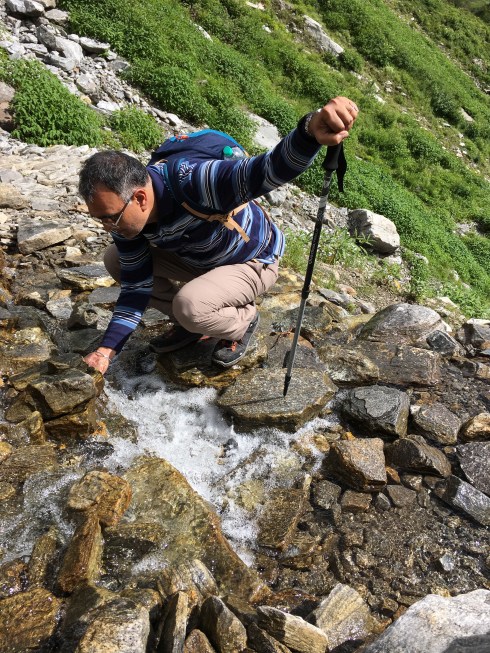
If you re tired and thirsty drink some water  from the spring – its energising and refreshes you, full of minerals. This is how life was as God made it and we messed it up. Every 30 minutes I stopped for doing a few Pranayams and deep breathing – this really helps in ensuring that the oxygen content in your blood is high. All along your trek you are walking along the Pushpavati river.

The climb was easy and at 9.15 I was in the Valley of Flowers. This UNESCO world heritage site is spread over 30 square kilometres. the end point is the Tipra Glacier ( 14,500 feet) – from the entry of the Valley of Flowers to the Tipra Glacier is a 10 Km Trek ( 6 Hrs) and you can pitch a tent there for the night.

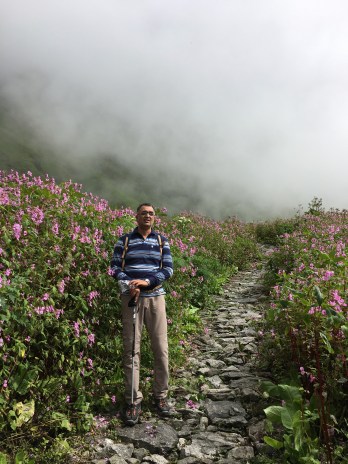
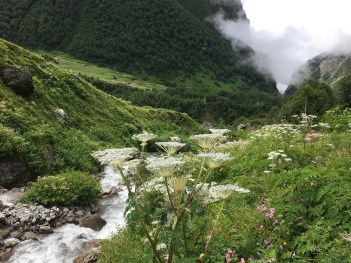
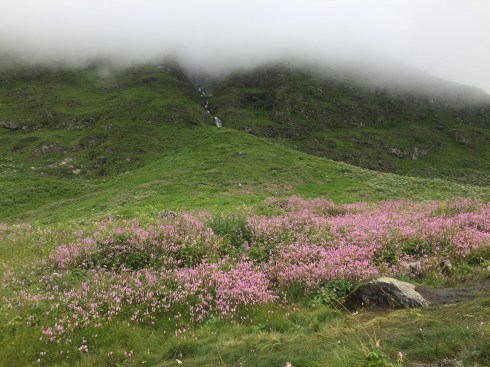
We walked 3 kms inside the valley – it was mystical , foggy , surrounded by mountains, brooks and waterfalls all around you – and flowers in a multitude of colours and shapes. Just you and nature. Its nice – but if you have expectations of meadows of flowers as far as the eye can see then you may be a tad disappointed. Which I was – the Valley of Flowers met expectations – did not exceed. It was very nice but it was not jaw dropping spectacular


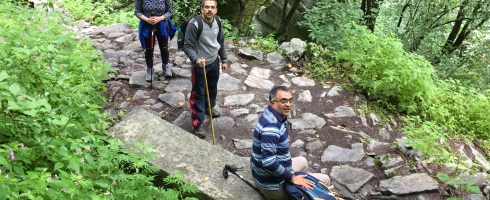
We had packed lunch – there are no shops on this route , and after lunch we started the trek back to Ghangria by 12 noon. Going back is always tougher – and to add to the challenge of climbing down it started drizzling. The pathways here are not cemented – its just rocks of different shapes that are on a path – its wobbly and pokey – and on an incline it can be risky. I struggled and moved step by step , inch by inch and finally made it back to the room dead tired by 4 PM , almost 4 hrs. (Most people do not venture 3 Kms deep into the Valley)

A Foot massage followed by a nice warm bath , and a nourishing dinner and I slept like a log at 9 PM (My friends ensured that they were warmed up by a Patiala Peg – there is no liquor available at Ghangria , so ensure that you get it with you or buy it at Joshimath , the stores at Joshimath close by 6 PM – so chances are that by the time you reach its closed)

Day – 4 : Recovery Day 

Last 2 days I had trekked 25 Kms and I was tired. The Tour Company had smartly planned 2 days for the Valley of Flowers – in case of heavy rains there was a backup day. Fortunately for us this backup day was the rest day. The last 4 – 5 days I had been getting up at 4.30 , and was tiring – I needed rest. Guess what – this was the only day in our travel that it was raining heavily. My colleagues decided to walk around and visit a waterfall close by and see the tents. I stayed back in the room to catch up on my strength.

Day – 5 : Hemkunt Sahib 

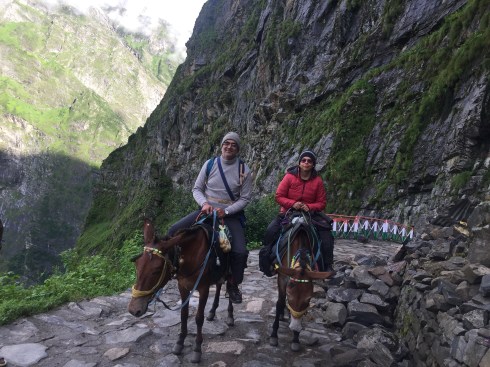
Located at 14,500 feet – the trek from Ghangria to Hemkunt ( Also spelled as Hemkund ) is steep. You scale 5500 feet in less than 6 kms. The pathway is in better shape than the Valley of Flowers – but most of the route is not as scenic as the Valley of Flowers. Climbing becomes difficult because of the steep altitude and lower oxygen. You have an option of taking a Mule ride – which I did. We left sharp at 6.30 and reached Hemkund at 8.30 – there are many shops on the way on this route. It was a bright and sunny day with Blue Skies. Good to reach early as it gets very foggy after 11 AM .

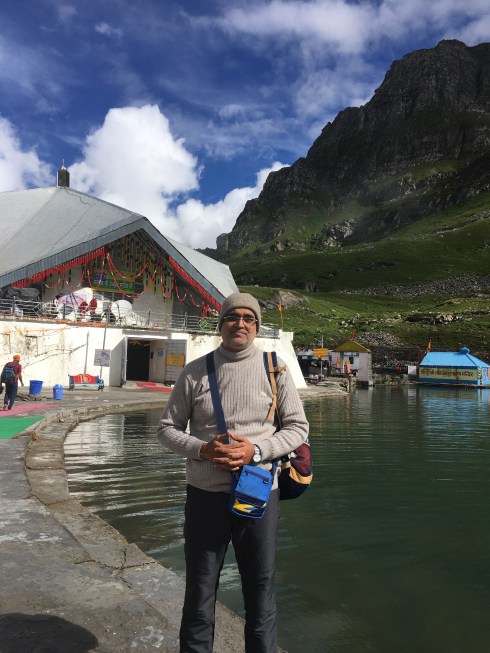
In his previous birth Guru Nanak is said to have meditated at this spot. Its a beautiful serene place with a glacial lake surrounded by 7 peaks. The mist plays peek a boo with the lake and the whole experience is magical. Right behind the Gurudwara is a place where Lakshman is said to have meditated – and there is a temple in memory of him. Hem Kund as the name suggests is a Snow Lake – and the Gurudwara is open only from June to Sep, rest of the year it is not accessible because of heavy snow. Best period to travel is September.

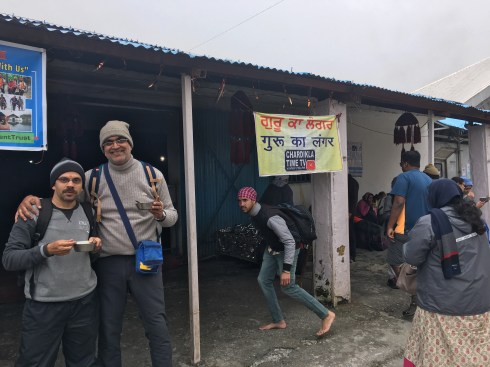
The water in the lake is freezing , but the strong sardars brave the cold and take dips bare bodied. After a walk around the lake I went and sat inside the Gurudwara from 9.15 to 10 AM. The “Ardas”  is at 10 AM  and at 12 AM ,  we attended the 10 AM “Ardas” after which very tasty Halwa was served as Prasad. Stepping out we had piping hot Khichdi and Tea. Our friends who started the trek at 5.40 AM made it by 9 AM (Which was great – most people take 5 – 6 hrs to climb up)

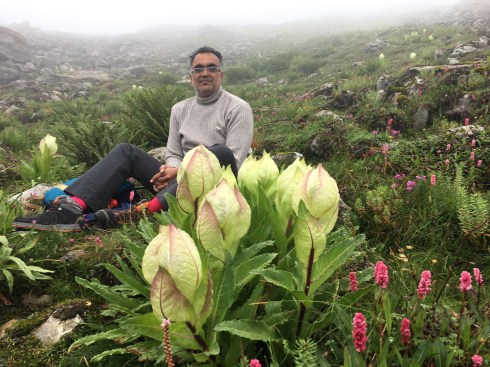
The rare Brahma Kamal flower blooms in plenty in and around the Hemkunt Saheb – we could see them as we started our trek back. We climbed a small hill – with no path just to get closer to these rare and beautiful flowers. There was a sense of accomplishment and peace as I sat next to the flowers.

I started the trek back with gusto but after an hr my feet started hurting. The steep incline puts pressure on your toes and I was mentally holding back running down – allowing gravity to help me in the way back. I ploughed along for 5 kms and finally the last 1 km I had to take a pony ride. the master trekkers in our team went down almost sprinting in less than 2 hrs.

Day – 6 : We head back to Joshimath 

After breakfast at 6 we started our journey back to Gobind Ghat – the plan was to reach by 9 and then head to Badrinath and Mana on the way to Joshimath. By now my feet were tired and I took the Mule back. We were at Gobind Ghat by 9 – collected the Prasad from the Gurudwara and headed towards Badrinath.

Its a 2 hr drive and the road has many tricky spots where landslides happen frequently. We had been informed that the road was closed for the last 2 days. Fortunately when we reached the roads were open. But there was the risk of landslide in a 100 metre stretch.

Having come so far I wanted to go but the fear of the majority over ruled the faith of a few. We travelled ~ 600 kms in the fragile Himalayan landscape safely and I was sure that we would have passed this 100 m stretch also – God had opened the path to us after 2 days – Badrinath was empty and we would have had great Darshan – but it was not to be. In 2010 I was at the gates of Badrinath but it was very crowded and the Q time was 3 hrs – and we were not able to get a Darshan – I am sure I will get lucky the 3rd time.

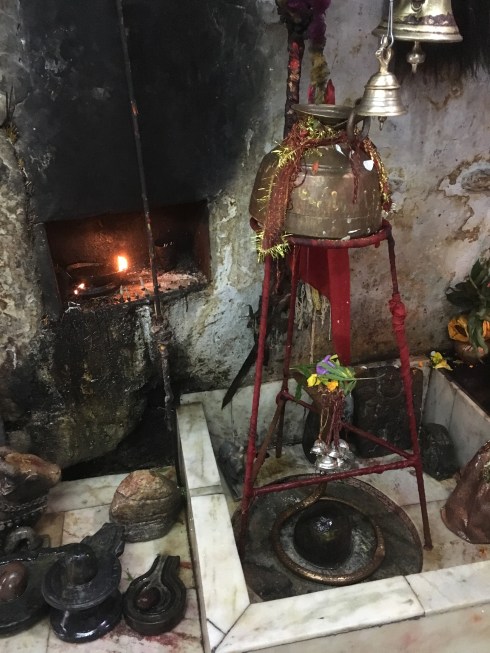
On the way back we stopped by at Jyotir Mutt – one of the 4 mutts established by Shankaracharya, he spent almost 14 years here. We were blessed to spend time in front of the Akhand Jyoti that he had lit almost 2500 years back, and pray in front of the “Swayambu” Shiv Linga below the 2500 year old Kalpa Vriksha. This place is brimming with energy and positive vibrations.

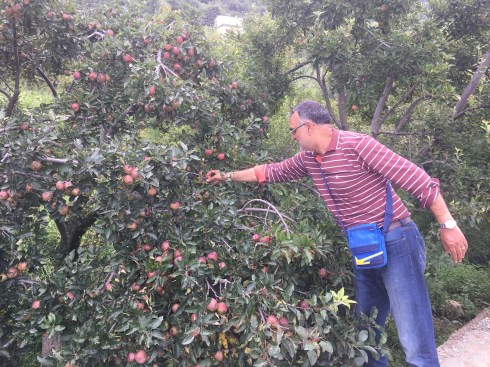
Blue Poppy the tour operator delighted us by putting us up at Auli for the night instead of Joshimath. Auli is a hill station at 9500 feet located 15 km from Joshimath.  I had visited Auli a few years back. Its a world famous Ski Town and the ITBP Skiing School is located here. Others in the group took the Cable Car from Joshimath to Auli while I went by the Tempo Traveller with the luggage and on the way stopped by an Apple Orchard. Its a rare joy to pluck an Apple from a tree and bite into it – with the juice flowing down your mouth.

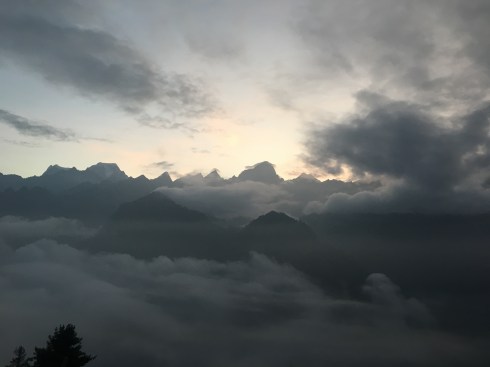
Blue Poppy has very nice Log Cottages at Auli with excellent view of the Nandi Devi. Its mostly cloudy but at 520 AM in the morning I got a good view of the peak. We rested , ate well and were ready to leave the next day.

Day – 7 : We head back to Rishikesh

Breakfast at 6.30 and we started our journey back at 7 AM – we saw multiple landslides that had been cleared and barring a 30 min stop we had a smooth drive all the way to Rishikesh. On the way we did a brief stop at the Dhari Devi temple – one of the 108 Shakti Peeths and highly revered in Garhwal. This is a Kali temple located between Rudraprayag and Srinagar. The temple has the upper part of the Goddess and the bottom part is in another temple called Kalimath in Agasyamuni ( near Uttar Kashi)


We reached Rishikesh by 5.30 PM. On the way we passed Vashisht Guha – I love this place and have visited it twice, but it looked like rain was round the corner and we had to abort our plans. At Rishikesh we stayed at the Vasundhara Palace – an excellent property in Muni Ki Reti, 2 min walks from the Ganga. Our friends braved the rain to walk and see the sights of Rishikesh but I preferred staying in the room.

Day – 8 : We head back to Bangalore 

Dehradun airport is closer to Rishikesh – on a Sunday it was a 30 min drive. My flight was at 12.40 and Indigo was nice enough to pre pone my connection at Delhi from 5 PM to 2.40 PM – being the long weekend Bangalore traffic was a breeze and after a comfortable flight I was back home at 6.45 PM

Coincidence – the couple sitting next to me in the flight were also coming back from the Valley of flower trek. They had gone thru a company called India Hikes.

We had gone thru Blue Poppy – a company run by a lovely couple. I was very happy with their arrangement and response. Always ready to customise and help it was a pleasure working with Seema and Devkant Sagwan. Blue Poppy does only Valley of Flowers Trek – they don’t cut corners and try to provide the best. The guide they had provided was excellent.

Other Useful Points ( The company you go with will provide a exhaustive list – this is just a reaffirmation of some important points) 

Valley of Flowers is open from June to Sep , June the valley is covered in snow , July / August is the best time to visit , by Sep the flowers start drying up .

  • 5 Years back 70% of the travellers were foreigners but now Indians have taken over and almost 80% of the travellers are Indians – and they come in all shapes and sizes from 16 year old to 75 + . Gujaratis, Bengalis form the largest groups , while a significant number travel from Bangalore. Its great to see Indians moving from just    ” Seeing Holidays” to ” Doing Holidays”
  • Invest in good gear – a Good trekking show with ankle support is a must
  • Get knee support – coming downhill that will be a big help
  • Ensure to use Sun Screen – we pray for sunny days but at this altitude the sun can be harsh and you will get sun burnt. So even if it is cloudy and rainy as you start remember to use the sunscreen
  • Stay Fit and put in some effort few months before you travel to be in shape. Some people are genetically fit to trek others like me have to pit in some effort.
  • Carry medicines but you don’t need them – on the 1st day night at Ghangria I felt my heart was thumping very fast – but I was able to meditate and bring it down. Don’t panic and take medicines proactively – they are not needed. A strong mind and a fit body is all you need.
  • Eat light – and avoid oily greasy food as you travel
  • This is cash only economy so carry 10 – 15 K with you in currency
  • Can you travel on your own ? Yes some people do but I feel its best to go with an agency that can provide professional guidance and help. An emergency situation is a step away in these regions and thats when you need the help of an agency.
  • Pray and have faith in the almighty – respect the mountains , don’t dirty it
  • Last but not the least – talk to someone who did the trek as you plan and pack , my wife’s guidance and support was invaluable ( she did this trip last year)


Journey to the Valley of Flowers

14 Aug

Nature rewards you after hard work. Getting to the Valley of Flowers in the middle Himalayas is a long and tedious journey – almost 3 days from Bangalore. Its a trip that requires planning and getting in shape – but eventually the reward is worth the effort. For anyone wanting to make a trip to Valley of Flowers and Hemkunt Saheb this Blog will provide all the details.

A quick Summary of the trip

  • The journey : Bangalore – Delhi – Dehradun – Haridwar – Joshimath (6050 feet) – Gobind Ghat – Pulana – Ghangria ( ~ 9500 feet) – Valley of Flowers ( 9500 – 12000 feet) – Hemkunt Saheb (14500 feet)
  • Almost 50 kms of trekking ( I did 35 by trek and 15 by Mule) which treats you to Fresh air & Divine views
  • 25 hrs of driving in the rugged Himalayan landscape – we travelled in the monsoon and witnessed at least 25 landslides – by divine grace we were not impacted by rain or landslides and sailed thru smoothly.

You can do this trip in 8 days but I decided to spend a few days at Gurgaon to meet friends and visit the Akshardham temple – A masterpiece where you can easily spend 4 – 5 hrs. Having travelled to Delhi so many times in the past 15 years this was one landmark that I had not visited. The story of the young sage Swami Narayan is fascinating and has close similarities to that of Shanakrachary. We missed the fountain and the light show in the evening – but I am sure I will come back to this well maintained energised place.

Swaminarayan Akshardham, New Delhi

Day 0 : Bangalore – Delhi – Haridwar 

My friends house at Gurgaon is also a temple – so much of peaceful energy, and it was a great start to an exciting 8 days ahead. He was kind enough to drop me at Platform 16 Ajmera Gate, Delhi Dehradun Shatabadi. This is the last platform – so if you get dropped on the other side of the station its a very long walk . I reached Haridwar at 11.45 and was in my Hotel by 12.45 ( Regenta Hotel – Royal Orchid on the Haridwar Rishikesh Road). My friends from Bangalore had taken the morning flight and they also reached the hotel by 3 PM. That evening we stopped by the Sapta Rishi Ashram and the Adhbut Mandir on the way to Har Ki Pauri to view the Ganga Arti. Aug is not busy season, because of monsoon and the “kavad” season is over  – the Ganga was in spate, frothy and muddy. Haridwar is a chaotic place and the Ganga Arti at the Har Ki Pauri  was a shade compared to what I had seen in Varanasi or even Rishikesh. (Lord Shiva and Lord Vishnu are believed to have visited the Brahmakund in Har Ki Pauri in the Vedic times). For all the noise we make on Hindutva it would be good if Indian temples and places like Haridwar , Rishikesh and Varanasi are kept as clean as the Vatican or the Golden Temple. On our way back we had a tasty dinner and had an early sleep (Given the long travel ahead I made it a point to eat light and avoid gravy / spicy food all long )

Day – 1 : Haridwar – Joshimath (278 Km – 12 hrs drive) 

We left our hotel at 6 AM and reached Joshimath at 5.30 PM. The journey was pleasant – our 14 seater Tempo Traveller had only 9 – so there was enough space to stretch your legs. Enroute we crossed Rishikesh – Dev Prayag (Bhageerathi & Alaknanda confluence) – Srinagar – Rudraprayag (Alaknanda – Mandakini Confluence) – and finally Joshimath and checked into Auli – D. A decent hotel with basic functionality – neat rooms, geyser, decent food. The weather was hot and humid all through and only near Joshimath did we start feeling pleasant. The road is good – you ascend from the plains to 6050 feet over 278 km so the ascent is smooth – no sharp U bends. We stopped for breakfast and lunch (No branded restaurants on the way – food is decent but the ambience and cleanliness of the dhabas is sad, toilets are disappointing, big challenge for women travellers who comprise almost 50% of the Trekkers to the Valley of flowers)

Day – 2 : Joshimath – Gobind Ghat – Pulana – Ghangria 

After a breakfast of Aloo Paratha, Poha and Chai we left at 7 AM by the Tempo Traveller. Our next stop was Govind Ghat – 20 Km (45 min). On the way we stopped to admire the Vishnu Prayag – the confluence of Bhuyandar & Alaknanda – a place where sage Narada is supposed to have meditated.

We reached Govind Ghat by 8.30 AM and had to stand in a Q to complete the registration process. We unloaded our luggage and took a Jeep to Pulana – 4 km away. From Gobind Ghat you will lose Mobile Connectivity – all you will have is very sporadic BSNL land line connection at Ghangria. The trek to Ghangria starts from Pulana – its a 11 Km trek , not very steep. If you walk at a relaxed pace it will take you about 4 – 5 hrs. We started at 9.30 and reached our room at Ghangria by 2 in the afternoon. You also have an option of riding a mule for Rs 850/- or be carried in a basket by a Nepali Sherpa or to take a chopper from Govind Ghat (5 Min – Rs 3500, Operates only if weather is good) . Most people walk – the guide had loaded our luggage on mules so that was easy. This is the first trek – energy levels are high – and I strongly advocate that you walk this stretch. There are nice views of forests, waterfalls, gushing springs. the pathway is cobbled – lots of shops on the way to stop for lemon juice or food or snacks. Keep your rain cover handy in your small backpack – the weather is very unpredictable. It did rain after almost 3 hrs of trek and the rain did slow me down.

Ghangria is the base camp for both the Valley of Flowers and Hemkunt Saheb. Located at 9050 feet its a small hamlet that operates only for 4 months from June to Sep.

You have an option of staying in a small basic functionality hotel or in tents. The Tents may have better views but no electricity and running water. Blue Poppy the company that had planned our trip had booked us at a small inn called Krishna Place – its the type of room I may not have stayed even when I was in college. Small, Cramped, the quilts and bedsheets were dirty, the limited staff were stinking  – two of us stayed in a room designed for 3 – we used a bed for keeping our bags, there was no place in the ground to keep any bags.

The good things – You have electricity and running water and Hot Water was provided by Bahadur ( 1 bucket / day is free – extra is Rs 50/bucket) – the hotel provided Tea, Bottled water, Pakodas, Maggi etc and also a Foot Massager – who charged 200 Rs for a 10 min massage. That was a luxury for the first few days – before we realised that his rate was higher than that in a high end spa at Bangalore. The guy also washed and ironed clothes – we were in for a shock when he told us after washing that he charged Rs 150/- per piece. But thats the premium you pay at 9500 feet.  There are a few dhabas nearby that serve good food – all our meals were at Gangotri – from piping hot Upma at 6 AM to Rajma, Chole, Noodles and even Dosa – we had no challenges with good hot food all thru the trip. I stuck to Khichdi most of the days. Tea Coffee is served using Milk Powder – you do get curd , but I think even that is made from milk powder. Price for food is reasonable.

Day – 3 : Ghangria – Valley of Flowers – Ghangria

I had been praying for months for a safe trip with good weather and it was a joy to see clear sky at 5 AM. After a warm bath and breakfast we started our trek at 6.30. A short distance later you complete the registration formalities.(Our guide had taken all the details and entry fees earlier and done the needful so we had no waiting period). Entry pass is Rs 150 valid for 3 days The busiest day at the Valley of Flowers has seen 500 visitors , in July – August the average crowd is about 200 / day. the best part of this trek is that no ponies are allowed – you walk or you are carried by a Sherpa.

Climbing has always been easy for me – coming down thats a challenge on my knees. Sunny skies and the excitement of the final destination nearby energises you and I covered the 4 km to the entrance of the valley of the flowers in 2 1 /2 hrs . Its a beautiful scenic trek thru forests and gushing springs. The weather is pleasant and perfect for trekking. the views are amazing.

If you get tired and thirsty drink some water from the spring – its energising and refreshes you, full of minerals. This is how life was as God made it and we messed it up. Every 30 minutes I stopped for doing a few Pranayams and deep breathing – this really helps in ensuring that the oxygen content in your blood is high. All along your trek you are walking along the Pushpavati river.

The climb was easy and at 9.15 I was in the Valley of Flowers. This UNESCO world heritage site is spread over 30 square kilometres. the end point is the Tipra Glacier (14,500 feet) – from the entry of the Valley of Flowers to the Tipra Glacier is a 10 Km Trek (6 Hrs) and you can pitch a tent there for the night.

We walked 3 kms inside the valley – it was mystical , foggy, surrounded by mountains, brooks and waterfalls all around you – and flowers in a multitude of colours and shapes. Just you and nature. Its nice – but if you have expectations of meadows of flowers as far as the eye can see then you may be a tad disappointed. Which I was – the Valley of Flowers met expectations – did not exceed. It was very nice but it was not jaw dropping spectacular

We had packed lunch – there are no shops on this route , and after lunch we started the trek back to Ghangria by 12 noon. Going back is always tougher – add to the challenge of climbing down it started drizzling. The pathways here are not cemented – its just rocks of different shapes that are on a path – its wobbly and pokey – and on an incline it can be risky. I struggled and moved step by step, inch by inch and finally made it back to the room dead tired by 4 PM, almost 4 hrs. (Most people do not venture 3 Kms deep into the Valley)

A Foot massage followed by a nice warm bath, and a nourishing dinner and I slept like a log at 9 PM (My friends ensured that they were warmed up by a Patiala Peg – there is no liquor available at Ghangria, so ensure that you get it with you or buy it at Joshimath, the stores at Joshimath close by 6 PM – so chances are that by the time you reach its closed)

Day – 4 : Recovery Day 

Last 2 days I had trekked 25 Kms and I was tired. The Tour Company had smartly planned 2 days for the Valley of Flowers – in case of heavy rains there was a backup day. Fortunately for us this backup day was the rest day. The last 4 – 5 days I had been getting up at 4.30 , and was tiring – I needed rest. Guess what – this was the only day in our travel that it was raining heavily. My colleagues decided to walk around and visit a waterfall close by and see the tents. I stayed back in the room to catch up on my strength.

Day – 5 : Hemkunt Sahib 

Located at 14,500 feet – the trek from Ghangria to Hemkunt ( Also spelled as Hemkund ) is steep. You scale 5500 feet in less than 6 kms. The pathway is in better shape than the Valley of Flowers – but most of the route is not as scenic as the Valley of Flowers. Climbing becomes difficult because of the steep altitude and lower oxygen. You have an option of taking a Mule ride – which I did. We left sharp at 6.30 and reached Hemkund at 8.30 – there are many shops on the way on this route. It was a bright and sunny day with Blue Skies. Good to reach early as it gets very foggy after 11 AM .

In his previous birth Guru Nanak is said to have meditated at this spot. Its a beautiful serene place with a glacial lake surrounded by 7 peaks. The mist plays peek a boo with the lake and the whole experience is magical. Right behind the Gurudwara is a place where Lakshman is said to have meditated – and there is a temple in memory of him. Hem Kund as the name suggests is a Snow Lake – and the Gurudwara is open only from June to Sep, rest of the year it is not accessible because of heavy snow. Best period to travel is September.

The water in the lake is freezing , but the strong sardars brave the cold and take dips bare bodied. After a walk around the lake I went and sat inside the Gurudwara from 9.15 to 10 AM. The “Ardas”  is at 10 AM  and at 12 AM ,  we attended the 10 AM “Ardas” after which very tasty Halwa was served as Prasad. Stepping out we had piping hot Khichdi and Tea. Our friends who started the trek at 5.40 AM made it by 9 AM (Which was great – most people take 5 – 6 hrs to climb up)

The rare Brahma Kamal flower blooms in plenty in and around the Hemkunt Saheb – we could see them as we started our trek back. We climbed a small hill – with no path just to get closer to these rare and beautiful flowers. There was a sense of accomplishment and peace as I sat next to the flowers.

I started the trek back with gusto but after an hr my feet started hurting. The steep incline puts pressure on your toes and I was mentally holding back running down – allowing gravity to help me in the way back. I ploughed along for 5 kms and finally the last 1 km I had to take a pony ride. the master trekkers in our team went down almost sprinting in less than 2 hrs.

Day – 6 : We head back to Joshimath 

After breakfast at 6 we started our journey back to Gobind Ghat – the plan was to reach by 9 and then head to Badrinath and Mana on the way to Joshimath. By now my feet were tired and I took the Mule back. We were at Gobind Ghat by 9 – collected the Prasad from the Gurudwara and headed towards Badrinath.

Its a 2 hr drive and the road has many tricky spots where landslides happen frequently. We had been informed that the road was closed for the last 2 days. Fortunately when we reached the roads were open. But there was the risk of landslide in a 100 metre stretch.

Having come so far I wanted to go but the fear of the majority over ruled the faith of a few. We travelled ~ 600 kms in the fragile Himalayan landscape safely and I was sure that we would have passed this 100 m stretch also – God had opened the path to us after 2 days – Badrinath was empty and we would have had great Darshan – but it was not to be. In 2010 I was at the gates of Badrinath but it was very crowded and the Q time was 3 hrs – and we were not able to get a Darshan – I am sure I will get lucky the 3rd time.

On the way back we stopped by at Jyotir Mutt – one of the 4 mutts established by Shankaracharya, he spent almost 14 years here. We were blessed to spend time in front of the Akhand Jyoti that he had lit almost 2500 years back, and pray in front of the “Swayambu” Shiv Linga below the 2500 year old Kalpa Vriksha. This place is brimming with energy and positive vibrations.

Blue Poppy the tour operator delighted us by putting us up at Auli for the night instead of Joshimath. Auli is a hill station at 9500 feet located 15 km from Joshimath.  I had visited Auli a few years back. Its a world famous Ski Town and the ITBP Skiing School is located here. Others in the group took the Cable Car from Joshimath to Auli while I went by the Tempo Traveller with the luggage and on the way stopped by an Apple Orchard. Its a rare joy to pluck an Apple from a tree and bite into it – with the juice flowing down your mouth.

Blue Poppy has very nice Log Cottages at Auli with excellent view of the Nandi Devi. Its mostly cloudy but at 520 AM in the morning I got a good view of the peak. We rested , ate well and were ready to leave the next day.

Day – 7 : We head back to Rishikesh

Breakfast at 6.30 and we started our journey back at 7 AM – we saw multiple landslides that had been cleared and barring a 30 min stop we had a smooth drive all the way to Rishikesh. On the way we did a brief stop at the Dhari Devi temple – one of the 108 Shakti Peeths and highly revered in Garhwal. This is a Kali temple located between Rudraprayag and Srinagar. The temple has the upper part of the Goddess and the bottom part is in another temple called Kalimath in Agasyamuni ( near Uttar Kashi)


We reached Rishikesh by 5.30 PM. On the way we passed Vashisht Guha – I love this place and have visited it twice, but it looked like rain was round the corner and we had to abort our plans. At Rishikesh we stayed at the Vasundhara Palace – an excellent property in Muni Ki Reti, 2 min walks from the Ganga. Our friends braved the rain to walk and see the sights of Rishikesh but I preferred staying in the room.

Day – 8 : We head back to Bangalore 

Dehradun airport is closer to Rishikesh – on a Sunday it was a 30 min drive. My flight was at 12.40 and Indigo was nice enough to pre pone my connection at Delhi from 5 PM to 2.40 PM – being the long weekend Bangalore traffic was a breeze and after a comfortable flight I was back home at 6.45 PM

Coincidence – the couple sitting next to me in the flight were also coming back from the Valley of flower trek. They had gone thru a company called India Hikes.

We had gone thru Blue Poppy – a company run by a lovely couple. I was very happy with their arrangement and response. Always ready to customise and help it was a pleasure working with Seema and Devkant Sagwan. Blue Poppy does only Valley of Flowers Trek – they don’t cut corners and try to provide the best. The guide they had provided was excellent.

Other Useful Points ( The company you go with will provide a exhaustive list – this is just a reaffirmation of some important points) 

Valley of Flowers is open from June to Sep , June the valley is covered in snow , July / August is the best time to visit , by Sep the flowers start drying up .

  • 5 Years back 70% of the travellers were foreigners but now Indians have taken over and almost 80% of the travellers are Indians – and they come in all shapes and sizes from 16 year old to 75 + . Gujaratis, Bengalis form the largest groups , while a significant number travel from Bangalore. Its great to see Indians moving from just    ” Seeing Holidays” to ” Doing Holidays”
  • Invest in good gear – a Good trekking show with ankle support is a must
  • Get knee support – coming downhill that will be a big help
  • Ensure to use Sun Screen – we pray for sunny days but at this altitude the sun can be harsh and you will get sun burnt. So even if it is cloudy and rainy as you start remember to use the sunscreen
  • Stay Fit and put in some effort few months before you travel to be in shape. Some people are genetically fit to trek others like me have to pit in some effort.
  • Carry medicines but you don’t need them – on the 1st day night at Ghangria I felt my heart was thumping very fast – but I was able to meditate and bring it down. Don’t panic and take medicines proactively – they are not needed. A strong mind and a fit body is all you need.
  • Eat light – and avoid oily greasy food as you travel
  • This is cash only economy so carry 10 – 15 K with you in currency
  • Can you travel on your own ? Yes some people do but I feel its best to go with an agency that can provide professional guidance and help. An emergency situation is a step away in these regions and thats when you need the help of an agency.
  • Pray and have faith in the almighty – respect the mountains , don’t dirty it
  • Last but not the least – talk to someone who did the trek as you plan and pack , my wife’s guidance and support was invaluable ( she did this trip last year)

________________________

Please follow my Facebook page for regular updates on A Few Good Things 

https://facebook.com/afewgoodthingsvak1969/