Lord Hanuman is considered as the incarnation of Lord Shiva. He is known for his formidable strength. Lord Hanuman also known as Anjani Putra, Vayu Putra, Kesari Putra etc is revered for his wisdom and communication skills. Since childhood we have worshiped Hanuman as our family deity. During dark & challenging times prayers to Him have always been a source of courage. For the past 20 years, I have been visiting the Panchamukha Hanuman temple in Koramangla every Saturday. His grace has always been with the family. This Blog will try and throw light on this manifestation of divine energy.
Who is Ahiravana (Also known as Mahiravana)
When Ravana’s son (Indrajit) was killed by Lakshmana, he sought revenge. He summoned Ahiravana from Patala. Ravana convinced him to capture Rama and Lakshmana. He wanted them to be sacrificed to the goddess Mahamaya. Ravana promised Ahiravana great power in return

Despite Vibhishana & Hanuman’s efforts, Ahiravana, employing various disguises and illusions and abducted Rama and Lakshmana. In one instance, he disguised himself as Vibhishana, tricking Hanuman into allowing him entry. Once inside, Ahiravana successfully kidnapped Rama and Lakshmana and transported them to his kingdom in Patala. Upon discovering their disappearance, Hanuman vowed to rescue them and sought guidance from Vibhishana.
Overcoming Makardhwaja – the gatekeeper of Patala
As Hanuman was returning after setting Lanka ablaze, a drop of his sweat fell in the ocean. It landed into the mouth of a massive crocodile. The inhabitants of Patal Lok captured the crocodile. They discovered a remarkable being named Makardhwaja upon dissecting the creature’s stomach. Recognizing Makardhwaja’s exceptional intelligence and strength, Ahiravan, the ruler of Patal Lok, appointed him as the guardian of his palace.
When Hanuman endeavored to enter Ahiravan’s palace, Makardhwaja intercepted him. Hanuman was intrigued and asked for an introduction. Makardhwaja declared himself the valiant guardian of Patal Lok. He also claimed to be the proud son of Hanuman. Astonished, Hanuman initially doubted Makardhwaja’s claim, for he had devoted himself to celibacy throughout his life. Then, Hanuman delved into meditation, seeking enlightenment about Makardhwaja’s origins, and uncovered the truth.
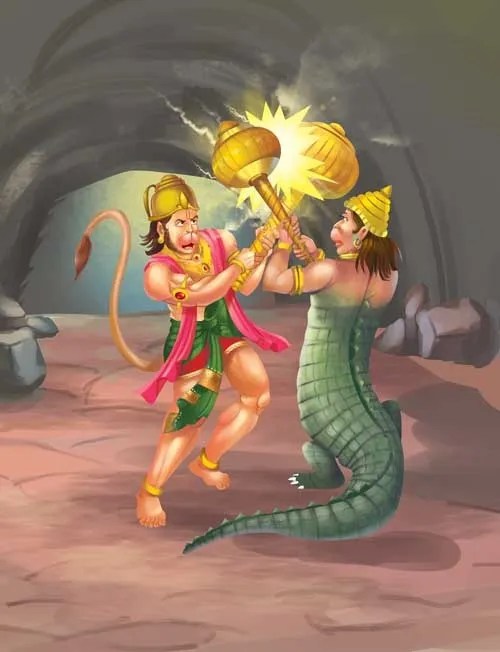
Makardhwaja revealed to Hanuman that he was prepared to confront even his father. He wanted to honor his allegiance to his mentor, Ahiravan. To uphold his master’s wishes, Makardhwaja challenged Hanuman to a duel before granting him access to the palace. Impressed by Makardhwaja’s unwavering loyalty and dedication, Hanuman bestowed his blessings upon him. The two engaged in a formidable battle, culminating in Hanuman emerging victorious
Fight with Ahiravana
Vibhishana had informed Hanuman about Ahiravana’s strength source. It came from five lamps in Patal Lok. These lamps were facing five directions. To end his magical powers, all the five lit lamps needed to be extinguished in one breath. To achieve this seemingly impossible task Hanuman takes up the Panchamukhi form and blows out the lamps in one breath. The five faces of Panchamukhi Hanuman represent an eagle – Garuda facing the west. A boar Varaha faces the north. A horse Hyagriva faces the sky. A lion Narasimha faces the south. The fifth is the original Hanuman himself facing the east.

Panchamukhi Hanuman has ten arms holding different weapons. In the fierce battle with Ahiravana, Hanuman was victorious. He managed to free Rama & Lakshmana from his clutches in Patala.
Significance of the 5 Faces
Kapimukha – Hanuman’s original face facing the east removes blemishes of all past deeds and confers purity of mind . West facing Garudamukha drives away evil spells, black magic influence and negative spirits. It flushes away poisonous effects from the human body. North facing Varahamukha wards off the negative affects of planetary influence – especially Rahu. South facing Narasimhamukha dispels fear and ensures victory over opposition. Sky facing Hayagriva confers knowledge , victory and saves one from being childless.
Panchamukhi Hanuman near Mantralaya
Raghavendra Swami was engrossed in intense meditation for 12 years in a cave near Mantralaya. He had the vision of Panchamukha Hanuman who blessed him. Since then Panchamukha Hanuman has been his Upasana deity. The temple I visit in Koramangla is managed by Raghavendra Swami followers. The main deity is that of Panchamukha Hanuman along with shrines for Raghavendra Swami & Lord Ganesha.
This is the cave where Raghavendra Swami meditated. The Priest explained that the shrine is Swayambu – self emanated.
Panchamukhi Hanuman is popularly worshiped at a temple in Kumbakonam, Tamil Nadu as well.


 A Few Good Things
Very insightful.
LikeLike
Thanks
LikeLike