Shrimad Bhagavad Gita
The Scripture of Mankind (By Swami Tapasyananda)
A Detailed Summary
Why this Summary – Introduction and Context
A dipstick with college batchmates, friends & relatives, revealed that almost no one had read the Shrimad Bhagavad Gita – The Divine Song of the Lord. This exercise is to provide a simplified but correct explanation of The Gita.
Over the last two years I have summarized “The Scripture of Mankind” by Swami Tapasyananda chapter by chapter covering all the important details.There are many commentaries on The Gita. A version recommended by Sri M is “The Scripture of Mankind” by Swami Tapasyananda. He was a senior monk of the Ramakrishna Mission and a disciple of Swami Shivananda (Tarak Nath Ghoshal), one of the 16 disciples of Ramakrishna. His writing is simple and easy to comprehend.
Most commentaries on the Gita either run into 1000+ pages or are very brief conceptual writings. I could not find something in-between.
This summary is an attempt to fill that gap. Each chapter is summarised crisply in 3 – 4 pages covering all the points
Most of the content is from “The Scripture of Mankind” – however for certain sections I have leveraged content from Swami Chinmayananda’s “The Holy Geeta” and Sri M’s talk for Chapter 15.
A Few Points as we get started
It is difficult to summarise the Gita. Every word and verse is profound . It takes an enlightened, erudite soul to write a commentary or explain the vast knowledge. This is a summary of Gita as elaborated in The Scripture of Mankind. It is a compilation of the essence of the Gita from each of the chapters of the book. Not a word is based on my interpretation.
I hope this summary gets your curiosity awakened leading you to reading the Gita on your own. Self-study at your own pace is the best way to internalise the knowledge.
Why reading and understanding the Gita is easy today
Some myths need to be dispelled. You dont need to know Sanskrit to read and understand the Gita. You can read a book, watch a video, attend a session with an enlightened teacher. There is enough information out there, easily available. Reading the Gita is more like doing a course in Psychology / Self Help. It’s a great tool to help find your purpose and streamline your day-to-day life.
Shankara & Gita
Although Adi Shankara’s introduction to his commentary on the Gita bemoans the misinterpretation of the text by others, there is no commentary or any kind of writing that precedes him.
So, it is reasonable to surmise that it was Sri Shankara who for the first time lifted it up from the vast ocean of the Mahabharata literature and fixing its verse content at 700 wrote an authoritative commentary on it. We may also surmise that it must be he who gave recognition to it as an Upanishad and as a Brahma Vidya.
Different interpretations of the Gita
Difference in interpretation of the Gita have arisen due to the varying perception of relationship between Brahman and the Jiva and on the relative importance of the 4 paths. All through the Gita there is a play between Samkhya & Yoga. A universal scripture contains several strands of teachings suited to men of different stages of development. These varying stands are not mutually contradictory or incompatible. They are the Vision of the same Reality from the points of view of the Jivas at different stages of development.
What is the secret of the tremendous appeal of the Gita
It deals with the practical problems of life. How a man could discharge his duties as a member of an imperfect social order and at the same time realise his highest spiritual destiny.
The Gita begins with an ethical problem – and in solving this problem a noble devotional philosophy is expounded. The Gita teaches man the goal to be attained and the means for attaining it.
The goal is the Supreme Personal Impersonal Brahman. And the means – the paths of Knowledge, Work, Psychic Control & Devotion.
A well-known Sanskrit couplet says ” The Gita is the most excellent nectarine milk, drawn by the cowherd’s son Krishna as its milker, from the udders of the Upanishads, using Arjuna as the calf. All men of purified intellect are the consumers of that milk”
What is the Ethical Conflict?
The conflict is between a sudden and purely personal inclination bursting on one’s mind and a social duty, the avoidance of which under that inclination would have meant ruin to a whole community that had laid its trust in one. Sri Krishna though God incarnate, is Arjuna’s friend, charioteer, and spiritual counsellor. He resolves the conflict in Arjuna’s mind and restores him to a sense of moral equilibrium by finding a new sanction for action
The Gita is the eternal dialogue going on between the ego and the higher mind.
Gita and its Historical significance
All the great Indian commentators and enlightened souls have taken the background events of the Gita and the people involved in it as historical.
The Kurukshetra war is supposed to have been fought in about 1400 BC according to latest archaeological evidence as against the traditional date ascribing it to a time just before the beginning of Kali Yuga 3102 BC.
Gita & Mahabharata
The Bhagavad Gita appears in the Bhishma Parva of the Mahabharata and comprises 18 chapters from the 25th to the 42nd.
_________________________________________
Chapter I
Arjuna Vishada Yoga
Arjuna’s spiritual conversion through sorrow
The first chapter is almost entirely a narration of Arjuna’s confusion, pain, and agony. It defines the problem statement of the Gita.
The Kurukshetra war is about to begin. The two armies are facing each other, and the great warriors blow their conch shells announcing the start of the war. In this charged atmosphere Arjuna tells Krishna
O Achyuta! Please station my chariot between the two armies so that I may have a view, on the eve of this battle, of all those standing ready to fight, and learn who all are the persons with whom I have to contend.
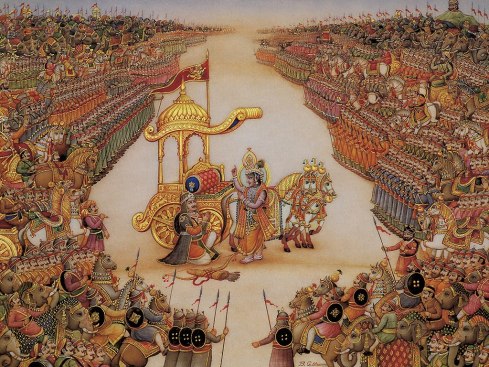
Stationed in his chariot between the two armies, he finds on both sides kith and kin and venerated persons like teachers and grandfathers standing ready to kill one another for the sake of power. The frightful consequences of a fratricidal war dawns on him in all vividness.
Seeing these relatives standing eager to join battle my limbs are giving way; my mouth is parching. I am trembling. My bow is slipping from my hands. My skin is burning. I find it impossible to stand firm , and my mind is reeling.
O Janardhana! Even if these people with their intelligence overpowered by greed do not see any evil in the decay of families any sin in the persecution of friends, why should not we, who are aware of the evil of such decay of families, learn to desist from that sin.
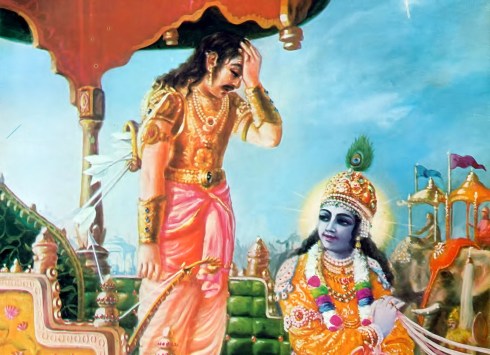
A war weariness and world weariness together comes upon him with dramatic suddenness. Under their impact he forgets all his social and family obligations, and wants to take up an ascetics life instead of indulging in what he conceives to be a senseless carnage under the guise of duty. He becomes a pacifist and a quietist suddenly.
He feels it is better to eat a beggar’s food than enjoy wealth stained with the blood of relatives and friends. Shocked at the prospect of a senseless carnage Arjuna decides to lay down his arms and surrender to the Kauravas, to court death at their hands or to become an ascetic.
He drops his weapons in a mood of depression caused by utter confusion as to what his duty is under such circumstances. And sits down in the chariot seat refusing to fight the war.
If Arjuna doesn’t fight, the war is over. This ethical dilemma must be resolved.
It’s a mind game, and the master psychologist Lord Krishna resolves the crisis step by step in a structured manner, finally awakening Arjuna to his senses so that he can complete his duty.
The Last Stanza
The Gita itself tells us about what it is. At the end of the first chapter, we find a narration reading as under:
Om Tat Sat
Iti Srimad Bhagavadgeetaasu Upanishatsu
Brahma Vidyaayaam Yogashaastre
Sri Krishna Arjuna Samvaade
Arjuna Vishaada Yogo
Naama Prathamo’dyaayah ||
Thus, in the Upanishads of the glorious Bhagavad Gita, the science of the Eternal, the scripture of Yoga, the dialogue between Sri Krishna and Arjuna, ends the first discourse entitled “The Yoga of the Despondency of Arjuna”
The narration as given above at the end of the first chapter occurs also at the end of all the other subsequent chapters, the only difference being the respective title of the chapters.
This narration is called `Sankalpa Vakya’ meaning an epilogue for the chapter. It reveals in a very concise form the glory and greatness of the Gita and states the theme of the concerned chapter.
The meaning of this recital is as follows
- Om Tat Sat – A designation for the Absolute enabling everybody to turn towards Godhead
- Gita is called Upanishad because it contains the essence of all the Upanishads which are the revelations of the ancient sages.
- Brahma Vidya or the science of the Eternal because it teaches about the changeless Reality behind the ever-changing phenomenal world of perceptions, emotions, and thoughts.
- Yoga Shastra because it is a scripture that explains the technique of right living and provides a practical guide to work it out in the form of Jnana Yoga, Karma Yoga, Bhakti Yoga and Raja Yoga.
- Samvad because it is in the form of a dialogue between Krishna and Arjuna, the Divine and the human, the former teaching the latter how to function successfully and efficiently in a community.
- This chapter is entitled `Arjuna Vishaada Yoga’ or the Yoga of despondency of Arjuna.
End of Chapter 1
____________________________________
Chapter II
Samkhya Yoga
Communion Through Knowledge
One of the most important chapters in the Gita, Lord Krishna explains to Arjuna that the true Self is not the Body but the immortal Spirit.
You can call it Soul, Spirit, Ultimate Truth, Pure Consciousness, Atman, Brahman, God. It’s all the same. This is the essence that pervades amongst one and all.
The succeeding chapters throw light on the paths and steps to recognise this divinity within oneself and march ahead on the spiritual path towards liberation. A Sadhak should read this chapter multiple times to internalise the learnings.
This chapter covers the following topics
Arjuna Seeking refuge – As Arjuna continues his lamentation and self-pity, Krishna administers a strong dose of reprimand, saying that his attitude benefits only a eunuch and not a hero. But Arjuna’s sorrow is so deep rooted that the reprimand has no effect. He continues in his attitude of self-pity and finally takes refuge in Lord Krishna as a disciple. From here almost all the verses are from Lord Krishna.
The Immortal Atman – Sri Krishna recognises that Arjuna’s ignorance makes him equate man with his visible body, which in turn makes him think of death as total destruction. At the very start of his discourse Krishna expounds the high philosophy of Atman.
“You pretend to be a wise man in speech, but your behaviour is like that of the most ignorant. A wise man takes death as a trifle. For he knows that the essence in man is the Atman, the birth-less. The deathless, the eternal Spirit whom weapons cannot cleave, fire burn or air dry. Birth and death are only of the body and not of the Atman. The body in relation to the Atman is like clothes one puts on and throws away. Or like the passing phases of life like childhood, boyhood, youth, and old age. Pleasant and painful experiences of life are passing episodes. A man who knows this and is never moved by pleasure and pain, by life or death, is alone wise and fit for spiritual freedom.”
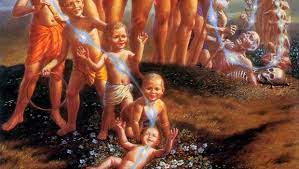
Death from a worldly point of view – Death is natural to all beings, and there is no use in sorrowing for this unavoidable occurrence. Life comes from the Unknown, for a short time it remains in the field of the known, and to the Unknown it goes back again. Of what use is man’s wailing over this eternal process.
He then starts the co-relation and works on the mind of a valiant brave soldier.
If you avoid your responsibilities in this righteous war, a veritable portal to heaven for a valiant Kshatriya, everyone will say that you have tucked tail for fear of death and fled away for life like a coward. To survive with this stigma of cowardice is worse than a hundred deaths. Dead in the battle field you will attain heaven, victorious you will enjoy the earth. So, arise and fight. And if you can practice even – mindedness in pain and pleasure, in success and failure, you shall not incur any sin by slaughter in battle.
The Gospel of dedicated work – Having reminded Arjuna of the real nature of man as the eternal Spirit, Lord Krishna now proceeds to declare how one could gradually realise this divinity inherent in oneself.
He continues “I taught you till now about the philosophy of the Atman. Now hear from me about the doctrine of communion through work. This path is free from danger and easy to perform. It seeks to secure the one pointedness of the mind through detachment in work”.
He then criticises the man who performs Vedic rituals for worldly enjoyments and fulfilment of his ambitions.
Man is after many worldly enjoyments and ambitions. Hearing that they could be obtained through Vedic rituals he performs them one after the other, hoping for success. Though they may look like acts of piety, they are only expression of pure worldliness. They make the mind restless and scattered. The more we are motivated by selfish gains in our work, the more we get steeped in worldliness.
The more we work in a spirit of duty, without caring for gains, the more shall we get spiritually oriented. But lack of interest in worldly gains should not make you lethargic or slipshod in your work.
For Karma Yoga (Communion through work) consists in maximum efficiency combined with detachment. It is for this reason that Karma Yoga is called “Skill in Action”
He explains that when one is free from longings for worldly enjoyments one gains spiritual conviction and one’s intelligence is established in steadiness.
This concept is elaborated in detail in Chapter 3 – Karma Yoga or Communion through Action.
The Man of Steady Wisdom
Arjuna then asks how to recognise an individual who has attained a state of “Steadiness of Intelligence”
Krishna explains – Such a person who has abandoned all desires from his heart, is every satisfied with the bliss in his higher self. Nothing external attracts him. he is unperturbed in misery and happiness. . He is free from attachments, fear & anger. He has immense control over his senses.
The hold of the senses on an ordinary man is very powerful. Like a ship on the high seas is at the mercy of the winds so is the intelligence of a man at the mercy of sense objects. One who things longingly of sense objects develops attachment. Attachment in turn grows into strong desires and infatuation. Infatuation effaces man’s sense of distinction between proper and improper. He becomes a slave of his animal instinct, he loses rationality.
So the control of the senses is the pathway to spiritual advancement. This is what is meant by being Brahman Consciousness. Attaining to it, a man is never reborn.
A Few Important Verses
- Know that reality by which everything is pervaded, to be indestructible. No one can cause the destruction of this Being.
- What is said to perish are these bodies, in which the imperishable and unlimited Spirit is embodied. therefore fight, O Scion of the Bharata race.
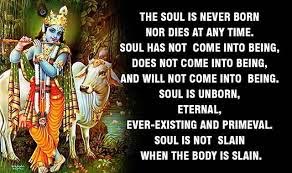
- He (This Self) has neither birth nor death. Nor does he cease to be, having been in existence before; unborn, eternal, permanent and primeval, He is never killed when the body is killed.
- Arjuna, know this Self to be eternal, undecaying, birth-less and indestructible.
- Some have a glimpse of Him as a marvel, some speak of Him as a marvel, and yet others hear of Him as a marvel. Yet none understands him in Truth, despite (seeing, speaking and) hearing about him.
- What has been declared to you is the Truth according to the Samkhya (path of knowledge). Listen now to the teachings of Yoga (path of selfless action with devotion) by practising which the bondage of Karma is overcome.
- There are people who delight in the eulogistic statements of the Vedas and argue that the purport of the Vedas consists in these and nothing else. They are full of worldly desires. Paradise is their highest goal. And they are totally blind in a spiritual sense. O Arjuna – The Vedas deal with material ends. But you be established in the Spirit.
- When your intellect, fed up with the bewildering scriptural doctrines and their interpretations, finally settles in steady and unwavering introspection in the Spirit, then you will attain to real Yoga.
A man of uncontrolled senses has no spiritual comprehension. he has no capacity for meditation either. For the unmeditative there is no peace. And where is happiness for one without peace of mind.
Additional Notes & Commentary
Sat & Asat – The constantly changing forms are called “Asat”. They are non-existent in the sense that they have no ultimacy in themselves. They come and go. Once all the forms cease they leave no residue, except “Sat” or the Essence, the changeless being, the substratum on which all forms appear. It is Awareness, Witness of change.
Sukshma & Sthula Sharira – The gross body is the one that changes from birth to birth (Sthula Sharira). It’s compared to the changing of dress. It perishes and disintegrates with time.
The subtle body or the (Sukshma Sharira) in which the Pranas (vital energies), mind, intellect and the ego are integrated survives death carrying all the Karma’s created in one’s life to the next. When enlightenment comes and the Jiva realises his real identity as the Atman then the Sukshma Sharira also perishes. This marks the real death and opens the door to immortality. This is emancipation or Mukti.
Concept of 5 Koshas or Sheaths
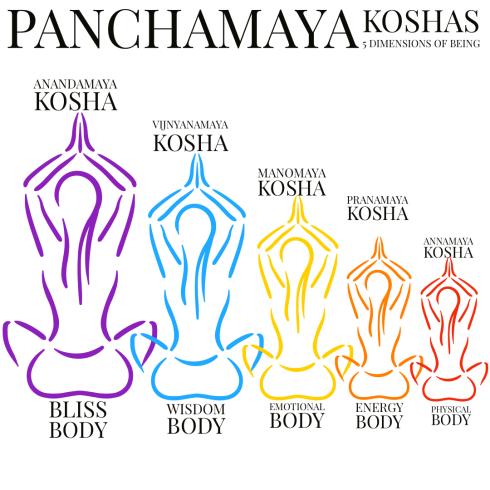
The human personality according to Vedanta has 3 Bodies and 5 Sheaths or Koshas.
- Annamaya Kosha – Gross Body
- Pranayama Kosha – Vitalistic sheath
- Manomaya Kosha – Mental sheath
- Vijnanamaya Kosha – Intellectual sheath and
- Anandmaya Kosha or the sheath of Bliss.
The Atman is clothed in these sheaths. The Atman endows the sheath with the light of consciousness. These 5 sheaths are organised into two bodies. All the sheaths except the Anandmaya Kosha ensouled by the Atman comprise the Sukshma Sharira or the gross physical body. They part from the gross body at death carrying with it all the tendencies, merits & demerits acquired in life. It then hunts for another embodiment in this earth sphere or in any of the higher or lower spheres according to the Karma of the Jiva
Samkhya & Yoga – In Indian philosophy are known as two allied systems having the same metaphysics but different methods of practise.
Samkhya is the intellectual analysis of the material characteristics and the separating of Prakriti from Purusha – The Spiritual monad. The system does not accept a God , a universal being, who is the master of all spiritual monads and material categories. Salvation consists in the Purusha getting isolation from the material categories with which it is integrated in the state of bondage.
Yoga is the systematic practise of concentration by which the realisation of that metaphysical truth is realised
Many lifetimes – Spiritual practice may take a whole lifetime or several lives to fructify as realisation. Aspirant should never feel that efforts are lost. The bank balance is preserved and carried on to the next life. The competence one has acquired remains in the subtle body and in the next life one begins from where one left in the previous life.
Work as an offering to the divine – In the path of salvation work as duty has a place. All work has to be done as an offering to the Divine and not for attainment of heavenly felicities or any other type of enjoyment.
End of Chapter 2
____________________________________
Chapter III
Karma Yoga
Communion Through Action
The Context : Arjuna’s confusion increases. Lord Krishna instead of answering his question directly has given him a long lecture on varied topics – Atman, death from a worldly point of view, has criticised Vedic rituals, talked about control of senses to develop a state of Sthithaprajna (The self-satisfied state of a man of steady wisdom). He has also briefly mentioned Karma Yoga.
All this seems to be irrelevant and confusing to Arjuna
Chapter 3 starts with Arjuna framing his question
“If discriminative insight is superior to action, why do you ask me to engage in this terrible war. Your conflicting words are confusing me“.
Lord accepts his criticism. His first discourse was preliminary. He has put forth many issues. A clarification is called for. Lord Krishna explains
- Two ways of spiritual fulfilment have been revealed by Me – Samkhya (the path of knowledge) and Yoga (the path of devotion cum action). I will now focus on the path of Action
- Abstaining from action you do not gain the unperturbed ideal state of Sthithaprajna. You will lapse into idleness
- Man is a part of nature, and nature is always active he is therefore compelled to act. So, sitting quiet and thinking that one has attained the unperturbed state is rank hypocrisy, because such a person’s mind will be busy thinking of the objects to which he is attached.
- The way to Spiritual development is in action without attachment under proper regulation of the senses. Perform your duties for action is superior to inaction. If you are totally inactive even the survival of the body becomes impossible.
The Law of Yagna
- Lord created man with the law of Yagna as the means for his worldly prosperity and Spiritual evolution. Yagna means Self Sacrifice.
- Yagna at the lowest level is one of give and take – what we commonly refer to as reciprocity.
- Man lives in a community which can thrive only by the exchange of commodities and services amongst its members. One who fails to do his part of work but insists on getting his share is an exploiter, a thief. He violates the law of Yagna and gets morally degraded.
- The Vedic fire sacrifice where thanksgiving offerings were made to the Devas for the benefits bestowed on them by Nature is symbolic of this great law of life.
- Anyone who gives up Action will be abandoning Yagna too, thus violating the basic commandment of the Creator. Vain is the life of that sinful and self-indulgent person who fails to fulfil his obligations in this cycle of mutual inter – dependence and service.
- Pure, unselfish Action without any thought of return or obligation is the highest aspect of the law of Yagna.
- The distinction between the work of the worldly minded man and the enlightened Karma Yogi is clearly explained. The former is self-centered while the latter has overcome self-centeredness and still works for the good of all.
- Enlightened souls should also work, else they set a bad example for their followers. Janaka and great Rajarishis continued to be in their field of action even after becoming enlightened souls.
- Look at Ishwara himself “In all the 3 worlds there is nothing that is binding on Me as a duty. Neither is there anything I have to gain. Still I am always engaged in work”. He continues by saying ” If I did not continue in my Action unwearied, men all around would have followed My way. If I did not work all the world would have perished. I would have been the cause of confusion among men leading to their destruction”.
- Initially Karma Yoga was described as work without attachment and without desire for the fruits of the action. A more complete view of Karma Yoga is later given where it is taught that all actions should be resigned to the Lord. “Offering all your Actions to Me, your mind in unison with the Spirit and free of desire & ego you fight without the slightest touch of hatred or excitement”
- Whoever follows this teaching of mine with their minds full of faith and free from disparagement, they are released from the bondage of Karma.
- One’s own Dharma (duty) even though not glamorous is better than any duty alien to one’s growth (Para Dharma) however well performed. For even death in doing one’s duty leads to one’s good, while a duty alien to one’s growth is burdened with fear of downfall.
Wisdom is not to be confused with Inactivity
- Someone immersed in the Spirit (Self) there is no obligatory duty to discharge. But even the noble self-realized soul immerses himself in action. Otherwise they will set a bad example for their followers
- In all the 3 worlds there is nothing that is binding on me as a duty. Neither is there anything for me to gain, nor anything that I cannot gain. Still I am always engaged in work.
What is SIN
Having patiently heard, Arjuna voices the next question “What is that prompted by which a man is forced to indulge in sin even against his will“.
- To which the Lord replies – It is Lust, it is Anger, born of Rajo Guna, insatiable and prompting man to great sin. Know this to be the enemy in man’s Spiritual life.
- As fire is enveloped by smoke, mirror by dirt and the embryo by the placenta, so is knowledge overcast by lust. The Senses are the seat of lust. Hence control your senses, slay this enemy – the destroyer of all knowledge and realisation
- Senses are great they say, superior to the Senses is the Mind, Superior to the Mind is Intellect and superior to Intellect is the Atman.
Additional Notes
- What can Nigraha (Control or repression) do? Nigraha may be equated with the modern psychological concept of repression. It means to forcefully suppress a desire or try to eliminate it. In either case the desire or the tendency is not eliminated but only driven underground from where it will wreak havoc on the body and mind.
- Non – attachment can never arise until the mind is able to hold the attitude of the witness and not of one seeking enjoyment.
- Svadharma & Paradharma – Svadharma for most men is a life of action. Arjuna is being exhorted to adopt Karma Yoga as his way of spiritual development. Because a life of activity is the Dharma or way of life born of his own nature. For him Samkhya or workless contemplation will be Paradharma. While Paradharma may look attractive and one may to a certain extent succeed in pursuing it, in the long run one is sure to breakdown. Workless contemplation will soon degenerate into sheer idleness and result in Spiritual ruin. Karma Yoga may not be glamorous, but it is safe and will be found contributing to one’s ultimate good.
- The Senses, Mind, Intellect, and the Spirit are the 4 layers of human personality. The Spirit which is the ultimate foundation of the man is pure consciousness and the uninvolved witness of the modification of these 3 layers. He alone is the conscious entity, and the 3 layers associated with Him are inert in themselves but become living and conscious when His light of consciousness percolates through them. These appendages of the Atman form the instruments of perception and the storage space for the memories of experiences.
End of Chapter 3
____________________________________
Chapter IV
Gyan Karma Yoga
Renunciation of Action in Knowledge
This chapter focuses on 3 things
- The Doctrine of Incarnation
- The true meaning of Actionlessness
- Power of Enlightenment
The Doctrine of Incarnation
Lord Krishna starts the conversation by stating that He has revealed this Spiritual knowledge in different ages for the benefit of man. Whenever unrighteousness prevails I embody myself as the Incarnate for the protection of the good and destruction of the evil
यदा यदा हि धर्मस्य ग्लानिर्भव- ति भारत ।
अभ्युत्थान- मधर्मस्य तदात्मानं सृजाम्यहम्- ॥४-७॥
परित्राणाय- साधूनां विनाशाय च दुष्कृताम्- ।
धर्मसंस्था- पनार्थाय सम्भवामि युगे युगे ॥४-८॥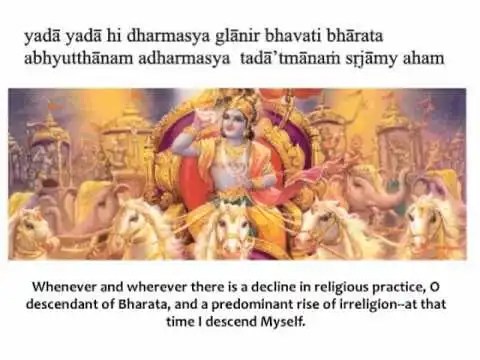
The true meaning of Actionlessness
Non action which is the characteristic of the Atman does not mean inactivity. It means being established in pure awareness without involvement in any kind of change. Such a person is an enlightened soul. A person who by effort of his will keeps aloof from external action but inwardly remains subject to attachment and egoistic motivation is an idler.
Knowledge based action is the highest form of Yagna in the Vedic tradition. Sacrifice or Yagna can take many forms. It may be with material ingredients, or austerity. It may involve the practise of concentration or control of the senses and prana. It may involve scriptural studies or of practise of discrimination.
The peak of yagna discipline is reached when the doer sees the acts, means of action, things acted upon and the process of the action as being different manifestations of the Brahman. This is called attainment of Samadhi in action.
Power of Enlightenment
This Jnana is the most powerful of purifiers. It is said that even a sinner becomes a saint on its onset. This wisdom comes naturally to one who becomes perfect in the discipline of dis – interested action.
Important Quotes from this chapter
- You and I have passed through many births. I remember them all, but you do not.
- Whenever there is a decline of Dharma and ascendence of Adharma then I manifest myself in a body
- For the protection of the Good, for the destruction of Evil and for the establishment of Dharma, I am born from age to age
- Whoever worships me through whatever path, I verily accept and bless them in that way
- What is Work and what is “No Work” is a subject regarding which even the wise are perplexed. I shall therefore speak to you about work, by knowing which one is liberated from evil.
- The truth about the nature of “beneficial work” has to be understood, as also the ‘baneful work” and of “no work”. The way of work is difficult to understand
- One who is free from desires, whose mind is well controlled, and who is without any sense of ownership, incurs no sin from works, as his actions are merely physical.
- For one who sacrifices not, this world is lost.
- Scorcher of enemies! Sacrifice involving knowledge is superior to sacrifice with material objects. All works without exception culminate in knowledge.
- Just as a well kindled fire reduces a heap of firewood to ashes, so does the fire of divine knowledge reduce all sins to ashes
- A man of deep faith (Shraddha) obtains this divine knowledge, being full of zeal and devotion for it and endowed with mastery of senses. Having obtained this knowledge, he is established in supreme peace very soon.
- An ignorant man without faith, who knows only to doubt, goes to ruin. To such a doubting soul there is neither this world nor the world beyond. There is no happiness for him
________________________________
Therefore, cutting asunder the sceptical tendency of the heart by the sword of divine knowledge, betake yourself to Yoga (Communion through sacrificial action) and arise, O Scion of the Bharata race!
______________________________
Additional Notes
- This chapter highlights the deep mystery of Divine incarnation. It is a mystery because the infinite, omnipotent being is born as a limited human being
- How the incarnation takes place is indicated by two expressions
- Atma Maya – His inherent power or will. This is what makes the impossible possible. It implies that manifestation in any limited or imperfect form does not affect His infinitude and perfection. The worship of the incarnation is therefore equal to the worship of the Supreme Being Himself.
- Prakritim Svam Adhistaya – Prakriti is His material nature constituted of the 3 Gunas. The body and mind of all beings are a combination of these. But in a human the combination is formed subject to Karma. But the body of the Incarnation is not subject to Karma. His body is formed of pure Sattva. The individual on the other hand is born as a slave of Karma for attaining the individual needs of Dharma, Artha, Kama, Moksha. An individual’s body is mainly Tamas and Rajas and as he advances spiritually a little of Sattva also enters
- It is more often after His lifetime than when He is alive that an Incarnation receives wide recognition
- According to the stages of the evolution of the human mind there will be different conceptions of the Deity. The more skilled the workman the more artistic will be the form he chips out of the block. None can claim that his conception embraces the whole of Him as no bottle can hold the water of the vast ocean. He reveals only what one is fit to receive
- The 3 qualities necessary for progress in spiritual life are
- Shraddha or Faith
- Ardent Practise
- Control of the Senses
End of Chapter 4
____________________________________
Chapter V
Karma Sanyasa Yoga
Communion through Renunciation
This chapter focuses on 2 things
- The harmony of the paths of knowledge & work
- The way of the illuminated ones
The harmony of the paths of knowledge & work
Arjuna is confused. His predicament is logical as Lord Krishna has been stating points which sound contradictory. The question he poses here is similar to what he raised in the 3rd chapter. He seeks a clear unambiguous answer on what he should follow.
He queries – “On one hand you seem to advocate the abandonment of all karma in one breath and in the next you praise the discharge of all actions in a disinterested manner” – Which of these two should I follow?”
Lord Krishna explains
A contemplative life characterised by abandonment of all actions (Samkhya), as also the discharge of all actions with detachment (Yoga) – are both valid spiritual paths. They may look different but they are the same. There is however an important link between them. Without undergoing the discipline of detached action it is vain to abandon all external action, for it will result only in idleness and hypocrisy.
He clearly states that as paths they may be distinct but the spiritual realisation they confer on the aspirants is the same.
He further clarifies – The attainment of detachment in action is the very essence of spiritual life. Once this is attained it is immaterial whether one abandons external action or not. One who is truly detached is now fit to be united with the Supreme.
The way of the illuminated ones
For a person with such detachment he feels that it is Prakrit (Nature) of which the body & mind is a part that works and reaps the fruits – not he. And the Holy Spirit is the only unconcerned witness of all these movements of Prakrit.
Remaining in that state of Spirit consciousness he is not impacted by any experiences of life – pleasant or unpleasant. His dealings with all – has a sense of equality. Since he knows that they are all the unaffected Spirit and not the body to which the distinction of high & low, rich and poor apply.
In this embodied state he has full control over his passion and senses. Knowing that contactual joy only brings sufferings. He turns for satisfaction inwards towards the bliss of the Supreme Spirit of which he is a part.
He becomes an adept in the practise of Samadhi and can anytime withdraw from the surface life of the body and be merged in the bliss of the Spirit within.
Excluding all sense perceptions, fixing the look between the eye brows, steadying the flow of Prana (outgoing breath) and Apana (incoming breath) thru the nostrils, controlling the senses, mind & intellect, devoid of desires, fear and anger – and aspiring for liberation alone – a meditative sage so established is liberated for ever.
Points to Ponder
A traditional Advaitin would argue that there is total contradiction between both paths.
By work or Karma, the ancients meant Srauta Karma the work explained in the Vedas which were purely ritualistic and Smarta Karma – Duties imposed by the law codes, which were partly ritualistic and partly as per your state of life. It was held that performing these works will help one to attain the purity of mind & intellect which then would give one the competence needed for the contemplative disciple called as Samkhya.
When one has attained that competence one should abandon all Karma. To continue the practise of Karma Yoga afterwards is like husking the already husked paddy. Karma has therefore to be completely abandoned at a certain stage.
In the Vedic society if a Brahmin or Kshatriya lived without performing his ritualistic duties it was considered degrading. Those who had gone beyond the need of it were therefor expected to take to the Ashram or the Forest
End of Chapter 5
____________________________________
Chapter VI
Dhyana Yoga
Communion through Meditation
This chapter focuses on 3 things
- Continuation on the topic – Detached work leads to Enlightenment
- Practise of Meditation
- Difficulty of Inward Concentration
Detached work leads to Enlightenment
Real Sanyasis and Karma Yogis are not very different. Both have the common perspective that the mind should have the capacity to abandon all hankering, desire, attachments, hopes and expectations.
In the initial stage as one sets on the path towards detachment work is essential. Without work one would lapse into idleness and hypocrisy. With this work he must practise Introspection & Meditation. That is needed to achieve the goal of detachment.
For a beginner Work or Karma becomes Karma Yoga only when it is supplemented with Meditation. However, for one who has become established in detachment, Sama or introspection becomes the path for further progress. Whereas action is a “must” for the former it is only a “may” for the latter. However the cultivation of a detached mind free from hopes and expectation is common and essential to both.
Practise of Meditation
The mind of one who has succeeded in meditation is comparable to a steady flame undisturbed by the wind. He becomes established in the experience that he is the Spirit & not the body. He is in a state of Bliss which is the nature of the Spirit. Once he is established in this state nothing else is felt as attractive or valuable. He is not distracted even by the greatest of worldly sorrows.
A person adept in Meditation also attains a new vision of the totality of the existence, the experience of the Divine residing in all entities.
The difficulty of inward concentration
Having listened patiently, Arjuna now raises two valid questions.
- As the mind is unsteady, the work of making it steady is as difficult as stilling the air. How could this be accomplished?
- What is the fate of one who attempts this but is not successful even by the end of his life? Is he a lost soul – his whole life efforts having ended in failure?
Lord Krishna responds in detail to these pertinent questions
Though the mind is difficult to control this can be done by
- Steady Practise
- Cultivation of dispassion for worldly enjoyments
- A strong aspiration for a higher life
The last of these is the most important. If a strong aspiration and desire to evolve is not present, practise alone will not be of much use. Failure in Yoga is mainly due to lack of aspiration for a higher life.
But there is no absolute failure in Yoga. A person carries the legacy of whatever effort he has put in this life to the next one. He will be born under conditions favourable to spiritual development. With the power of his earlier practise as his background he will strive forward life after life, till success is attained.
One practicing the discipline of Concentration / Meditation is immensely greater than one engaging himself entirely in scripture ordained works or in intellectual study of the Vedanta. The practise of concentration should be accompanied with intense faith and devotion to the Lord. Then Yoga becomes the most potent spiritual discipline.
A few relevant quotes from this chapter
- To him who has subdued the lower self by the higher self, the self-acts as a friend. But to him who has lost his higher self by the dominance of the lower one, the self-functions as the enemy – always hostile to him.
- A Yogin whose spirit has attained contentment through knowledge and experience, who is unperturbed, who has subdued his senses, to whom a lump of earth and a bar of gold are alike – such a Yogi is said to have attained steadfastness in spiritual communion.
- Let a Yogin constantly practise spiritual communion residing alone in a solitary spot, desireless, possession less, and disciplined in body & mind.
- Holding the body, head & neck erect, motionless and firm, gazing at the tip of the nose, fearless, serene, restrained in mind and established in the vow of continence, he should sit in spiritual communion with Me, looking upon Me as his highest and most precious end.
- Success in Yoga is not for those who eat too much, nor for those who eat too little. It is not also for those given to too much sleeping, nor to those who keep vigil too long – MODERATION
- For now, who is temperate in food & recreation, who is detached and self-restrained in work, who is regulated in sleep & vigil – Yoga brings about the cessation of the travail of samsara.
- He who sees Me in all beings and all beings in Me – To him I am never lost, nor he to Me
- A Yogi (One practising Meditation) is superior to a man of Austerity, he is superior to a scholar, he is superior to a ritualist too. Therefore, O Arjuna, be you a Yogi.
Points to ponder
- Verses 5 – 6 seem to imply that there are two aspects to the Self of man – one higher and the other lower. The higher Self is the Buddhi turned towards the Atman – The Spiritual essence. The lower Self is the Mind dominated by the senses. It is said the sense dominated mind must not be allowed to overpower the Buddhi – the higher Self. If this is to be avoided the Buddhi must draw strength from the Atman by communion with it. Such a Buddhi fortified by Atman consciousness can easily uplift the sense bound mind and integrate it with itself.
- Verses 29 – 32 are of considerable metaphysical, ethical & psychological
- Metaphysically it asserts the unity of all existence in a Spiritual Self which is both personal and impersonal – thereby emphasising the intimate relation between the Spiritual Self and the individual self.
- Ethically it teaches the most universal principal of ethics. To do towards and feel for other selves as for one owns self is the highest principal of ethics.
- Psychologically it shows that the spiritual intuition which Yoga gives has a distinct content of a unique nature and is not a mere fantasy without life enhancing value.
- Verse 47 – The verse immediately following the praise of Yoga tells us that devotion to God which makes one cling to the Lord in utter faith and self-surrender makes Yoga even more exalted. In the Gita the word Yoga is used in many senses. Here it mainly refers to the Ashtanga Yoga – the 8 limbed Yoga of Patanjali. It is the science of concentration and stilling the modes of the mind.
- The Samkhya which teaches the discrimination between Purusha & Prakriti – does not have much place for God & devotion in it. But the Gita everywhere stresses the supreme importance of the Ishwara and devotion to Him in making all spiritual discipline complete. So it is pointed here that the Yoga of discipline of concentration will be more perfect if the object of concentration is the Lord.
End of Chapter 6
____________________________________
Chapter VII
Gnana Vignana Yoga
Communion through Knowledge & Realisation
Lord Krishna starts the dialogue by stating “Hear now O Arjuna, how one resigned to Me and absorbed in love of Me attains full knowledge of Me through the practise of spiritual communion”
This chapter focuses on 4 topics
- The two powers of manifestation (Prakriti) – Lower & Higher
- The all-embracing Divine
- The 4 Types of devotees
- One God forms the object of all worship
Lower & Higher Prakriti
He starts by stating that very few men strive to know God. Of those who try, only very few succeed after many births.
“Among thousands of men there will just be one here or there striving for spiritual perfection. From among the aspirants so striving, one perchance knows Me in truth”
He goes on to explain that he has two powers of manifestation (Prakriti’s). The lower Prakriti is material nature comprising of Earth, Water, Fire, Air, Sky, Mind, Intellect & Ego. The higher Prakriti is His manifestation as Jiva or centre of Consciousness. While the former is His unconscious nature, the latter is His conscious nature that supports and sustains the world.
The all-embracing Divine
Just as a string supports the beads in a necklace, so are all thing sustained by Him. His immanent self is the essence of all entities. In water He is taste, in Sun & Moon their brilliance, in all the Vedas the sound symbol Om, in the sky element sound and in men their manliness. In the earth element He is the sweet fragrance, in fire He is brilliance, in living beings – the life principle and in austere men, He is the austerity.
He explains to Arjuna that He is the eternal seed of all beings. Whatever manifestations there are of Sattva, Rajas, and Tamas they have all come from Him. “They are in Me not I in them”
Who transcends Maya – The 4 types of Devotees
He explains that his divine Maya constituted by the 3 Gunas is difficult to overcome. The Maya that obstructs the vision of men is also His creation. Only by surrendering to Him with one’s whole being can one get across this obstruction.
The lowest type of men – evil, foolish and demonic in nature being deprived of right understanding by Maya never take refuge in Him with devotion. He then goes on to explain the 4 types of devotees.
- Distressed one or the sufferer
- The Knowledge seeker
- The Wealth Seeker
- and the Knower
While all of them are noble, he says “the Knower I cherish as My very Self ” . The most beloved Bhakta the Knower is also called the Jnani. He is distinguished from the other 3 type of bhaktas in that he seeks nothing from the Lord – not even Moksha. To such a one the Lord gives Himself.
The Knower is forever established in the conviction that He is his highest goal. At the end of many births (of striving) the knowing one makes Him his refuge. A great soul of that type is rare to find.
One God forms the object of all worship
The Lord explains that He is One, He is Supreme. Influenced by their inherent nature and deprived of correct judgement, people adore other deities with various forms of worship. However he manifests himself in whatever form and aspect the devotees adore and makes that particular faith unshakeable.
He then goes on to add – “Veiled as I am in my Yoga maya (Divine Power) – I am not revealed to all. the deluded world does not know Me. O Arjuna! I know all beings – Past, present & future. But none knows Me”
He concludes this chapter by saying that only Complete Trust and Full Dependence on Him can help a person to strive for liberation from the travails of old age and death.
Important Points
- Sattva, Rajas & Tamas – the 3 constituents of Gunas or Prakriti are introduced here for the first time. The whole world of multiplicity is evolved by the permutation and combination of the 3 Gunas
- It is not that the Vedic religion teaches primitive polytheism. Unity of Godhead is a well-known doctrine. God manifesting himself in Deities is an expression of His power. The devotion of most is for attainments of boons or material welfare. For worldly needs like curing diseases, success, securing wealth etc. When worship of a particular deity is found effective people become votaries of that Deity. The Lord explains that the powers of these Deities are derived from the Supreme Being and it is the Supreme Being Himself who gives them the desired fulfilment.
End of Chapter 7
____________________________________
Chapter VIII
Akshar Brahma Yoga
The way to Imperishable Brahman
Key message from this chapter
- The Divine Mystery – Going deeper into concepts of Brahman, Spirit, Karma, Material & Divine manifestations
- Remembering the Lord at Death – The assured way to attain Moksha
- Creative Cycles – In this section the Hindu doctrine of Samsara and the cyclic process of time are explained.
- Life hereafter – Here Lord Krishna explains the paths by which embodied beings depart after death
The chapter starts with two questions from Arjuna
What is Brahman (The Absolute), What is the Spirit (Adhyatma), What is work (Karma), What is that which underlies the material manifestation (Adhibhuta) and the Divinities (Adhidaiva)
Who is Adhiyagna (The spirit underlying sacrifice) that resides in the body? How does a man of self-restraint meditate on the Supreme Being at the time of death?
The Divine Mystery
Lord Krishna explains – I am the supreme Imperishable Brahman – Akshara. The Brahman’s power manifested in every body as the transmigrating self (the Jiva) is the Adhyatma. The creative act which brings all beings into existence is Karma (Work).
Akshara is undoubtedly the Supreme impersonal being. The Upanishad describes the Jiva as a spark of the fire.
The ever changing perishable nature is the material aspect – Adhibhuta. All material combinations including the bodies of beings come out of it. When they perish the substance constituting the bodies go back to their constituents. The material nature as the substance subject to constant change is also imperishable.
The cosmic soul is the basis of all divine manifestations – Adhidaivata.
The cosmic soul co-relates with Purusha – he who “infills” everything. He is Hiranyagarbha – the first born in the creative process. He endows the senses with their power and directs them in their functions. Another interpretation of the word Purusha is “The collectivity of all individual spirits.” Others say that the Purusha is the Purusha of the Purusha Suktam – the cosmic person, the dismemberment of whose body in sacrifice is the origin of the universe.
Adhiyagna – the one object of all worship. He who is the very practise of worship and who gives the fruits of all worship whatever may be the Deity.
Karma is the creative will of God. “Great Nature is a womb to Me, I impregnate it with my seed”. Karma has also been interpreted in relation to the Vedic rite of sacrifice.
Remembering the Lord at death
Whoever thinks of the Lord at the time of death attains to His state on abandoning the body. There is no doubt on this. He adds that only those who think of Him intently during their lifetime will have the good fortune of remembering Him at the time of death.
He explains “All through life practise the discipline of concentration on Me. The syllable Om is my sound symbol. With that as support draw the mind to the innermost being and then concentrate on Me”
” He who with a steady mind and endued with devotion and strength born of spiritual practise, fixes his entire life force between the eyebrows at the time of death and contemplates on Him – he verily attains that Supreme Being”
Creative Cycles
In this section the Hindu doctrine of Samsara and the cyclic process of time are explained. Creation is co-terminus with time. Time has no beginning or end. It is endless, being cyclic. Someone who has merged with the Brahman, there is no returning to the mortal sphere in course of the endless cosmic cycles
The creative process, when the worlds are in manifestation is called Kalpa. It is followed by a dissolution of the manifested into elemental condition – this is Pralaya. Kalpa & Pralaya which are of equal duration alternate in a cyclic process.
All the Jivas are involved in the cyclical process undergoing birth & death according to their Karma’s, enjoying and suffering, subject to a temporary abeyance of the process when the whole of Prakriti is in dissolution. But they come back to the old condition when a new Kalpa begins just as plants spring from dormant seeds. This entanglement in the cycle of birth & death is Samasara.
The delinking of the Jiva from the cyclical process of Time is the ultimate aim of evolution. This attainment of delinking is called Moksha or Liberation. Attaining the Lord is the way to Moksha
Life hereafter – 4 Paths
Lord Krishna explains the paths by which embodied beings depart after death – The Dark Path & the Radiant Path
Those who are unattached and practise whole hearted devotion to the Supreme Being go along the Bright path and attain Moksha. Those attached to worldly values go along the Dark Path and come back to the world again at the exhaustion of the effects of their Karma.
Fire, Light, Day Time, Bright Fortnight, 6 months of the northern course of the Sun – the knowers of Brahman who depart along this path attains Moksha.
Smoke, night, black fortnight, 6 months of the southern course of the Sun – the Yogi departing by this path attains to the lunar sphere and returns.
(This is explained in more details in the Notes section below)
Notorious sinners go to Naraka – where they suffer for their sinful acts, after which they are born in animal bodies or as humans under miserable conditions.
There is a 4th category of person who have neither great sins nor great merits to their credit. They are ineffective persons who live a humdrum life of a self-centered nature without being virtuous or vicious. They die and are again reborn without going to any other sphere, and go on continuously drifting in the cycle of birth & death with its petty enjoyments and great sorrows until they become spiritually awakened.
Notes
The chapter touches upon the time scale of cosmic manifestation and dissolution, depicting the infinitude of Time.
- 1 Human Year makes 1 day & night of the Celestials
- 1200 Celestial Years makes one Chatur Yuga ( 4,32,000 human years makes one Chatur Yuga or a cycle of 4 Yuga’s)
- 1000 Chatur Yuga’s makes one day time of Brahma – Kalpa. An equally long period is his night – Pralaya
- 365 such days & nights makes 1 year of Brahma
- A hundred such years constitute his life span
- The end of his life is marked by a major Parlay (Maha Pralaya) of duration equal to his lifetime.
- After that the creative cycle (Maha Kalpa) starts again under a new Brahma.
The Path of Light
Jivas who have practiced devotion to God and performed all their duties and work as offerings to Him – and without any desire of their fruits will have a gradual spiritual progress passing through various realms like Fire, Light etc. Presided by deities known by those names. The Jiva gradually attains higher spiritual evolution in realms that foster spiritual growth and finally attains liberation.
The other way known as Pitryana (The way of Manes) – The Non-Luminous path is through realms known as Dhuma, Ratri etc – presided by deities of these names. They attain the Lunar Sphere. There they enjoy the fruits of the ritualistic and philanthropic actions of a meritorious nature, which they have performed with an eye on the fruits – and when these merits are exhausted they take rebirth on earth.
End of Chapter 8
____________________________________
Chapter IX
Raja Vidya & Raja Guhyam
Sovereign Knowledge & Sovereign Mystery
Significance of the chapters name
The prefix “Raja” shows the importance of the subject. In an earlier chapter Lord Krishna had spoken about Yoga which was known to the Raja Rishis being forgotten in course of time. And how he was going to revive the lost teaching by imparting to Arjuna. He describes this ancient lost teaching as “Rahasyam” – Secret, Esoteric Knowledge, a Mystery. Rajavidya and Rajaguhyam may well be the lost knowledge that he is now sharing with Arjuna. There is profound learning in this chapter, and it starts with this statement from the Lord
I shall now declare to you, who are endowed with reverence, that profoundest of all mystic doctrines and the way to its experience, by which you will be free from the baneful life of Samsara
The teachings in this chapter can be summarized under the following heads
- Devotion is the ultimate science
- Devotion can help you understand the Divine Mystery
- What is true worship of the Divine
- Is redemption open only to the devout
- Devotion is the ultimate science
The doctrine of devotion is the noblest & profoundest of all sciences. It is easy to practice. Those who neglect it will be subject to the cycle of births & deaths and will not attain salvation. Highest worship according to the Bhagavata Dharma consists in the total surrender of all the fruits of action. Whatever man does by the body, by mind, by buddhi, and by senses – let all that be dedicated to the Supreme Being.
In this chapter the Lord says “Whatever you do, whatever you eat, whatever you give away in charity, whatever austerity you perform – do all that as offering unto Me”
- Devotion can help you understand the Divine Mystery
- Devotion is generated by contemplating on His Mystery and Glory.
- The Lord is the indwelling spirit in all, but nobody contains Him. It is He who contains them.
- It is also not true that they rest in Me because I am the pure and incorruptible Spirit which remains unaffected by their presence
- I am the creator and sustainer of this mighty universe but am not affected by it
He is the source and support of all existence, but he has no contact with them, nor is he dependent on them. But all objects are given their status as existing entities because of His will. But for Him they would have had no existence. But he is Self-Existent. The Lord says contemplate on this divine Mystery.
- What is true worship of the Divine
This section brings out the clear distinction between attaining heaven and attaining salvation. In other religions heaven or paradise is the final destiny of all pious believers. But in Vedic religion heaven is just a state like our life on earth. Heaven provides enjoyments of a greater refinement as a reward for Vedic rituals and charities done. Just like your money in a bank these merits are exhausted by enjoyment. And when the credit balance is zero these Jiva’s must come back to earth and acquire new merits for more enjoyments after the end of their earthly life.
A real lover of God lives a life of surrender to God and service of His creatures without praying for any reward. Lord calls such devotees as “Ananyah” – Those who do not think of Him different from their real Self.
External worship is symbolic. In an earlier chapter Lord Krishna directs a shattering criticism on the sacrificial cult. Vedic rituals were elaborate, requiring meticulous performance. Its objective was heavenly felicities. It was open only to Kshatriyas and Brahmins. Women were excluded.
The Bhagavata Dharma which Krishna proclaimed has characteristics of a very different nature.
It’s important features are
- Faith in One Supreme Spirit
- Adoration of Him with devotion
It is open to all including women and outcastes, unlike the Vedic rituals which are open only to men of the twice born Varnas (Dvijas).
(Dvija – The concept was that a person is born physically through his parents at home, spiritually through his teacher who helps the student form the mind and realize the self)
In this form of adoration, rituals and ingredients are subordinate. Lord says “Leaves, flowers, water etc. given to me with love and dedication I consume with supreme satisfaction”
- Is redemption open only to the Devout or to all
The Gita declares “Even a confirmed sinner if he worships Me with unwavering faith and devotion must be considered as righteous; for he has indeed taken the right resolve”.
Towards the end of the Chapter lord Krishna throws light on an interesting perspective.
Is God partial towards his devotees as against those who do not adore Him?
This attitude is common among worldly beings in high positions. Those who flatter are rewarded. Those who do not are excluded from favor. Is God also like that?
Those who adore Him approach close to Him and therefore participate in His blissful nature. While others ignorantly or deliberately exclude themselves from Him and become interested in worldly life with its consequences.
The Bhagavata Purana explains this point by comparing God to the Kalpataru (Wish Yielding tree). Those who go under the tree and pray are rewarded. Those who exclude themselves fail to get these blessings on account of their own fault.
This may lead to a question – Is God a passive element? is he not responsive to the devotee’s attitude? Does not the devotee get any active help from Him?
Sri Ramakrishna answers this declaring that if the devotee takes two steps towards God – He takes ten steps towards the devotee. A devotee will find from experience that the grace of God works on him in a hundred ways without him knowing it.
This chapter ends with a verse
“Let your mind be absorbed in Me. Be devoted to Me, sacrifice unto Me, and bow down to Me. Thus, having Me as your highest goal, and united with Me in mind, you shall come to Me alone.”
Other Useful Points
9 Steps of Spiritual Discipline
In the Bhagavata Purana a spiritual discipline of a very wide scope is presented. It has nine steps
- Shravana – Hearing
- Kirtana – Chanting Hymns
- Vandana – saluting all as the tabernacles of God
- Daasya – Cultivating the attitude of the servant of God
- Sakhya – Comradeship with Him
- Atmanivedana – Complete self-surrender
The Gita considers mainly Padaseva (Pada being taken as the manifestation of the Supreme Being) and Atmanivedana.
The 4 Yoga’s
The 4 Yoga’s are based on the three aspects of the human mind – The intellectual, emotional and the volitional. Jnana Yoga is essentially intellectual. Bhakti Yoga emotional. Karma & Raja Yoga volitional.
Raja Yoga is the science of concentration. What is done is to use the willpower to make the mind one – pointed. The will is used for inward purpose. In Karma Yoga also the application of will is the main feature of the discipline, but it takes an external direction.
It is unpsychological to make a watertight compartmentalization of these four Yoga’s.
Divergence in people
The Gita seems to recognize a kind of basic divergence in people. Daivi Prakriti & Asura Prakriti – The Divine & the Demoniac. The characteristics and ways of life of these people are explained in Chapter 16.
Maya
Included in Lord’s power or Maya are two tendencies working in opposite directions. Vidya(Enlightenment) which works towards the liberation of the soul, and Avidya (Ignorance) which leads to more and more of worldly bondage. Moral & pious actions bring one more and more under the influence of Vidya. Immoral and sensuous indulgences bring him more and more into the sphere of Avidya.
End of Chapter 9
____________________________________
Chapter X
Vibhuti Yoga
Manifestation of Divine Glory
Meaning of the word Vibhuti
Vibhuti means special manifestation of divine majesty, power & glory. The word arises from Vi + Bhu, meaning “arise, expand, appear”. The whole of Nature, including the mighty universe and what is experienced in it is a declaration of the power & majesty of the Creator.
In the next Chapter Lord reveals His cosmic form. In this chapter He tries to explain that he is the seed of everything. Without Him nothing can exist. There is no end to His manifestation.
Whenever you see anything powerful, good & glorious, know that to be a manifestation of an atom of My power. With an atom of My being, I pervade and sustain everything
This chapter has two sections
- Contemplation on Divine Excellence
- The Vibhutis – Arjuna wants to know about the Lord’s glorious manifestations in life & nature.
Contemplation on Divine Excellence
As an aid to devotion & self-surrender Lord explains the Divine majesties and excellence by contemplating on which the devotional mood is reinforced.
- No person however great knows Me – For I pre-exist all
- Neither the host of Gods or Maharishis know my origin – for I am myself the origin of all those Gods and great sages
- When man knows Me as the unoriginated and eternal Lord, he becomes sinless and free from delusions
- All the higher faculties of man are but a faint reflection of My excellence
- All great men, saints & saviors are indeed projections of My thoughts
Intelligence, knowledge, sanity, patience, truth, sense control, mind control, pleasure, pain, birth, death, fear and fearlessness, non-injury, same sightedness, contentment, austerity, benevolence, fame, and obloquy – all these diverse modes of mind seen in all beings proceed from Me alone, their ultimate sanctioner.
Those who contemplate on Him and recognize Him as the essence in all that is glorious and impressive will be thrilled with devotional experience and attain perpetual communion with Him.
All those whose vital energy is drawn to Him through devotion receive the illumination of spiritual insight. The lamp of wisdom is lit within them, and the Lord reveals Himself as the Soul of their Soul.
The Vibhutis
Lord explains that He is the seed of everything. Without Him nothing can exist. There is no end to his manifestations. With an atom of His being, he pervades and sustains everything.
When Arjuna requests Lord Krishna to tell him his divine powers and majesties – He says “I shall declare to you what my divine self-manifestations are, but I shall mention only the chief of them, for there is no end to their detail”
- I am the Self residing in every being. I am their beginning, lifespan & end.
- Of the 12 Aditya’s I am Vishnu, among the luminaries I am the Sun, among the seven Maruts I am Marichi and of the Nakshatras I am the Moon.
- Of the Vedas I am Sama Veda, among the Devas I am Indra, of the senses I am the Mind, and of living beings I am Intelligence
- Of the 11 Rudra’s I am Shankara, among the demigod’s I am Kubera, of the 8 Vasus I am Agni, among mountains I am Meru
- I am the chief of priests Brihaspati, among the war lords I am Skanda, among the water reservoirs I am the Ocean
- Among the great sages I am Bhrigu, I am the mono syllabled Om, among holy offerings I am the Japa, among immovable objects I am the Himalayas.
- Of all the trees I am the holy Fig tree, among divine sages I am Narada, among perfect souls I am Kapila the sage
- Among horses I am Uchchaihshravas, among elephants Airavat, among weapons I am the Thunderbolt, I am Kamdhenu the celestial cow and Kama the God of love. Among serpents I am Vasuki & Ananta.
- I am Varuna, and among enforcers of law I am Yama. Among daityas I am Prahalad.
- I am Time, I am the Lion amongst animals and Garuda among the birds, among rivers I am Ganga, among fishes I am the shark, among warriors I am Rama. Among purifying agents, I am the Wind.
- Of all created objects I am the beginning, middle and end.
- Among the sciences I am the science of Spirits, and of debaters I am the power of correct reasoning.
- I am all destroying Death. I am also the Origin of all that to come to. Among virtues I am fame, fortune, speech, memory, intelligence, constancy, and patience.
- Among Sama Hymns I am the great chant Brhat Sama, among Vedic meters I am Gayatri. Among months I am Margashirsha. Among seasons I am the flower bearing Spring.
- I am victory, determination, and constancy too.
- I am the rod of chastisement in the disciplinarian, I am silence in the art of secrecy, and I am wisdom in the wise
He concludes by saying
Of all the beings I am the seed O Arjuna. Whatever exists in the world, living or non-living, none of them can be if I were not. There is no end to my divine manifestation. What I have expounded, forms only a few of them by way of example.
And finally, the last verse is a question to Arjuna
Of what avail is this detailed understanding of my manifestation to you O Arjuna! Supporting this mighty universe with but one single fragment of Myself, I remain unchanged and transcendent.
Notes
Three attitudes are possible regarding things expressed in Nature. Sri Ramakrishna expounds these attitudes in a simple analogy of a beautiful garden.
- A common sight seer goes to the garden and sees the beautiful flowers. His interest is only to pluck some flowers and carry them home. He is exploiting Nature for his enjoyment.
- A Botanist is interested in the scientific study of the plants. For him nature is something to be investigated and studied upon.
- A man of devotional and philosophical mind goes there. The garden charms him – but he looks for the designer of the garden whose wisdom is reflected on it. For this man the power revealed in Nature is a pointer to Natures Creator or God. This is the view that the Hindu Scriptures take.
End of Chapter 10
________________________
Chapter XI
Vishwaroopa Darshan Yoga
The Vision of the Cosmic Form
Arjuna wants to have a direct experience of the Divine majesty. Lord gives him a new power of insight to enable him to experience the Divine.
Lord then displays His cosmic form. It is limitless – and encompasses the entire universe of conscious & unconscious entities as also anything else you desire to experience.
What Arjuna saw was beyond comprehension – A Divinity boundless and all pervasive. He saw the transcendent form as the Lord of the universe. Countless faces, countless features. Bedecked with countless celestial ornaments and equipped with countless weapons.
The brilliance of this form was comparable to 1000 suns blazing suddenly in the sky. Arjuna saw in the form all divinities. He saw the whole universe abiding in Him.
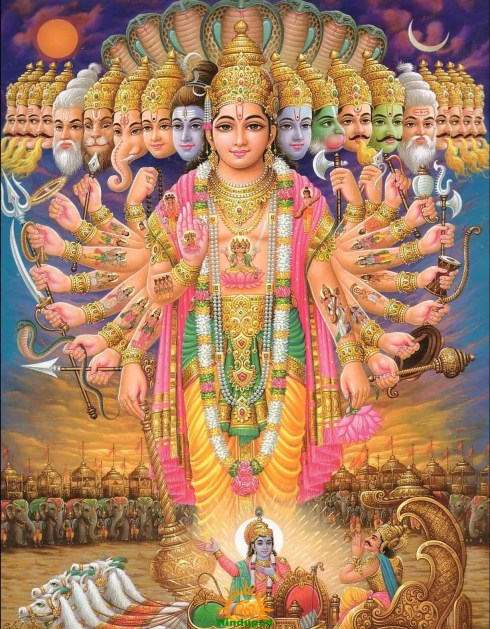
The experience shakes Arjuna to the core, and he loses himself in utter self-abnegation & devotion. With head bowed and folded hands Arjuna says
“I see everything in You, I don’t see the beginning, middle or the end. I see a boundless being shining as a mass of light difficult to look at. I realise now that you are the supreme imperishable being – the worlds ultimate refuge”.
“Seeing your stupendous form, the whole world is trembling in awe. I am shaken to my core with awe. My strength is exhausted, and my mind is without pace”
Arjuna now sees the future of the war in the cosmic vision. He sees all the host kings, Kauravas, Bhishma, Drona, Karna, principal warriors on both sides – all rushing headlong into the supreme visions fearful mouth. He sees some of their heads caught and crushed in the fangs. Just like moths swarming into a flaming fire all these men are rushing headlong into the mouth of death.
Arjuna in full humility pleads with Lord to tell him more. What is the purpose of this Vision?
Krishna explains “I am the mighty world destroying TIME.
Even without you, not one of the warriors in these rival armies shall survive. That is destined. These warriors are already slain by me. So, arise – win fame and destroying your enemy enjoy the prosperous kingdom. Because all these warriors are already slain by Me.
You are just an instrument Arjuna
This is the core of the teachings of the Gita
Having realized that his childhood friend Krishna is the Lord of the universe he now pleads for his ignorance of the past. “If in the past I have by mistake been discourteous to you while playing, relaxing or feasting please pardon me”.
A scared Arjuna now pleads with Krishna to revert to his earlier form which he has known all his life. He is overjoyed but also trembling with fear.
The Lord says “Out of My grace I have by my divine power revealed to you this form of Mine. Infinite, primeval, radiant and all inclusive. Never has it been seen by anyone before except you. No Vedic study, austerity, sacrifice or rituals can lead to you to this Vision. It can come only by divine grace.” He then returns to his earlier familiar form.
Finally, Arjuna is composed and restored to his natural state of mind.
Important notes
- The greatness of the Lord consists in the fact that there is no decay. Lord is not in any way affected by creating, preserving & dissolving this vast and mysterious universe by Himself and out of Himself. The relation between the Lord & the Universe is the crux of Vedanta metaphysics.
- “Be Thou but an instrument “– marks the pinnacle of the Gita’s teachings. An unilluminated mind is ego centered and works with an eye on the fruits of the action. The Gita teaches that a spiritual aspirant should work offering all the merits of his works to God.
- The all-comprehensive dominance of the Divine will can be illustrated by the example of a living body. Each cell has an individuality & function. The cells of the heart, brain, digestive system all carry out different activities individually and collectively. But they all share the total energy of the organism. If any of the cell considers its individuality as independent and seeks to function independently it becomes a cancerous cell and perishes. The individuality of the Jiva and its freedom are only like this. All individuals derive their power from His will and exist and function for His purpose. The recognition of this is to become a mere instrument or occasion – “nimitta matram” for His functioning.
- Perfect Self Surrender – Not only the fruits of work are surrendered but even the agentship. In Bhakti the Jiva becomes one with the Lord in point of will and in Jnana he becomes one with Him in being. Since “will” and “being” – cannot be separated in God both these disciplines carry one to the same end. They can both be self-sufficient disciplines.
- Three types of feeling overcome Arjuna’s mind on seeing the Cosmic Form of the Lord as Time the destroyer. These are Joy, Fear & Perturbation.
- Why Fear on seeing the divine vision? Arjuna’s mind is not fully prepared yet. Before the life of ego centered consciousness is transcended – one must pass through the experience of Kali the all-consuming Time which is Death. As long as the ego clings to itself, it is afraid to face death in all her stark nakedness.
- Ramakrishna also wanted to give the cosmic experience to Naren. When Naren began to experience the whole universe dissolving into his elements and his own ego too being blasted he felt terribly frightened like Arjuna and cried out “What is happening to me? I have a father & mother”. Then the master finding Naren not ready for the experience withdrew it from his consciousness.
- Spiritual experience may be compared to an electric current of very high voltage. If it’s passed through a machine that can withstand only 250 Volts – the machine breaks down. Man’s gross & subtle body must be prepared to receive Cosmic energy. They must become Until this condition is fulfilled providence keeps human consciousness insulated from these experiences.
End of Chapter 11
____________________________________
Chapter XII
Bhakti Yoga
Communion Through Loving Devotion
Having experienced the Divine Cosmic Vision, Arjuna now wants to know in the eyes of the Lord who is a better Yogi
- The one who follows the path of devotion looking upon God as the Supreme Person – A God with form & attributes OR
- Who looks upon him as the Impersonal Absolute? (Aksharam Avyaktam) – A formless, nameless God.
The chapter dwells on this aspect in detail but the clear and unequivocal answer given by Lord Krishna is that He considers a true lover of God (Bhakta) as more perfect in spiritual communion.
The doctrine of the Gita is that both these are self-sufficient spiritual disciplines. Neither need to be subordinated to the other. Both routes take the spiritual being to the same Supreme Being. However, Bhakti has its advantages, and these are explained in this chapter.
The Jnana Path is difficult
Lord explains that the path of the Impersonal Absolute is difficult for men who are immersed in body consciousness. The obstacles they face are greater. They must control their senses and tranquilize their mind.
Every spiritual aspirant is an embodied being. There may be Jeevan Mukta’s (Those liberated in life) who are not body conscious, but very few aspirants are. So, the demand for this qualification excludes 99% of aspirants from this path.
In addition to the handicap of body consciousness there is another great challenge. On this path aspirants will have to stand on their own strength and cannot hope for a helping hand.
The aspirants understanding of the divine is that he is impersonal and hence without response. An impersonal person cannot be prayed to, nor does he respond. By one’s discriminative effort one can rise to His level and be He. As the person’s faith is so the Lord is to him.
The Path of Devotion as stated by Lord Krishna
The path of devotion according to the Gita is the easy and royal road to the attainment of the Divine.
- Fix your mind on Me alone. Let your reason penetrate Me. This comes naturally for those who have an inborn hankering for God and whose mind always tends to Him.
- If you are unable to fix your mind steadily on Me, then try to reach me through the systematic practice of concentration. These can include Japa & Meditation.
- If you are not capable of practicing systematic concentration, then devote yourself wholeheartedly to works of service to Me.
- If even this is too difficult for you to perform then take refuge in Me and thus controlling the mind, give up the fruits of all your actions – recognizing Me as their agent and enjoyer.
Who is a Bhakta? What are the ideal qualities of a Bhakta?
- He is a friend of all
- He is free from self-centeredness, unaffected by vanity & pride
- He is free from elation, anger, sorrow, and craving. He neither seeks the pleasant nor shuns the unpleasant.
- He is free from the agitation of the moods caused by euphoria, anger, and excitement
- Always cheerful, patient in all circumstances
- Firm in his resolve
- Absolutely self-surrendered to the Lord
- Attracting the love & affection of all, unperturbed, pure, indifferent to wordly values.
- He is devoid of the feeling that he is the doer of anything, he is alike to friend & foe, praise & insult and looks at the whole world as his home.
Krishna to his disciple Uddhava in the Bhagavata
When a man continues to follow the disciplines of Bhakti without a break, I begin to dwell in his heart and thereupon all the desires of the heart are destroyed owing to My presence. Pure devotion for Me dawns only on such a person who wants nothing from Me – worldly fulfilments or even salvation.
End of Chapter 12
____________________________________
Chapter XIII
Kshetra Kshetragna Vibhaja Yoga
Differentiator of the Knower from the Known
This chapter has a direct linkage to the ideas discussed in Chapter – VII and VIII. The intervening 4 chapters were occasioned due to Arjuna’s intellectual hesitation and mental doubts. But the philosopher in Krishna never forgets the main theme “The imperishable Brahman”. So, after consoling his disciple and temporarily removing his doubts, he goes back to this topic.
The Seen & the Seer, the body & the Spirit, are inextricably mixed up in man in a state of ignorance. The chapter explains that man undressed of matter is the Eternal & Infinite Spirit. To undress and get rid of matter, we must have a precise knowledge of all that constitutes matter in us.
The discrimination between the inert matter equipment’s and the vibrant spark of Life, the Spirit, is presented to us in this chapter which is titled the “Field” and “The Knower of the Field”, Kshetra – Kshetragna Yoga
The matter – equipment’s and their perceived world of objects together constitute the “Field”. The Supreme Consciousness illuminating them, and therefore seemingly functioning within the field, gather to itself consequently, the status of the “Knower of the field”
The Pure Consciousness becomes the Knower of the Field – and this knower thereby experiences joy & sorrow, success & failure, peace & agitation, jealousy, fear and a million other emotions. The sorrow of the Samsara is thus entirely the private wealth of the “Knower of the Field “ – The Jiva.
If through discrimination the “Field” and its “Knower” are known separately through meditation the student can detach himself from the matter equipment’s and therefore get away from the “Field” of these sorrow ridden experiences. Thereby the “Knower of the Field” who was earlier the “experiencer” of the sorrows, transforms himself to be the experiencer of Absolute Knowledge
Prakriti & Purusha
In the Samkhya philosophy Prakriti is the inert equipment and Purusha the vital sentient Truth that sets the entire assemblage of matter in action. When Purusha weds Prakriti the experience of good & bad are born.
The entire world of objects constitutes the kingdom of matter. The vital knower of the world of matter (Consisting of all the equipment’s and their array of perceptions, feelings & thoughts) is the Spirit.
Lord then announces, “I am the Knower of the Field in all Fields” He is identifying himself with the SELF that is everywhere. This is like electricity saying “I am the one energy that gives the glow in all filaments across the world”
What is Supreme Knowledge
A correct knowledge of what constitutes in each of us as the perishable, changeable, finite, inert matter and of the nature of the Infinite, Imperishable and Sentient Spirit is the Supreme Knowledge.
The Lord then starts explaining to Arjuna what Kshetram or Field is
- The 5 Great Elements or Maha Bhuthas out of which the grosser elements are formed
- Egoism (Ahamkara) – The “I” – ness and “My” – ness
- Intellect (Buddhi) – The determining faculty which thinks rationally and comes to its own conclusion and judges what is right & wrong
- The Unmanifested (Avyakta) – Also called the “Vasanas” it rules the functions of the mind & intellect
- The Ten Senses – The five sense organs of perception and the five sense organs of action
- The One Ekam – The Mind. Even if sense organs are many the faculty that receives the stimuli form all the 5 avenues of perception are one and the same – The Mind.
- The five objects of the senses – The eyes can perceive only form; the ears can listen only to sound… Not one of the sense organs can perceive the objects of the other sense organs. Thus, there are 5 distinct type of sense organs. The entire gross world is perceived as nothing but a play of these 5 types of sense objects.
The 24 factors enumerated above are the 24 principles (Tattvas) of the Samkhya philosophy.
However, the Lord doesn’t stop there in detailing what comprises Kshetra. Desire, hatred, pleasure, pain, intelligence, etc. are also constituent elements of “The Field”.
In short not only do the gross body, mind & intellect constitute the entire world of objects, but even the perceptions experienced through them, the emotions and thoughts are also included in all comprehensive term “Field – Kshetram”
Qualities to ascertain Supreme Knowledge
Lord Krishna then lists down certain mental and emotional attributes, moral attitudes and ethical principles that are essential prerequisites for the seeker who is anxious to experience the Infinite Self
- Humility, modesty, non-injury to living beings, forgiveness, patience, uprightness, service to the teacher, purity, steadfastness, self-control.
- Absence of attachment for objects
- Abandonment of the thought of “I”
- Non-Attachment
- Absence of excessive love for child, wife, home..
How to achieve the above?
The Lord says “To achieve these qualities, you need to have unswerving devotion through contemplation on Me. Resort to solitude and abhor vulgar company”
Lord Krishna then explains the Object which ought to be known.
The object to be known is the Supreme Being. He cannot be described in words like “existent” and “nonexistent”. He unfolds everything in Himself and dwells in everything. Though devoid of senses He enlivens all sense powers. He supports everything. He is the enjoyer of all the Gunas. He is the originator and the consumer of everything. He is the Lord of all and remains undivided. He is the ultimate consciousness that reveals everything. He is the source of all light and life and the center to which all spiritual quest is directed. He verily resides in the heart of all.
This chapter concludes with a section on “Knowledge as discovery of one’s Spiritual identity”
- There are two aspects in man – the body mind which is part and parcel of Universal Nature. And the Spirit, which is ultimately one with the Lord, the supreme Subject.
- Unaware of his real nature the Spirit identifies himself with the properties of material nature and becomes subject to repeated embodiments of Samsara.
- There is present in that embodied being another Purusha – the witness of all, the sanctioner of all, The Lord and support of all, the master of soul and matter.
- Lord tells Arjuna “Let the aspirant overcoming the identification of the Spirit with material Nature, find his identity in Me, the Supreme Lord’
- Ultimate Truth or Real Knowledge consists in the understanding of this distinction between Nature & Spirit and the Spirits absolute freedom from Nature.
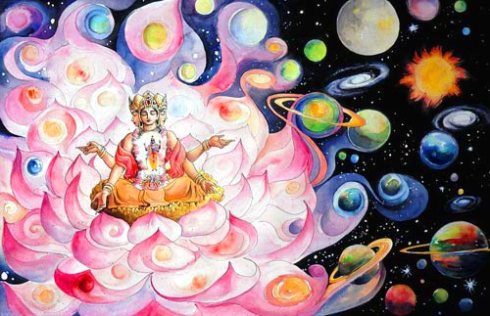
End of Chapter 13
Contents for this Chapter have been summarized from “The Holy Geeta”, Commentary by Swami Chinmayananda & “The Scripture of Mankind” by Swami Tapsyananda
____________________________________
Chapter XIV
Gunatraya Vibhaja Yoga
To attain salvation, you need to go beyond the Gunas
The Gita is a discourse on self-perfection. It is a logical treatise that progresses step by step across chapters. This chapter talks about the concept of “Gunas “. The knowledge of Gunasis important for self-diagnosis and to master your mind.
The Great Nature (Prakriti) is like a womb to God. He deposits therein the germ of creation, the creative impulse, out of which everything comes into being. All creatures whatever be the womb from which they are born, really have the Great Nature as their womb – the source of origin. Lord Krishna states that He is the Universal Father the bestower of the seed in all the wombs.
The 3 Gunas are born of Prakriti (Nature) – they bind down the immortal soul to the body. The 3 constituents of Prakriti are in a state of equilibrium. It is on disturbance of this equilibrium that evolution and involution of the creative cycle depends.
What is a Guna?
A Guna in ordinary language means a quality or an attribute. But the Guna of Prakriti are its constituents – or better defined as Disposition. They cannot be isolated as substances but are known only through their effects in the form of various qualities.
Gunas indicate attitude with which the mind functions. The 3 Gunas in different proportions influence the mental and intellectual caliber of every individual. These influences provide the distinct flavor in each personality, in every individual all 3 are present but the proportion differs.
The Three Gunas
Sattva = Unactivity. It is stainless. It is lucid & healthy. It is luminous and harmonious due to its purity. It binds the soul with the feeling “I am happy, I am full of knowledge”
Rajas = Activity. Rajas is the nature of passion. It is the source of thirst & attachment. It binds the soul by entangling it in action (through the feeling “I am the doer”). Avarice, extroversion, ceaseless planning and execution, restlessness, desire for enjoyment – these arise when rajas prevail
Tamas = Inactivity. Tamas is born of unwisdom. It creates delusion. It binds the soul with the disposition characterized by negligence, indolence, lethargy, negativity & sleepiness.
Rajas when directed for a purpose or service that is unselfish leads to Sattva. Work is important if it is not self-centered. This helps you purify your mind. From Sattva arises Wisdom, from Rajas – Greed and from Tamas heedlessness, error, and ignorance.
Those established in Sattva evolve to higher goals, while those abiding in Rajas remain in mid-course. Steeped in evil tendencies, the Tamas dominated men degenerate.
If one dies when Sattva is the predominant Guna, then one attains the pure regions of the knowers of the Highest. Those who die when Rajas dominate are born as men attached to action. Those dying in Tamas are born in the wombs of creatures with no reason.
Having understood the concept of Gunas, Arjuna now wants to know how to transcend the Gunas – How to rise above them and become a Trigunatit?
The response from lord Krishna is like what was explained in Chapter – 2 (Sthithaprajna) and the qualities of a Bhakta in Chapter 12. A person who has transcended the 3 Gunas never identifies himself with the passing moods of elation, excitement, and depression. In all disturbances of the metal and physical environment he remains unperturbed. He is alike in pleasure & pain, to friend & foe and he never feels he is the doer of anything.
The Lord explains “it is only one who serves me with unswerving devotion can hope to overcome the dominance of the Gunas and attains fitness to become Brahman”
So, one can conclude the following from this chapter
- Everything we experience is subject to the Gunas, one must realise this, life is the play of the Gunas.
- Only through Sattva comes clarity, peace of mind.
- Nevertheless even Sattva binds the self. The aim must be to ‘cross beyond the Gunas’.
Additional Notes
Prakriti & its evolution as explained in Samkhya
While the Gita is associated with the psychological and spiritual aspects of the Gunas, the Samkhya philosophy which originally propounded the doctrine of Prakriti with its 3 constituents called Gunas, derived all the cosmic categories.
Listed below is Prakriti as its evolutes and the whole universe in subtle and gross aspects.
Products of Sattvic Ahamkara
There are 14 presiding deities
- Dik, Vayu, Aditya, Varuna and Ashwins – Controlling the 5 Jnanedriya’s (Organs of knowledge)
- Agni, Indra, Vishnu, Mitra and Prajapati – Controlling the 5 Karmendriya’s (Organs of action) and
- Chandra, Brahma, Rudra and Kshetragna presiding over the 4 aspects of Antahkarana. These are however excluded in the Samkhya analysis.
What is Antahkarana?
This is what is ordinarily called the mind. Its 4 aspects are mind, intellect, egoity & mind stuff (Chitta). They are controlled by Chandra, Brahma, Rudra and Kshetragna.
What are Karmendriyas?
These are the organs of action and are 5 in number – speech, hands, feet, excretory organ, and the generative organ. They are controlled by Agni, Indra, Vishnu, Mitra and Prajapati
What are Jnanendriyas?
These are the 5 organs of knowledge. – Ear, skin, eye, tongue, and nose. The deities controlling them are Dik, Vayu, Aditya, Varuna and Ashwins
End of Chapter 14
____________________________________
Chapter XV
Purushottama Yoga
The mystery of all the all-pervading spirit
____________________
This chapter is considered a jewel in the Gita. It is one of the rare pieces of literature in the world that tries to define infinity
Swami Chinmayananda.
_____________________
In India from ancient times onwards the chapter has been recited before taking food as a prayer by the Brahmins.
Lord Krishna compares the created world with an inverted “Ashwattha” tree (Pipal Tree) – which is equated with Samsara. Some say the tree has gained its name because horses used to stand below its shade. According to Shankara the tree has been chosen to represent the entire cosmos because of its derivative meaning – “Shwa” means tomorrow, “Stha” means that which remains. So, the word “Ashwattha” means that which will not remain the same tomorrow. In short, the world indicates the ephemeral, ever changing world.
Samsara or life on earth is like an inverted tree. The roots are above – unseen, and the branches and leaves are down below in the world of the seen. We cannot see the roots – they are beyond the perception of the common man’s senses. Controlled by the Gunas the common man with his sense organs and mind can only see the leaves and the branches.
The leaves of the trees are compared to the Vedas – which represent knowledge. To understand the source – the roots, one must gain knowledge from the Vedas.
Lord Krishna expands on this and beautifully explains. Under the influence of the Gunas we are constantly caught in the budding foliage of our sense organs. The branches spread, develop secondary roots and mankind is tangled in this bondage.
Why are we entangled?
Because we are a slave to our sensory organs. Always looking for enjoyment. We are confused, there is an identity crisis. We don’t realise that the true identity, the essence is within us. For one involved in day-to-day life, the full tree is not visible. He is not able to ascertain the source.
So how do we gain freedom from Samsara?
The only way is to cut yourself from the tangled mess by the powerful axe of detachment. Seek refuge in that supreme power with intense devotion.
How do we learn the art of detachment?
The knowledge comes from the scriptures, like the leaves of the Trees which represent the Vedas. They are right next to you.
How can this knowledge help you?
The knowledge of the Supreme Brahman makes your mind tranquil. It helps you to be unaffected by situations pleasurable and painful. Such a person can return to the eternal state, the origin root from which everything began.
Defining the Supreme State
Lord Krishna speaking as Supreme Reality explains to Arjuna the bliss one gets when he understands the ultimate Truth.
One who has attained this state and understood his source – he is self-illuminated. The light of consciousness is shining bright within him. He has no desire to return to the state of day-to-day affairs. (Some do to spread the knowledge after having tasted the bliss)
How it all started
A fragment of Myself, a spark has become an embodied spirit in this world of the living. This spark attracts to itself the mind and the 5 senses born of Prakriti. Trace the path back – Senses – Mind – beyond that is the spark, the origin, the eternal Spirit.
The eternal Jiva
This spark when he gets a new body or abandons a new body carries with him like the wind his sensory experiences. Just like the wind carries the fragrance of the flowers. There is no other place in the disembodies body – so the Jiva carries it.
Who is enjoying – Eternal Jiva or the limited body?
In our day to day lives with our sensory organs we experience objects of the materialistic world. We are not able to distinguish that the spark in us the Jiva is a witness to this enjoyment. The Gunas have entangled everything as one.
Those who have the eye of the wisdom, the Gyanachakshu they can see through this mirage. They understand that the real witness is nothing but consciousness. It neither feels joy or pain. It is eternally free. It has no beginning or end. It is imperishable.
Lord now explains the concept of the Supreme Reality.
The supreme reality is complete. It is Poorna. The spark of that Supreme Reality residing in us is also Poorna. Not knowing that we are trying to achieve completeness and happiness with our sensory organs.
Everything is powered by Me. The brightness of the Sun & the Moon. The fire of desire. I nourish the plant and herbs. I am the gravity that keeps galaxies spinning. I am the fertility of the soil. As the Supreme being & Supreme Energy I am everywhere. I am the source. I have no beginning or end.
Residing in living beings I am the consciousness. I also manifest as the fire of digestion. I abide in the hearts of all beings. I am the original teacher of the Vedas; I am the Vedas. I erase memories, I create memories.
Kshara & Akshara – The Supreme Purushottama
The lord explains that His being has a threefold aspect. As the ever-changing matter I constitute the body of all (Kshara Purusha). As the unchanging witness consciousness – the Jiva I dwell in all these bodies (Akshara). But above all I am Purushottama – the Supreme Purusha who manifests all these, supports all these, indwells in them all, and yet remains the Transcendent spirit – an iota even of who is not affected by all these manifestations.
The Lord says that the person who contemplates on this mystery that I am of the Supreme Purushottama, he understands all and offers himself to me with his whole being.
End of Chapter 15
Contents for this Chapter have been summarized mainly from the talk by Sri M at the Badrinath retreat. A few areas have been referenced from “The Scripture of Mankind” by Swami Tapsyananda and “The Holy Geeta”, commentary by Swami Chinmayananda.
____________________________________
Chapter XVI
Dhaivasura Sampat Vibhaja Yoga
The divine & the demoniac types
In this chapter Lord Krishna talks about two types of souls with inherently opposite tendencies. The Daivi or divine is Godward looking and is receptive to ideas leading to liberation. The other type Asuri is just the opposite. They are steeped in worldliness and are anti God & anti spiritual. The divine heritage leads to liberation and the demoniac to bondage.
The Asuric types makes no distinction between righteous & unrighteous, the pure & the impure, truth & untruth. In their world view there is no place for God. Pursuit of lust and money is the supreme quest in their lives. To achieve their goals, they will resort to any means – fair or foul. They exploit and oppress all their fellow beings, as also the lord immanent in them.
In comparison the Divine type are pure, fearless, self-controlled, generous, loving, truthful, patient, benevolent and free from pride and vanity.
Most of the shlokas in this chapter go at length to explain in detail the demoniac traits.
- These people appear as agents for destruction of the world
- Steeped in insatiable lust, motivated by hypocrisy, vanity, arrogance, and avarice, given to corrupt and impure ways of life, they work in pursuit of false values entertained through delusion.
- These people look on sex as the highest aim, convinced that there is no higher purpose in life than this
- Enslaved by lust, anger, and greed they strive to accumulate wealth in improper ways for the fulfilment of their sensuous desires.
- I am the master, everything is for my enjoyment, I am the successful man, the powerful man, the happy man.
- Gripped by bewildering thoughts, entangled in delusion, and ever given to sex indulgences – they are degraded into states that are loathsome and full of suffering
- Vain, stubborn, and intoxicated with the pride of wealth, they perform for mere show Yagnas.
The Lord says – These vicious men, oppressive, cruel, and sinful are always hurled down by Me into demoniac wombs life after life. They thus go to lower states of degradation without attaining salvation
Lust, anger, and greed – this triad leads to the destruction of man’s spiritual nature. They form the gateway to hell. Only a man who is free of these vices can work out his own good and reach the highest goal.
Importance of the Scriptures as a framework
Lord Krishna ends the chapter by stating the importance of the scriptures. Scriptures help man in determining what is right & wrong. With its help the growth of demoniac qualities is arrested, and the development of divine qualities helped.
The whole of the Gita is a proof of the need for an objective criterion for regulating one’s conduct. Arjuna was confused and it needed a Krishna the greatest of Guru’s to convince him. A real Guru is thus the best objective authority for giving a code of conduct. But in life such Gurus are rare to come by. So, we must turn to a scripture like the Gita for enlightening us on what is good and bad.
Notes
Difference between Man & Animals
Animals have lust but it is determined by natures call. They also have greed in the sense of urge to eat out of hunger, but when the hunger is satisfied, they are not concerned with accumulation like man. Animals have anger, but it is limited in scope. It is roused when they are hungry or face danger. It is not that all-consuming and vindictive as in man.
Nature of man is that he is given unrestricted scope to indulge in these urges until ruin seizes him. He has been given the ability to control, regulate and ultimately overcome these passions. When he does not exercise this capacity and fails to control the lower nature in him, he loses humanity.
At the human level, growth or evolution is through control of instincts and not by submission to them.
The Ideal Scripture
A scripture which has very tightly laid down rules results in incompatibility over time or in forced implementation by some. So, from a practical point of view a scripture can lay down only the main moral principles and leave the details to be worked out according to time & place.
In this respect the Gita is the perfect scripture and its universal moral doctrine laid down in verses 21 – 22 of this chapter is unexceptionable.
It states
“Sexuality, anger & greed lead to the destruction of man’s spiritual nature. They form the gateways to hell. They should be abandoned. If a man is free from these three, he can work out his own good and reach the highest goal.”
Gits prescribes self-control as the means to achieve this. It is thus the perfect universal Shastra for all mankind, whatever might be the religion one follows.
End of Chapter 16
____________________________________
Chapter XVII
Shraddhatraya Vibhaja Yoga
The three divisions of Faith
This chapter talks of the importance of FAITH. Here Lord provides guidance to lead a Sattvic life and explains how the Gunas influence your Faith. The last section also explains the concept of Om Tat Sat
The chapter starts with a query from Arjuna
“There are persons who offer worship full of faith, but without following scriptural injunctions – of what nature is their faith? Is it born of Sattva, Rajas, or Tamas”?
Lord Krishna explains the concept of Shraddha (Faith)
Shraddha is much more than Vishwas (Belief). Shraddha is born of Svabhava – the character potential that one brings down from past life and attainments. Shraddha is an inner intuition and natural receptivity to ideals. Man is constituted by his Faith – he is what his Faith is. His preference in respect of objects of worship, food, austerity & charity will depend on his Shraddha (Faith)
Faith & its linkage with the Gunas
The aspirations & type of ideals that attract the men dominated by each of the three Gunas are then explained leading to the conclusion that it is the Sattvic Guna in man that generates Shraddha in him.
Worship
Those endowed with the quality of Sattva worship the Devas. Those with Rajas – the Yakshas & Rakshasas and those with Tamas – the spirits of the dead. A Sattvic person performs worship not with an eye for its fruits but merely out of the feeling that its one’s duty to perform.
Food
Purity of food has been very much insisted in our scriptures. Our body and mind are influenced by the food we eat. We are what we eat. Sattvic people eat juicy, soft, nourishing food that promotes cheerfulness, longevity, vitality & energy. Persons who are Rajas by nature like food that is salty, bitter, excessively heating, pungent, burning and thirst producing. This brings on uneasiness, depression & disease. Tamasic people like tasteless food – decayed and unclean.
Austerities
- Service of the Devas, holy men, teachers, parents, wise persons – as also observance of cleanliness, uprightness, continence, and non-injury – these constitute austerities pertaining to the body.
- Speaking words that are not offensive, true, pleasant, and beneficial as also regular recitation of the scriptures constitute austerity pertaining to speech
- Serenity of mind, gentleness, moderation in speech, self-control & purity of heart – these are called austerities of the mind.
This threefold austerity performed with the highest faith, by men who are not motivated by expectation of reward and who are established in mental equanimity is declared to be the true nature of Sattva. Whatever is done without vanity but is motivated by the good of others is Sattvic.
Om – Tat – Sat
Om Tat Sat are the holy syllables indicating the sacrificial mentality. They are the symbolic designation of Brahman.
Om is called Shabda Brahma – it is the essence of the Vedas, the sound symbol of Brahman and the seed of all Mantras.
Tat or That is also indicative of Brahman as borne out by the great Vedic dictum Tat Tvam Asi. Here the That is Brahman.
Sat meaning Truth or Reality is also equally representative of Brahman. The Upanishad’s say in the begging only “Sat” existed.
These three words are so holy that they cannot be polluted. They can however remedy all pollutions and shortcomings. In the performance of all Vedic rites there is bound to be some shortcoming / omissions. The utterance of these words is offered as a remedy against actual, suspected, or possible shortcomings. The utterance of these three words is thus an unavoidable part of all Yagnas and holy work.
Lord Krishna ends this discourse by stating the importance of Faith. All sacrificial rites, all charity done is of no spiritual efficacy if they are not supported by Faith. The lord ends the chapter by saying that anything done without faith is Asat (Not God)
Additional notes
- Faith in a higher spiritual principle is the result of Sattva Guna. Faith is a rare gift of God at the human level. Just like reason and other higher facilities. So, the tendency of some, who consider themselves super rationalists to look down upon Faith, reveals only their ignorance. The rare faculty must be purified by the elimination of Rajas & Tamas.
- Man’s humanity is equated with the Shraddha he entertains. The status of a man consists in the loftiness of the ideals and aspirations he sincerely cherishes and tries to practice.
End of Chapter 17
____________________________________
Chapter XVIII
Moksha Sanyasa Yoga
Liberation Through Renunciation
The last Chapter starts with Arjuna questioning the difference between Sanyasa & Tyaga. As Lord Krishna explains the concept of true abandonment there is a deep linkage on this topic with the 3 Gunas. Lord Krishna explains how the Gunas dominate your character type – Brahman, Kshatriya, Vaishya & Shudra.
Towards the end of the chapter Lord Krishna explains to whom the Gita is relevant.
This should on no account be imparted to those who do not practice austere living, who have no devotion to Me, who cavil at Me and are devoid of the discipline of service. (Cavil – making petty or frivolous objections)
Distinction between Sanyasa & Tyaga
Abandonment of ritualistic work with promises of a specific reward in this world or the next is called as Sanyasa. Performing all actions without an eye on their fruits is Tyaga.
Should all action be abandoned?
The Lord explains – there are two views. Some wise men say that all action must be abandoned as there is some element of evil in every action. Others maintain that good work like worship, charity & practice of austerity should be continued.
Lord Krishna states his decisive view on this topic
Work like sacrifice, charity & austerity should not be abandoned. They are indeed purifying when performed without attachment and desire for the fruits.
It is impossible for any embodied being to abandon all work. Tamasic people renounce work that must be done as duty. The Rajasic abandon work because of fear of suffering & pain. The Sattvic undertakes his work with a feeling that it is obligatory duty and must be performed. He has no expectations of rewards or attachments as he performs his duty.
This is a reiteration of the powerful doctrine that is all pervasive in the Gita of Niskama Karma or unselfish work.
How to overcome the bondage of action
Lord Krishna explains the 5 causal factors required for all actions, good or bad which men undertake with this body, speech & mind. All these factors belong to Prakriti.
- One’s body – which is the seat of action
- The Ego claiming to be the actor
- The several instruments of action (Senses, mind etc)
- The varied and distinct type of movements involved
- The unknown & incalculable factor
The ignorant or the I-Sense feels himself to be the performer of the activity. If this false identity is overcome there is none to own an act and its consequence.
In the context of the war and Arjuna’s anxiety Shloka 17 here is relevant
He who is ever established in the feeling “I am not the agent” and whose mind is unsullied by attachment – he kills not really, nor is he bound even though he annihilates all these beings.
The 3 Gunas as the determinative factors
Lord Krishna explains that the 3 Gunas determine the nature of knowledge, action, and agent.
Knowledge dominated by Sattva leads to the understanding of unity in diversity. Action done by such a person is without hankering for fruits and without attachment, passion or hate. He is unruffled by success & failure. Intellect is said to be the nature of Sattva – which grasps the distinction between worldliness & renunciation, between moral & immoral, between knowledge & freedom. The power of determination is of the nature of Sattva – by which the mind, vital energy and senses are held in control through unswerving concentration.
The knowledge born of Rajas apprehends all beings as a multiplicity with no underlying unity. Attention is on the diversity of things. Work is done merely for gratification of his desire and a feeling of self-importance. He is swayed by passion and always on the look for the fruits of his action. He is cruel & impure at heart and is subject to adulation & depression in success & failure. His intellect takes a distorted view of what is moral & immoral.
Knowledge dominated by Tamas sees mere side issues as the whole truth and doggedly holds on to a view under the prompting of passion. Action dominated by tamas is undertaken thoughtlessly without any estimate of one’s capacity or resources and is prompted by delusion and cruel motives. The “doer” here is arrogant, vulgar, deceitful, malicious, despondent & procrastinating. Intelligence dominated by Tamas takes the wrong side of everything.
The 3 kinds of pleasure
That pleasure is of the nature of Sattva which is gained by long practice of discipline. Which puts an end to all sorrow. Which is like poison in the beginning but nectar in the end.
Pleasure born of the union of the senses with their objects, which seems nectar like in the beginning but turns to be poison in the end – this pleasure is the nature of Rajas.
Pleasure that springs from sleepiness & sloth, which is delusive in its effect on the spirit from beginning to end – that pleasure is the nature of Tamas.
Gunas & the character type
A great doctrine of the social philosophy of ancient India regarding the fourfold class system is propounded here. The 4 Varnas are character types based on the domination of the Gunas. This is determined by their evolution in past lives.
Lord Krishna explains that nowhere in the world or heavenly regions is there any being who is free from the three Gunas of Prakriti. The duties of the Brahmanas, Kshatriyas, Vaishyas & Shudras have been divided according to the qualities born of their own nature.
Serenity, control of the senses, austerity, purity, straightforwardness, knowledge, insight & faith in the Supreme Being – these are a Brahman’s duties born of his own nature.
Prowess, splendor of personality, unfailing courage, resourcefulness, dauntlessness in battle, generosity, leadership – these are the duties of a Kshatriya born of his specific nature.
Agriculture, cattle rearing & trade form the duty of the Vaishya born of his specific nature.
While the nature duty of a Shudra consists in subordinate service under others.
Work as Worship
There are two verses that link man’s social duties with spiritual discipline. By cultivating a special attitude towards work, work is turned to worship.
When man has the faith that he is always under the guidance of a Supreme Intelligence he stops being self-centered. He views himself as a worker of God. And all that he does is dedicated to Him. Such work as accrues to one according to one’s nature and is done with a spirit of dedication is called Svadharma – One’s natural duty.
This outlook makes him free from corruption and negligence and induces him to put his best effort in his work.
Spiritual fulfilment through total abandonment & resignation
Lord now explains to Arjuna how to attain the highest source of knowledge.
Endowed with purified intellect, established in self-control, abandoning the life of senses and attachments, frequenting solitary places, reducing food to the minimum, having speech, body & mind under control, ever meditative, endued with dispassion, abandoning conceit, violence, anger, lust, selfless & tranquil – such a person becomes fit for beatification in Brahma Consciousness.
For evolved men who have attained detachment & dispassion there are two paths
- A pure ascetic life in solitude devoting your time to introspection. Such practice endows the Sadhak with motiveless love of the Lord. A love not influenced by any forces of nature – Nirguna Bhakti
- Those who cannot completely withdraw from social life can continue to do their Svadharma with complete submission to Me.
Lord dwells in the heart of all beings. All beings are like objects placed in a wheel, and the Lord alone turns the wheel. Those on the wheel if they think they are turning it are in utter ignorance.
Seek shelter in Me with your whole being, and you shall attain peace. Let your mind be engrossed in Me. Be resigned to Me. I shall save you from the life of ignorance & sin.
Thus, I have imparted to you the wisdom which is more profound than all that is profound. Reflect over this teaching and do as you think fit.
This is remarkable – an enlightened teacher never imposes any teaching on a worthy disciple.
Even a man who listens to this holy conversation with deep faith and receptiveness shall attain liberation.
The Lord then asks Arjuna – Have you heard the teaching with a concentrated mind. Have all delusions born of ignorance been dispelled?
Arjuna replies – My delusions have been dispelled and my memory restored by your grace. I now stand firm with all my doubts cleared ready to execute your command.
End of Chapter 18
Tags: A simple guide to Gita, Bhagavad Gita for the layman, Everyone must read the Gita, Gita for the 99%

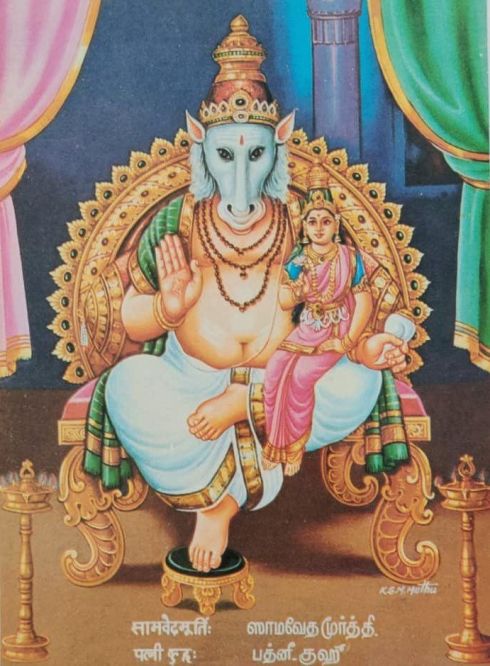









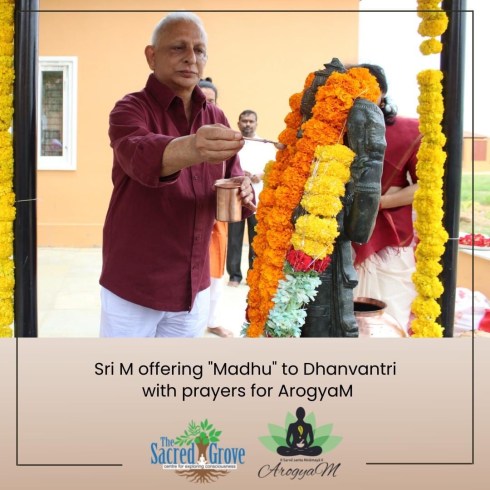





 A Few Good Things
Recent Comments