Archive | Daily Life RSS feed for this section

Axis Bank & Axis Direct Sites – Poor User Interface

24 Sep

We often see award ceremonies for best Banks from ET / Business Standard / Business India etc. Happy CEO’s gloating over their trophies ( which in most cases is linked to the ad spends you have made with that media group). I wish there would be an award for Online Bank Sites on ease of User Design / interface. I am confident that if there were one such award the bank that would win the LAST price for being the worst designed site would be Axis Bank & Axis Direct. 

Axis-Direct

Online Interface design for financial institutions have been happening for over 15 years. I remember how easy it was to use Datek Online in the US in 1999. Wellsfargo, Washinton Mutual in US and even Citibank and Stanchart in India have excellent intuitive UI design.

In addition to color, layout, font and clutter the two basic rules for website design are

1. How many clicks to get your job done

2. How prominent is my Call to Action

If I evaluate the Axis Bank and Axis Direct sites on these two parameters they fare very poorly.

Lets take the simple job of logging into http://www.axis.com – you want to see your balance. In most global banks that would be one click. the login page would be visible on the home page. In Axis bank its 5 Clicks.

1. http://www.axisbank.com – 2. Click on Login in a  cluttered home page where the CTA of Login is barely visible – 3. You land at a page that says imp information and has the login button again saying continue to login – 4. You land at help and support and how Axis bank.com is now available for Mac users & Continue to Login – 5. Finally you come to the secure login page where you can enter your login credentials

Painful? But thats Axis Bank and its incredibly poor UI design. I wonder who designed this website. But your problem doesn’t end there. In most sites including banks you can customise your login credentials. In Axis Bank its your Cust ID thats a 9 digit number which is difficult to remember. Most people would have their logins to all their favourite sites common – its easy to remember. Trying to remember the cust ID for Axis Bank is a pain – so every time you need to log in you need to check back on a file / folder where you may have written this number.

There are many transaction – which requires you to enter your Cust ID even if you have logged in with it. You have a Transaction password but in most cases you need to do the Transaction Password and the OTP that comes by phone. Overall very messy – the folks in the bank say its RBI regulation – but I am surprised that Citibank , Stanchart and most MNC banks operating in India under RBI guidelines don’t have this level of mess.

I am stopping here on Axis bank – but there is lots more to talk about. The site is begging for an average UI designer to take it up and clean it – I hope someone from Axis Bank management sees this blog and gets on the the job fast.

Lets move on top Axis Direct the trading site which even beats the Axis bank site. The home page is a clutter with no clear CTA, but if we can live with that lets see the effort to do some basic tasks.

View your Portfolio – thats the basic you want to do and see whats the gain / loss in your portfolio. Its 6 steps to get there after crossing many Ads

1. http://www.axisdirect.com – 2. login – 3. My Portfolio – 4. Equity – 5. Detailed View – 6. Instrument Equity . And once you finally land on the equity page there is no way for you to buy or sell the stocks that you see listed there. Normally there would be a simple button next to the equity in the Portfolio page saying Trade. But that common sense does not exist with Axis Direct.

Lets look at a few other examples and how difficulties to get to something as basic as seeing your Profit & Loss or your Trade book history. All of which is needed to determine your Tax Liability. The list below may look simple now – but the site is so poor on intuition that it took me hrs and multiple trials before I was able to figure this out

To check Derivatives Profit and loss: My portfolio>> Derivatives>> Portfolio analysis>> Tax Implications on my Derivative Portfolio.

To check Equity Profit and loss: My portfolio >> Equity>> Portfolio analysis>> Tax Implications on my Equity Portfolio.

To check Derivatives Profit and loss: My portfolio>> Derivatives>> Portfolio analysis>> Tax Implications on my Derivative Portfolio.

For Mutual fund Profit and loss: My portfolio >> MF >> Portfolio analysis>> Tax Implication for my Mutual fund portfolio.

Getting to Your Trade Book : Step 1: Login http://www.axisdirect.in 
> Step 2: Click on Trading >> History >> Trade book.

 Step 3: Select Equity trade book.

 Step 4: Select date ‘From and To’.
 Step 5: Click on ‘view report’.

India is known for its software design expertise. But examples like this clearly show why we are an outsourcing hub and not a design centre for products. User Interface, aesthetics, testing are all areas that are way down on our priority list. We just want to get the job done and say – we also have a website, so what if its the worst website in the country – who cares.

If Axis bank has a SEO / SEM web Marketing department – I am sure someone will pick this up and forward it to their MD. I hope very soon I can see a better site with better UI capability.

Buying a new Flat in Bangalore ? 8 Points to Check Out

12 Sep

Real estate in Bangalore has given excellent returns since 2000. And with Acche Din promised the near future looks bright. If you buy at pre launch from a good builder at a good location, chances are that you can see  75 – 100% appreciation in 4 – 5 years. However given the lack of regulation and rules the journey can be frustrating and challenging at times. Here are some pointers that you need to be aware of.

Let me start with a real life case. I booked a flight in Nov 2010 with a premium builder ( top 3 in Bangalore). It was a good location – on the main road, a metro station was supposed to open 100m away and a large Mall was also planned adjacent to the complex. The rate at Rs 3100/sft (pre launch) was great and with a staggered payment over  30 months and possession in Oct 2013 – it sounded like a great deal.

elevation

I am yet to get possession but I still think its a great deal – my investment has appreciated almost 100% , the flats are now selling at ~ Rs 6000/-sft and I am sure that in the next few years this will become 8 – 9000/-sft. But not everyone who bought at a later date are singing happy tunes. Lets look at some of the challenges of buyers in large complexes with 2000 – 3000 flats.

1. Density of Population 

This complex spread across 15 acres will have about 3000 flats. On an average 4 people / flat i.e. 12,000 people in 14 acres.

1 Sq Km = 247 Acres. So 14 Acres = 0.05 Sq Km. With 12,000 people in 0.05 Sq Km that would make it one of the most densest complexes in the country or the world. I did not do this math when I bought my flat. Initially the builder had promised large flats , later there were more 2 BHK and the no of floors went from 18 – 20 – 25 floors adding more flats and people.

Be mentally prepared for this – what you see in your prelaunch brochure is indicative and not the final.

2. Scale of Investment 

The first flat was sold for Rs 3000/- sft , the last one at Rs 6000/-sft . lets take the median price as Rs 4500/- sft. Flat sizes vary from 1200 – 2500 sft , again lets take the average size of a flat as ~ 1500 sft . Across 3000 flats the total super built up area sold is 4.5 million Sft. At Rs 4500/- sft the revenue earned by the builder is Rs 20250 Mn – 2025 Crores (337.5 Mn Dollars)

Thats a colossal investment – something that would make ET headlines – and we see at least 3 – 4 such projects getting launched in Bangalore every year. A company running this investment needs to have accountability/checks and balances /some Government control thru a regulator – sadly most of this doesn’t exist.

Even a vegetable trader make a 20% margin in Business – chances ares that the real estate majors make 3o – 40% margin , thats a 750 Crore profiit from a project of this size. Now you know why builders and politicians are best buddies.

3. Advance Payment 

This builder like many others had a Pre EMI scheme and collected the money  100% advance from many  gullible buyers. Others got a 10% discount for paying upfront. All this is great if the project is completed in the committed time. However in most cases the project delays are from 1 – 3 years. (Bangalore is better – in Delhi the delays can be 5 years +) How leading Banks like HDFC /Axis, SBI  entertain a scheme like this is baffling – but they do. The builder normally struggles to get a loan from a financial institution – by this scheme he conveniently funded himself 2000 Crores at a very low cost of funds . As the project gets delayed he has the seed money to fund other projects. So what if there is a delay here – the buyers have no choice.  I was lucky to be in Phase – 1 and my project is delayed by 15 – 18 months. But think of the people who bought in Phase 2 and 24 months after paying 100% money are yet to see the excavation work start. Not a happy feeling.

Learning – Never pay a Builder 100% advance, always pay as per structural progress, avoid the Pre EMI scheme which looks so attractive.

4. Structural Modifications 

Be prepared to see modifications. The brochure always says indicative drawings. What changes most commonly are two things

a) Roof height comes down to accommodate more floors ( from 11 – 12 feet ceiling height 10 years back they are down to 9 feet these days)

b) What are shown as stand alone buildings get merged. A stand alone multi-storeyed building needs two staircases from a fire escape ruling. By communing multiple building in one long wall like structure you can eliminate 1 staircase / building and save sft to build more flats. yes its cramped and results in less sunlight but who cares . The blocks are not connected internally and the only fire escape solutions is from the roof of one block to the other.

5. Contract & Undivided Share of Land 

The contracts are always one sided. You just have to sign on the dotted line. Most contracts do not even mention the undivided share of the land that is due to you. This is because the developer doesn’t know on day 1 how many flats will be built, what will be their size. In large projects the building comes in phases and the design and size of the flats vary basis demand and market conditions.

So what happens is that at the time of registration you get land based on the Plinth area of the building. The total Plinth area of all the buildings is normally not even 50% of the total complex area. Who owns the balance land ? The Builder doesn’t – since he is a developer. The land is always owned by a 3rd party. What if the land owner at a later date comes and stake claim ? Difficult to find answers to such simple logical questions.

The contract mentions a nominal delay penalty  (3 – 5 Rs / sft / Month) – thats less than Rs 7500/- for a 2500 sft flat. Even that is not paid on the 1st month of delay – but the builder says he will pay in final settlement. At the same time the contract does have a clause on cost escalation which the builder can invoke anytime.

6. Club House and Common amenities 

As the building develops the size and facilities of common amenities continue to shrink. rarely will you get the promised glamorous club house at the time of possession ( delayed possession) – the Club House will happen slowly as other phases construction starts. So in a 14 acre project – when you get your Phase – 1 flat , there is construction work and noise all around you for the next 5 years.

3000 Flats , 12,000 residents – have to make do with 1 swimming pool , 1 tennis court and 1 TT table. Thats what you have even in a 200 flat apartment complex. Get ready to reserve your play slot 1 week in advance.

7. Maintenance 

Most builders maintain the complex for the 1st 3 years. Post that they hand over to the community. I shudder to think how it will be to form a  management Committee in a  complex of 12,000 Indians. We struggle to get one going in a complex of 124 flats. How will one treasurer collect the monthly maintenance ? What if people don’t pay ? Are there large established 3rd party companies that can maintain complex of this with SLA’s.

8. How to protest 

Its almost impossible for the buyers to get together and stage a strong protest. For starters nobody knows his neighbour. Even if you get a Yahoo Group started – there is a lot of noise but little action. Leadership is a rare quality in India. Everyone is scared of getting over aggressive – the builder can always hold back your registration or penalise you with the worst parking lot.  Filing a case or going to the consumer court to protest is not an option – unless you are a very high profile buyer with strong connections (One Bangalore West) – so you just pray and wait. CREDAI , State Government , Builder Regulator , Agencies giving FAA ratings , Banks – all are not a partner to help you – they are all agencies just in name.

But inspire of all this people still flock to buy flats. With the top 3 builders you know that even if you get 80% of what was promised with a  2 year delay – you are still on a hot property with decent appreciation and a good community. So you are OK to look the other side and forget the pain and agony.

My only suggestion is – maybe we should be careful of the mega projects and look for complexes in the 250 – 500 flats range. Less complexity, faster completion, easier to maintain.

What drives Success ? Yesterday, Today & Tomorrow

4 Sep

A friend yesterday asked me a simple Question  – “What are the skills needed for a teenager today to be successful in life?”  –  My first response was quick and simple – aligning success to the Corporate world  – Be a specialist , Make your presence felt – Build your BRAND – Communicate right , Adapt , Be ready to learn and unlearn and integrate technology as part of your day to day life . Last but  not  the least learn to be a tactical diplomatic conformist – dissent is no longer the voice of progress.  But then as  I thought thru this for 24 hrs and started peeling the onion a totally different set of perspectives started to emerge.

The first question I asked myself  – How do you define Success ? The easiest answer is the materialistic answer – Being successful in todays world is Being Rich, Famous and powerful. A good job , managing a large team , a big house , International Holidays , No Debts, Large saving in the bank  and a good education . Maybe a powerful job like a politician. (Remember this is defining Success not Happiness)

Success

Thats the path which we normally take –  most parents in India would say that if you get to an Harvard – MIT – IIT – IIM….  chances are that you are on the right track and all set for a successful career and hence a successful life.

If you do a Google search on “Traits of successful people ” – its easy to find lists that include the following attributes as the key to Success – Resilience, Honesty, Time Management, Courage , Passion , Vision , Adaptability , Creating Value, Drive , Ambition  ….. etc

When everyone knows this Track and everyone wants to be successful – The Question I ask is why do only some people have these qualities and why is it that only a very few % less than 1% make it to the hallowed portals of Ivy League Colleges and then hop onto the so called Successful league.

WhyNotMe1

To answer this question – let me reference a recent dinner meeting I had with Ishani – a colleague from Durgapur –  the small town where we grew up. We lived in ABL – a model township. The officers quarters had about 100 Flats/Bungalows. Ishani was an encyclopaedia and knew details of almost every boy & girl who had passed out of ABL from 1975 to 1990. Across these 15 years about 100 Kids would have completed their class 10 . It was amazing to observe that almost 90% of them could be termed as very successful. More than 50% were in good jobs outside of India and the remaining doing very well in the country.

How could a small township generate such stupendous success demographics? What were the Ingredients? How could this work not just for one year but for 15 years at a stretch ? Could the answer for what makes you Successful lie here ?

And its not just ABL the above phenomena can be attributed to BARC Colony in Chembur, an IIT Campus where the kids of the staff do so well , and large colony like TISCO / TELCO etc.

Key Ingredients from these ecosystems ( Like ABL Township) that could be the defining Criteria for Success  

I was able to quickly identify 4 key Ingredients that could possible be the defining criteria on how the Kids from here had a great start

  • All parents were highly educated – Engineers and top notch professionals from good colleges and schools  – GREAT GENES
  • The two schools in town St Xaviers and Mount Carmel – ICSE were best in Class – Good faculty, good environment , Good Syllabus – GOOD SCHOOL
  • Township life was perfect to develop the all rounder – Sports , Plays , Public Speaking – there was always an opportunity to get the sporty or creative juices out – EXTRA CURRICULAR ACTIVITIES
  • Being a small group people interactions was high, bonding was high, it felt like an extended family – GOOD COMMUNITY

The formative years are so critical and getting an excellent grounding from birth to Age 16 with a  good school and a good community , backed with the right Genes made all the difference for this group of Kids . Of course you needed to work hard – but the community and peer pressure and school ensured that part happened.

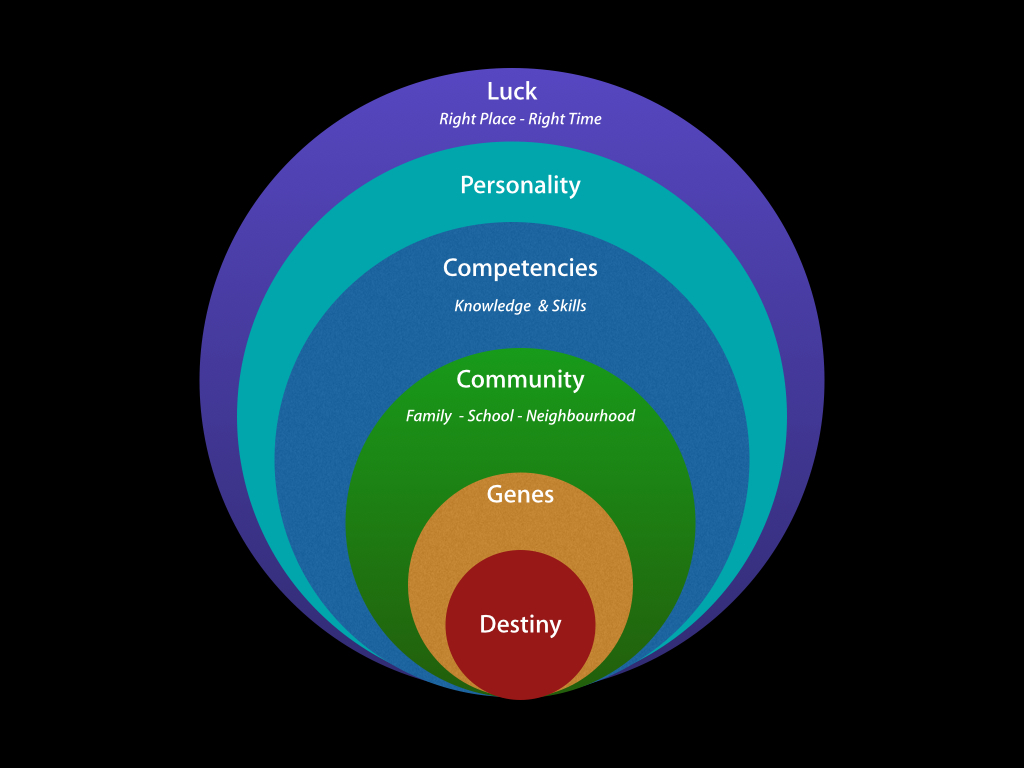
But is that all – Basis this I developed a very simple model to define the key elements of success

Success copy.001

At the root of everything is Destiny – why were these 100 Kids born in that community, getting all the favourable Tailwinds to succeed. Why did the balance 10% not take off ? Why were there some cases of  two children born in the same family – One taking off to a very successful career and the other falling back down the way ? Why did some have a slow start but accelerate later ? Why were some doing so well – suddenly fall back ? I would argue that at the root of everything is DESTINY. We may all say that we are self made men – but then the seed with which we are born has a significant part to play on which tree we grow up to be .

Destiny – Genes – Community – School are the Basics that gets you started with a great foundation. Then you build your competencies and skills thru college and work. And here the hard work, perseverance pays off as you polish your skills and get better with age.

And then you have another block called the  Personality Trait on which you may not have much control. This may be linked to you as an Individual. The personality trait some Psychologists argue stays with you from birth to death – you can works towards modifying them … a little but the personality is YOU and cannot be modified totally. Like Destiny you may have little control over them. You may at best know your Personality Trait and operate in an environment conducive to that.

The 5 Common Personality Traits 

  • Openness refers to traits such as how inclined someone is to conform to societal or cultural norms, how concretely or abstractly they think about things, and how open or resistant someone is to change. A person who is a creative thinker and always looking for ways to do things better would likely score high on measures of openness
  • Conscientiousness has to do with a person’s degree of organization, level of discipline, and how prone he or she is to taking risks. The college student who never misses a class and has a 4.0 GPA would probably prove to have a high degree of conscientiousness as measured on a personality assessment
  • Extraversion is a personality characteristic that describes things like how social a person is, or how warm and loving they tend to be. Extraverts are people who would typically prefer to go out to a party with lots of friends as opposed to stay in and watch a movie with one or two friends
  • Agreeableness takes into account how kind, dependable, and cooperative a person is. People who score high on scales of agreeableness are typically more interested in doing things for the common good as opposed to fulfilling their own self-interests
  • Neuroticism is a personality characteristic that describes how nervous or anxious a person tends to be, as well as, the degree of self-confidence and self-contentment he or she possess. Individuals who score high on levels of neuroticism will often be preoccupied with the ‘what ifs’ of life. They tend be worrisome and preoccupied with things that might not be within their control

And last but not the last – you may have everything going in your favour but Lady Luck may be missing. And without her – its difficult to find the magic called Success. With all your competencies, attitude, skills , personality Traits you still need to be at the right place at the right time to encash your cheque. If your Personality has A Positive attitude and some risk taking abilities that beckons Lady Luck faster – but most of the time its a wave that sweeps a generation to success. We had the baby boomers in the US and we in India were a lucky generation – thanks to the economy boom and 7% + GDP Growth rate since the 1990’s. We have hardly seen war or unrest. And with a high energy PM promising Acche Din – lets just hope that lady luck continues to smile on us for ten more years and see us thru our productive phase of this life.

So what are the levers that you have ?  Destiny, Genes & Luck are out of your control. You really can’t choose what community and school you will study in – thats your parents call. Yes you can work hard and get into a good college and develop the right set of Competencies all across your career to succeed. And knowing your personality traits strengths and weakness – work on some visible areas of weakness.

So is this the one formulae for Success ? Of course not. You will always have the Ramanajuam’s and Dr Abdul Kalam growing up to global brilliance after studying under a lamp post in a small village with no school or infrastructure. But these are exceptions and not the norm.

The huge advantage that some kids get – will go a long way in helping them get ahead in the race. But how they capitalise on it remains to be seen. Sadly most of them don’t see the advantage they have and let complacency seep in. Is that laziness or Destiny – I don’t know !

Good Monthly Pension Scheme for Retired People

28 Aug

Government of India in the Union Budget 2014-2015, announced the revival of Varishtha Pension Bima Yojana. Excerpts from budget speech by Honrable Finance Minister are, “NDA Government during its last term in office had introduced the Varishtha Pension Bima Yojana (VPBY) as a pension scheme for senior citizens. Under the scheme a total number of 3.16 lakh annuitants are being benefited and corpus amounts to Rs.6,095 Crore. I propose to revive the scheme for a limited period from 15th August 2014 to 14th August 2015 for the benefit of citizens aged 60 years and above“. LIC of India has been given the sole privilege to operate this scheme.

https://www.licindia.in/VARISHTHA_PENSION_BIMA_YOJANA_benefits.html

Highlights of the scheme 

1. Valid for people above the Age of 60

2. Maximum Monthly Pension is Rs 5,000 against a 1 time premium of Rs 6,66,665.

3. Post life of Policy Holder the principal will be transferred to nominee.

4. After 15 Years Policy can be surrendered – redemption same as purchase price

5. No redemption possible before 15 years (Exception for critical Illness)

6. After 3 years – Loan can be availed unto 75% of policy value

7. Monthly Pension is Taxable

8. Limited to One pension / Family

9. Scheme is open for a limited time of 1 year , closes Aug 2015

10. How is scheme better than FD ?

a) FD Interest rates for Sr citizens is 9.5% for greater than 1 year tenure.

b) However bank Interest rates may fluctuate during life based on interest cycle – in case of this policy this interest rate is fixed during the entire life of policy holder 

c) FD Liquidity is better than LIC

d) LIC Scheme is subject to Service Tax

e) Interest from both schemes are Taxable – if  person is in Taxable limit

POPFLATION – Sky High Inflation due to Population, Lifestyle & Migration

29 Jul

A few events in the last few weeks triggered me to write this Blog.

1. I have stopped buying vegetables and Grocery since my dad came to stay with us 18 months back. Last week I happened to step out to buy veggies on a Sat. I packed my two bags with the usual items for a week and gave the vendor Rs 300 ( 18 months back the cost for this would have been about 275 – 280 Rs) – he started at me and said the total cost was Rs 550 – thats almost a 100% increase in 18 months.

2. After the Veggies I went to buy Rice. I clearly recollect buying good quality Sona Masuri rice for Rs 36/- Kg 18 months back. Thats now Rs 56/- . Thats a 75% increase.

3. This Sun I visited my aunt after her Cataract operation. I enquired about the cost – Rs 78,000 for two eyes. In 1980 my Grandmother had got it done for Rs 2000, in 2005 my dad got it done for Rs 25,000 and 5 years back my mother had her Cataract done for Rs 50,000. Inflation for Cataract operation is more than 25% YoY.

4. 3 Years back we had agreed on withdrawing a certain amount of  cash every month for Maid salary , Misc expenses etc. Last six months I have observed that by the 15th we are running out of cash and withdrawing again. We went back to the drawing board and found that our monthly expenses have more than doubled in the last 3 years.

Don’t believe the Government when they say that Inflation is 8%. Its not. The only items that have got cheaper in the last 25 years have been PC’s ( In 1992 a PC AT, 1MB,  40 MB with a B&W Monitor was 40K , Today you can get a dual core High End Laptop 50X more powerful for the same price)

Why is this happening – its more than the UPA Government messing up for the last 10 Years. Lets look at some data.

Guess the human population in 1800? Just 1Bn. From AD 1 to AD 1800 it rose slowly and steadily from 100M to 1 Bn – in 1800 years. By 1930 – in the next 130 years it doubled to 2Bn, and in 30 years from there it became 3Bn – since then we have been adding a Bn people on earth every 10 – 12 years. Thats colossal and scary.  The question to be answered is what triggered this growth from the mid 1800’s ?

J_curve_graph

One trend I spotted was the plethora of inventions that happened between 1850 & 1900. Those 50 years specifically and the 19th Century could well go down in History as the era with the most revolutionary inventions. The Steam Engine , Electricity , Pasteurisation, Telephone , Plastic , Safety Match , Dynamite, Motor Vechile (For the full list see Annexure 1 at the end of the blog). These inventions got the Industrial Revolution started , quality of life improved , diseases were eradicated , food shortages became history and mankind has since then never looked back as humanity moved from survival – necessity – comfort – luxury. Finally the hand combat wars were over as we moved to Smart Wars that could decimate cities, but by and large civilian population was safe from the marauding enemies.

We see this trend even in India. In 1850 our population was less than 250M , during Independence we were almost 330M and 50 years later we are still growing at 1.2 B threatening to overtake China in the next 20 years.


popgrow

More people , more needs, more food – its a simple demand supply equation. As countries progress and per Capita income grows your nutrition basket has a higher mix of Vegetable & Proteins. Mother Earth had the resources to serve a 1B people , she is struggling to cater to the bulging needs of 7.2Bn people and may well collapse when we reach 10Bn .  We see this in India – food production has started going down or is flat. The green revolution delivered non linear growth in the 60’s & 70’s but has peaked out. GM Crops may be the only solution – but the side effects are being hotly debated. Add to this farmers see more value in growing vegetables , exotic fruits which deliver better returns than on crops like Rice and Wheat

production-price1_032313032840

Add to this the trend of City Migration. Poverty, dependance on Rains and lack of basic amenities is moving people from the Villages to the Cities in hordes. We already see that the Urban Population is 30% ( thats up from the < 10% in 1960) – as the Cities explode Inflation rises. Land prices have shot thru the roof  and the cost of maintaining a family with decent lifestyle in NCR , Mumbai or Bangalore is at par with the developed western world.

20120929_SRC858

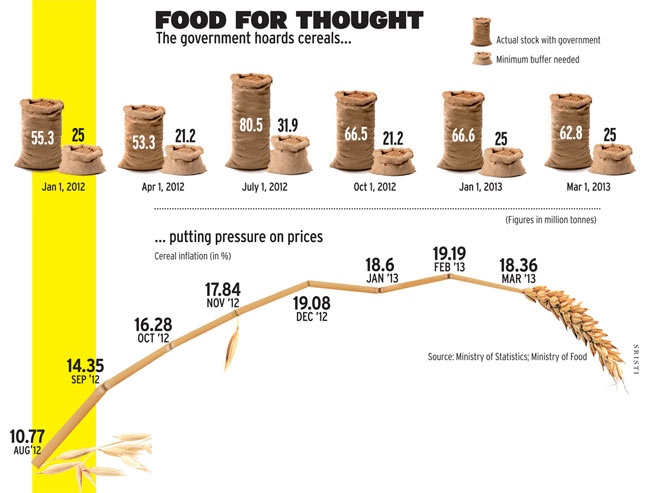
The formed food minister in charge for 10 years did not help – he piled up food in FCI to rot rather than let it go in the free market.

food-for-thought_050713055803

And if the Modi Sarkar ushers in Acche Din and the economy starts growing at 8 – 10% , thats going to give a further fillip to Inflation and cost rise. I shudder to think what will be the cost of undergoing a Cataract operation 30 years from now when I am 75 years old – it could be well over Rs 10 Lacs  – thats 20 Lacs for me and my wife. I don’t think I even thought about this and included this in my savings basket. Add a hearing Aid at 10 Lacs + ( Its already 1 Lac). The Bhindi and Beans thats touch 100+ Rs a Kg now could well be in excess of Rs 1000/- a Kg .  These are the necessities you need for survival.

So whats the Solution ?

Will my flat that appreciate 5 times in the last ten years give me value 30 years from now – or will it be a dead investment ? Will the Stock Market investments scale with these expense – or should we start buying large land banks in Tier 3 Cities and pray that they will keep up in cost with Inflation ?

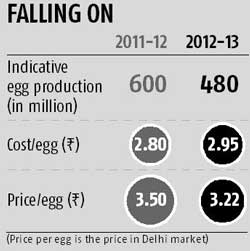
Maybe we eat more Eggs – Roti and Egg Bhurji can be a meal for Less than Rs 30/- for a family of 4 . But Rice , Dal , Curry , Curd can be expensive . So follow the advice of the ad and eat more eggs. Thats one commodity where the pice though increasing seems reasonable ( Current price for 1 Egg is Rs 4/-)

121312_36

Don’t worry about investing in your daughter’s MBBS & MD education. A 1 Cr Donation  to a good medical college can be earned back in 1 week ( If 20 years from now Cataract Operations continue their inflation and touch 10 Lacs / person). Now you need to laud the vision of Chidambaram and Son Karti for setting up Vasan eye care – that business probably delivers better ROE than Infosys and Wipro.

Mamta & Mulayam and Kejriwal should stop complaining about the  train hike and focus their attention on bigger things – like why Beans went from Rs 50 to Rs 120/- in 3 months or why the annual rate of inflation for a Cataract operation is 25% – I wish they would , but I know they won’t !

I don’t know the answer – all I know is that my retirement plans at age 45 stand cancelled. But I am really worried and you should be too. The inventions of 1850 – 1900 era and the world development trajectory have really screwed us badly!  Maybe capitalism wasn’t so good after all. Maybe Karl Marx should arise. We had a great run from 1992 till now but as the middle ages hit us and we look upon the second half of our life (Which is not going to be as productive as the last 25 ) a sense of deep concern sets in.  Lets hope it all works out well.

Annexure – 1 : List of inventions that happened between 1850 & 1900 

1862
• Dr. Richard Gatling patents the machine gun.
• Alexander Parkes invents the first man-made plastic

1866
• Alfred Nobel invents dynamite.
• J. Osterhoudt patents the tin can with a key opener.
• Englishmen Robert Whitehead invents a torpedo.

1867
• Christopher Scholes invents the first practical and modern
typewriter.

1868
• Robert Mushet invents tungsten steel.
• J P Knight invents traffic lights.
1872
• J.S. Risdon patents the metal windmill.
• A.M. Ward issues the first mail-order catalog.

1873
• Joseph Glidden invents barbed wire.

1876
• Alexander Graham Bell patents the telephone.

1880
• The British Perforated Paper Company invents a form of
toilet paper.

• In 1881 Alexander Graham Bell invents the first crude
metal detector and David Houston patents the roll film
for cameras.
45

1884
• Lewis Edson Waterman invents the first practical fountain
pen.
• Charles Parson patents the steam turbine.

1885
• Harim Maxim invents the machine gun.
• Karl Benz invents the first practical automobile to be
powered by an internal-combustion engine.
• Gottlieb Daimler invents the first gas-engined motorcycle.

1886
• Josephine Cochrane invents the dishwasher.
• Gottlieb Daimler builds the world’s first
four-wheeled motor vehicle.
• John Pemberton invents Coca Cola.
1887

• German, Heinrich Hertz invents radar.
• Emile Berliner invents the gramophone.
• F.E. Muller and Adolph Fick invent the first wearable
contact lenses.

1888
• Marvin Stone patents the spiral winding process to
manufacture the first paper drinking straws.
• John Boyd Dunlop patents a commercially successful
pneumatic tire.
• Nikola Tesla invents the AC motor and transformer.

1891
• Jesse W. Reno invents the escalator.

1892
• Rudolf Diesel invents the diesel-fueled internal
combustion engine.
• Sir James Dewar invents the Dewar flask or vacuum flask.

1893
• American, W.L. Judson invents the zipper.

1899
• J.S. Thurman patents the motor-driven vacuum cleaner.

Back to College – Surat Transformed

11 Jul

What a transformation in 22 years. Both our college – REC Surat (Now NIT Surat) and the city has transformed beyond expectations.  It feels like yesterday in 1992 when the final results came and we were all overjoyed to have completed our engineering degrees. There was always the fear of what would happen in FM6 – that was one terror of a paper but the good Dr Khajuria had ensured that there was a 100% pass – even if many did not deserve to pass.

The story of our college starts with the Icchanath (Shiva) temple at the main gate. The good lord has heard the fervent prayers of most students and ensured that the elusive 36 always happened and his aura kept the draconian ATKT’s  away . The temple is still there but the “thela wala’s” selling Sugarcane Juice , Bread Pakoda and Pan are all gone. When I think of the Bread Pakoda shop I think of the dimunitive Nara and how he managed 4 years of snacks at that joint without paying a penny during the crowded breaks.

IMG_3094

As you enter the college the admin department looks the same, faced by green lawns and lovely gardens. But you see an imposing building in the left. Thats the new girls hostel – a massive structure that has replaced the small building that could house 20 girls in the midst of the staff quarters. Lucky guys –  the male female ratio’s seem to be getting corrected in college finally.

IMG_3093

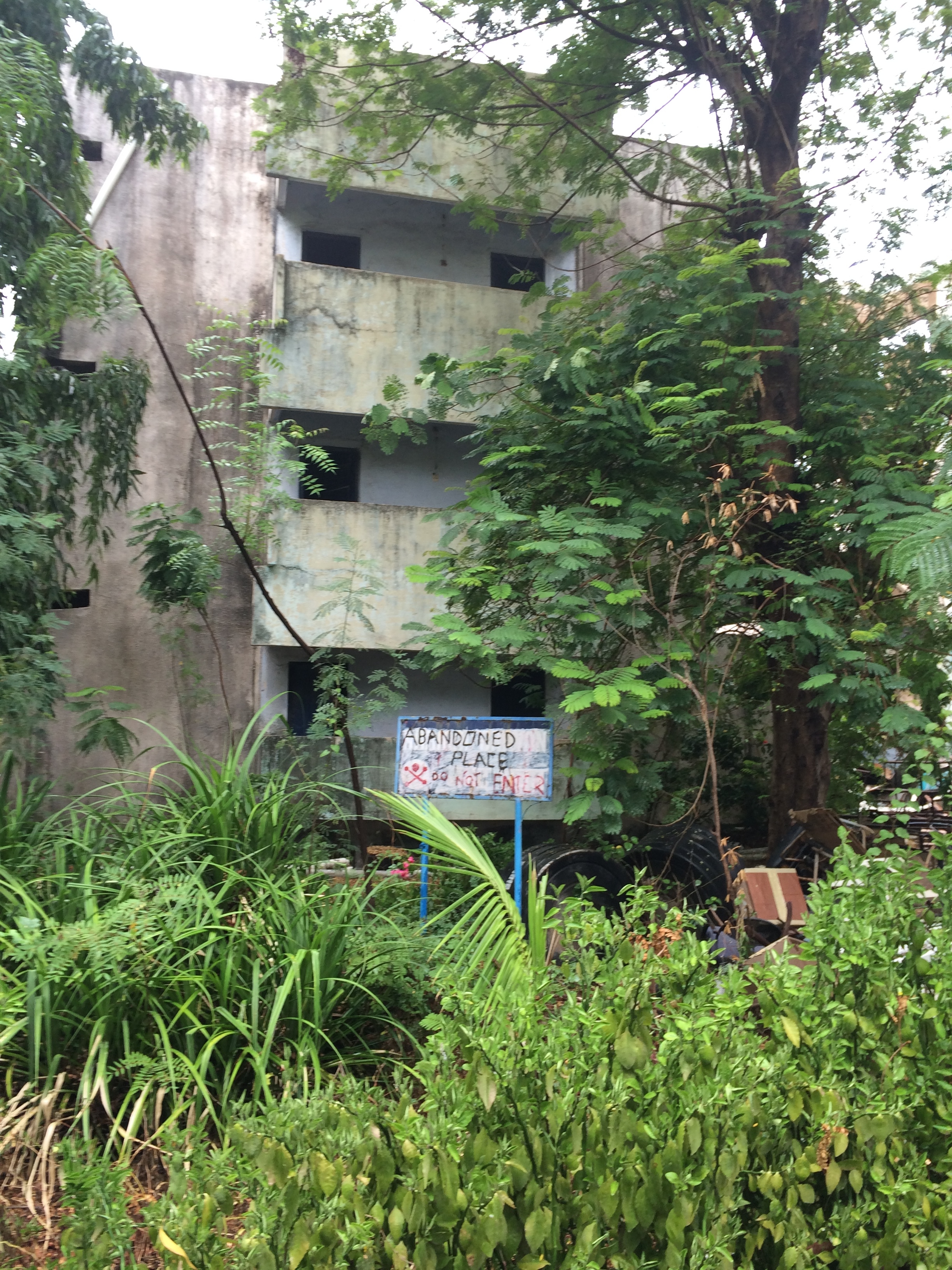
Not just the girls hostels – all the other hostels are also revamped. The old ones are abandoned or demolished. Picture below is of the old Hostel 2 Sarabhai Bhaban ( I Think) – now abandoned.

IMG_3087

Hostel 1 is now a fancy building with lifts. Rooms are 2 seaters and it looks like a fancy apartment complex. This massive structure accommodates all of the old Hostel 1,2 & 3 and more.

IMG_3086

IMG_3085

Shanker’s canteen no longer exists and as you walk towards Gajjar Bhavan you see the new Gajjar Bhavan – another large impressive building that stretches all along the road

83697262

Walking down the road the Physical education centre is still the same and so is the medical centre. Gandhi Bhavan is also abandoned and a new hostel with A/C rooms has come in its place. Looks like a lot of MTech / Phd students – many with family in campus.

IMG_3091

Our Mech department – No Change  and the labs still are the same – not many additions on the infrastructure side. I see the list of professors and a few names like Professor H.B.Naik still continue to be there. The college has added new departments in Chemical engineering.

IMG_3089

The canteen was empty but still serving Cutting Chai, Poha, Mitha Toast and Omlette. Inflation has caught on and the 50 Paisa cutting is now Rs 7/-. The library is still the same building. Right behind the Library is a new hostel complex coming up.  It was wonderful seeing how the college has transformed. I even spotted some peacocks in the campus.

Surat as a city has also transformed. The stretch from College to Dumas which was empty with small restaurants dotting both sides of the road has changed. This stretch and the university road stretch is full of apartments  and Malls. Its a broad 4 lane road that is being concretised.

surat505_121412010818

The city is full of flyovers – Athwa Gates, Textite Market, Adajan – all have their own large ones. Trafiic is busy but organised. You can see the Modi infrastructure charm in effect. The river looks clean and was flowing strong and vibrant along Chowpatty.

Surat

All is vibrant and shining in Surat. The only challenge was the airport. Surat Airport sucks. Our Spice jet flight to Mumbai was delayed by 3 hrs. The airport had no electricity for 3 hrs (This when I thought Gujarat had no power cuts even in the villages), toilets were stinking. With just 2 – 3 flights a day and AAI running the show – the Airport is a sorry sight. The only disappointment from my 1 day trip.

Its always a nostalgic trip to visit your college after many years. And the 1 hr I spent between 8 – 9 AM in the midst of a rushed 1 day business trip was well worth it.

North of the Narmada!

9 Jul

Some history facts from school days have stuck in my mind. One of them is the 634 AD victory of Pulakesin – II the great Chalukya King over Harshavardhan who ruled almost all of N India. A pitched battle was fought on the banks of the Narmada and Harsha lost. Since then the Narmada river has been a natural border between North &  South and a distinct culture, ethos and value system separates the two regions.

Chalukya_territories_lg

Rudyard Kipling in The Ballad of East & West says “East is East and West is West and never the twain shall meet“. I am going to extend this to the North & the South of India, and look at some interesting facts that differentiate the two.

I did a quick search on Google and found that since Independence almost 80% of the tenure of Finance Ministers in India have come from states that are below or along the Narmada (Bengal & Gujarat Included) – Chidambaram , Pranab Da, R.Venkatraman, C.S.Subramaniam, T.T.Krishnamachari, R.K.Shanmugam Shetty, S.B.Chavan, Y.B.Chavan, C.D.Deshmukh, Morarji Desai are some of the famous politicians who have held the post of Finance Misnister of india – all of them are from below the Narmada. ( the remaining 20% of the time we have had the Singh’s and Sinhas and Tiwari’s to name a few)

So is the case with the RBI Governors , here probably 90% of the tenure has been held by people from below the Narmada since independence – From the Current Raghuram Rajan to the formers – Subba Rao, Y.V.Reddy, C.Rangarajan, S.Jagannathan, H.V.R.Iyengar, M.Narasimhan, A.Ghosh, P.C.Bhattacharya , K.G.Amegaonkar and many more.

But the trend changes when you look at the Chief Justice of India, Chief of Army Staff and even Prime Ministers. Here people from North of the Narmada have brutally dominated in these posts since independence.

Lets analyse some more cases.

People of Indian origin or close linkage to India who have won the Nobel prize. 

Rabindranath Tagore, C. V. Raman, Amartya Sen, Hargobind Khorana, Subrahmanyan Chandrasekhar, Venkatraman Ramakrishnan and V.S.Naipul – Barring one again all are S Indians or Bengalis. Ramanujam the mathematical genius was also a S Indian and J.C.Bose the prolific inventor a Bengali.

Stamp

Since independence till the 70’s the IAS officer were predominantly Tamil Brahmins or Bengalis or Maharashtrians – and then reservation changed the game. Even today the largest no of CA’s come from the Chennai and Kolkatta centre. It so happens that the Kolkatta centre has started sending a lot of Marwari’s but yes birds of the same feather flock together – so a large number of Gujaratis, Jains and Marwaris have actually migrated to Chennai and Kolkatta.

Large Indian Software Companies and Indian MNC Heads 

CEO’s of almost the top Indian Software Companies were S.Indians (before Mr Sikka) but India Country Managers of most MNC’s are of  N Indian origin. The former needs scale and strategy and the latter is purely quarterly sales driven and the art of diplomacy to manage the masters. Nadella at the helm of MS is a S Indian and so was Krish Prabhu who was heading Alcatel many years back. Sundar Pichai the CEO of Google is also a South Indian.

Spiritual Saints 

Lets look at some Spiritual Giants – Shankara, Ramanuja, Ramana Maharishi, Shirdi Sai, Ramakarishna, Vivekananada, Sant Dynaneshwar, Sant Tukaram, Chaitanya Mahaprabhu, Raghavendra Swami…… almost all the names that are renowned in the spiritual world come from below the Naramada. And present day gurus or god men like Sai Baba, Sri Sri, Jaggi Vasudev (Yes we have Baba Ramdev from North and Nithyananda from the South  – but I guess they don’t fall in this league)

Ramakarishna, Vivekananada,

So the big Q – what makes this happen ?

Is it the Power of Rice? Yes Bengal,  T.Nadu and Andhra are predominantly Rice eaters and looking at the high % of Intellectuals and spiritual Gurus from these states one may reckon that this has something to do with the Power of Rice. And is it the  power of Wheat and Chicken that makes the Defence Chiefs  and the thick skinned politicians come largely from North of the Narmada.

Studying in a REC (Now NIT) I had the opportunity to observe three batches before me and after me – so a total of 7 batches of students across 4 years from every state in the country. Thats a large sample size for any survey analysis.

Three key observations I recollect from my College days

  • Diplomacy and aggression became more visible the more Up North you went from the Narmada. Trust Quotient went down.
  • Guys from the South and East tried to commit and deliver and there was a sense of guilt on going back on your commitment. There was no such remorse in students from the North – offence was the best form of defence for them. They were brutally thick skinned.
  • College Secretary post was always won by a N Indian but the Literary Committee secretary was always a Tamilian or Bengali.

In the 25 years I have worked in the Corporate world travelling all across India – I have tried to break the above logic but sadly I see it being true even today. Sure there are exceptions and I have a few N Indian friends who beat the stereotype totally – but thats more an exception than the norm. (And in S India you will find an A.Raja and N.Srinivasan) – but the big picture is clearer. A curd ricing eating S Indian symbolises – hard working, straightforward, not political and a Dilli Wala stands for ” Jugad, Smart Talk – and in a way an empty vessel that makes noise”

What makes North different? Is it the years of facing invaders at the borders and seeing your family, kith and kin slaughtered in front of you. Is  flexibility and adaptability an outcome of having to live under the rule of brutal invaders & Mughals for almost a 100o years ? I don’t know – but clearly there is a difference.

Yes the Idli has invaded the country, and Salwar Kameez is as popular in Tamil Nadu as Punjab but when it comes to genes and DNA the core is very different –  and I have no qualms in saying that  North is North and South is South and the twain shall never meet ideologically.


Soft Skills Training – An investment with ROI or a Robbery ?

27 Jun

I recently read an article by Rajeev Peshwaria in Forbes titled  ” The Great Training Robbery: Why the $60 Billion Investment In Leadership Development Is Not Working” .

The timing was right – we had just completed a bunch of training for our team and while everyone enjoyed the sessions the verdict on what its efficacy would be over the long run was debatable.

Clearly Corporate HR managers see dwindling value from Training investment. When I joined my first job in the early 90’s Induction Training was a 30 day residential affair. Today most companies say learn on the job after a 1/2 day induction. You can’t blame the HR folks – there is a linkage to this with attrition – and the CFO questions the ROI on the investment. In the 90’s of a batch of 30 inductees every year you probably lost 1 at the end of the year, today you may lose the whole batch in 6 months . So why be a Training academy is the question.  If you look at it from this aspect yes investment in Training does feel like a Training Robbery.

ROI

Lets look at the millions spent on Training mid and Sr management. People entrenched in the company in the mid 30’s or early 40’s. Most come with strong mindsets and getting them out of their mould itself is a big job. Many more come thinking this is my 6 monthly off day to get a break that HR has officially planned. There are hundreds of companies  evangelising content around Communication, Creative Thinking, Presentation Skills, Emotional Intelligence, Outbound Workshops on Team Building …….. and many many more. Most of these companies do a  good job. The content is brilliant, the Trainers do a great job and if you see the feedback form at the end of the session it almost always a WOW – but the Q is how long does this effect retain, is it practised, is there a change in habit – you need all this to show that the impact and ROI has happened.

Learning Pyramid

The standard learning pyramid says that training stickiness improves when the participant not just listens , but practises what he learns in real life. But the Q is how do you make that happen ?

In the last 6 months we have conducted two different set of programs by the same company and faculty (BlueChakra Talent – http://www.bluechakratalent.com, Faculty – Papiya Sarkar). The first program was for our team of Trainers – a motley group of  highly stressed out trainers who needed direction , advanced skills and tools to energise themselves.  The second program was for the sales team  on Communication tools to be effective in Negotiation & Objection handling. The content was customised and prepared after months of close discussions with Business and after talking to all the stakeholders. The delivery in both cases were by the same faculty and their facilitation skills were excellent – however one program was a HIT and is now on a journey that has changed the lives of the Trainers. On the second program for the sales team the verdict is still not out – but my feeling is that the halo effect will slowly diminish in a few months and all will be forgotten.

success-or-failure


There are 3 Things that made the 1st program for the Trainers successful

1. There was a NEED. The content was customised to that NEED. The team size was small and the approach was consultative and warm. It felt homely and comfortable to ask Q, clarify, reach out both during the program and after.

2. There was CONTINUITY. The first session had mixed feedback. Participant feedback ranged from this may not work  –  to I know it all. There was a sense of concern – on why this program, are we not good enough. But once we started doing this on a  quarterly basis the rhythm set in and people started seeing the value.

3. The COACH helped a lot and the lead Trainer was always there. The amazing content and tools would have gone down the drain if the coach from the company (Mentor Trainer) had not worked with each individual in the  3 months post the session to inculcate all the learnings. His patience and commitment made all the difference in making the learnings practicable and relevant. Once the participants practised and saw the improvements – it stuck, gave them the confidence to to do it more often till it became a HABIT.

The second program lacked a COACH. the sales managers were busy with their job and just worried about the targets. They could not spend time with the 25 + reportees they had on a  regular basis. HR was not involved – and even if involved could not have made an impact as this is a job of the line mangers to inculcate the learnings.

best-sports-coach-links

In summary – I don’t agree with the article in FORBES which says that Training is a Robbery. But if the organisation and the manager do not invest in making the Training Investment a Habit – then yes it will definitely be a investment down the drain. So to deliver value lets Train our managers to be good Coaches – because there are so many skills to be learnt and improved if we want our teams to succeed and grow and be relevant in the fast changing economy.


Turncoat Quotes on May 16th

23 Apr

Look out for these quotes from the famous turncoat politicians of India by May 16th lunch time.


Lalu-Prasad-Yadav


We are a democratic country. We have to go by what the people of the country  decide. The thumping majority for BJP and Modi Ji makes it clear that the people of the country do not hold him accountable for the  Gujarat Incident. With both the Supreme Court and the people of India giving Modi Ji a clean chit – who am I to question him ? The country has voted for Growth and an end to Corruption – the RJD will support him in his cause. My biggest issue was with JDU, now that they have been wiped out I am open to working with BJP towards making Bihar a prosperous and progressive state like Gujarat.


VBK-SHARAD_PAWAR_1621364f


I have always had high regard for Modi Ji. As the food minister I have seen how Gujarat has always been in the forefront of productivity. The NCP has the same agenda as Modi Ji of progress. To create jobs and ensure that the poor farmers of the country are included in the growth story. Gujarat and Maharasthra are twin states – we were actually one state at independence , I am very happy that finally someone from West India has become the Prime Minister. I did not contest this time. Its for Supriya and Ajit to decide. My daughter and the younger generation are looking forward for change and the country progressing rapidly. My best wishes to Modi Ji and he is always assured of our support for development.


23TH_MAYA_556672e

I am happy that finally an OBC has become the prime minister of this country. The grave injustice that has been done over the years will finally get resolved. The SP was always with the Congress , we were always against the policies of the UPA that was against the Dalits. I am confident that a OBC leader will be more considerate towards the needs of the poor and the downtrodden. I am confident that very soon we will throw out the inefficient gonda raj in UP and the BJP & BSP can form a strong government together.

Unknown


Our campaign is based on “Ma , Mati , Manush”. From Pranab Da to Chidambaram the UPA govt has not helped Bengal. The Left has messed up the state. Who has ruled the state since independence – its the Congress and the Left. They are responsible for this mess. My only priority is the progress of W Bengal. I have fought hard to become the CM and I want to deliver on my promise to my people. I need the support of the centre for this. If Modi Ji can help us to create jobs , and reduce our deficit – if he can give us a special package I am ready to support him.


jayalalitha1


TN and Gujarat are two of the most progressive states in the country. Both me and Modi Ji have brought about progress in-spite of the difficulties created by the UPA in the centre. We have shown how good capable administrators can run a state well. I have always been an admirer of the vision and development work of Mr Modi. The AIADMK is happy to support him – we need a friend at the centre to help us grow rapidly and meet the aspirations of the people.


26174


Telengana is a new state. We need to work closely with the Central Government to create a prosperous state and meet the dreams of our people. It has been a long march to creation of Telengana. The Congress party has promised many times and failed – it is finally with the support of the BJP that this state has happened. We owe our thanks to the support of BJP to make Telengana a reality. We now look forward to their support to make Telengana a model state like Gujarat.
And lastly Manish Tiwari and Kapil Sibal were out of country and not available for comment.

Nandan as MP – Right person at wrong place OR Wrong person at the wrong place ?

17 Mar

I recently saw a video on the legendary Karna. He was noble , a great warrior and known for his generosity. But greatness was not in his destiny since he made all the wrong Choices. When I look at the Bangalore South MP election to be fought between Nandan and Ananth Kumar I am reminded a little of the Karna effect.
Is Nandan the right choice ?  A successful CEO of a great company like Infosys – can he make things work for Bangalore ? Whats his track record in UID and Public Affairs ? How has he served Bangalore and the locality he lives in for so many years ? Lets look at  6 Facts and then decide if he can make an impact as an MP from Bangalore South.

1. Aadhar is not a one point KYC 

aadhaar

When UID was started there was a lot of hope. Here was the equivalent of India SSN. A one point contact  that would resolve all your KYC ( Know your customer) issues. Five Years later and 4000 Crores spent – sadly that dream is far from realised. Most people don’t know where to use the aadhar card. Banks / Credit card Companies / Land Registration etc  still insist on a PAN card and a Permanent address proof like your mobile bill or Drivers License or Passport. When you go to vote you need a Voter card and not the Aadhar. The vision that was promised by Nandan is far from reality.

2. Commitment – Is 5 Years good enough to set up an institution 

Is the UID chairman walking away from a  failed project ? If Metro Sreedharan and NDDB Kurien could spend a lifetime in setting up institutions why is Nandan walking away in 5 years from a project that could transfer this country but is yet to show any significant outcome. (He joined with a lot of fanfare in July 2009).  If you are passionate to the cause should you not have spent 10 more years making this a grand success and ensuring that the initial vision is delivered.

3. Supreme Court & PIL on AAdhar 

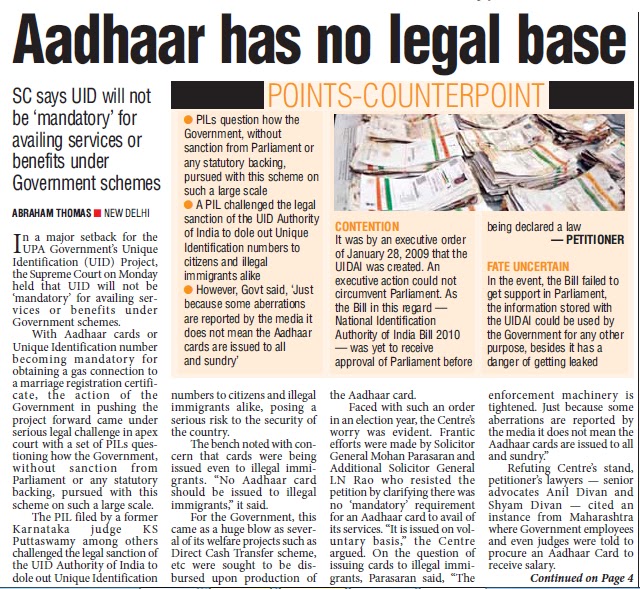
I took a 1/2 day off from office to link my Aadhar card with my HP Gas connection and Bank account. That was mandated – a few days later I was told that the program is being reversed. A lot of promise to make subsidy payments to the poor using Aadhar thereby saving on leakage has been announced but sadly not delivered. Ina  corporate you under commit and over deliver – but UID has overcommitted and under delivered. Early signs of a politician in making. There are many PIL’s filed against Aadhar on security of personal information, privacy , misuse – and many have questioned the constitutional validity. I recollect a Supreme Court judgement that it was not mandatory to have an Aadhar card for many transactions. Couldn’t this have been thought through in more detail before spending 4000 + crores.

ScreenShot014

If you struggle to run a Government institution with so much Govt support –  what can we expect from you as a MP ?

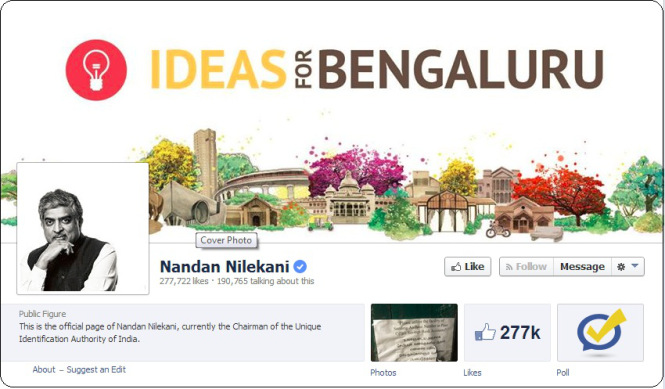
4.  Bangalore – Koramangla & Nandan 

The Facebook site Ideas for Bengaluru was started on Feb 19th with a nice post of visiting  beautiful lake / park in Sarjapur . Nandan has been living in Koramngala for many years. I am also a resident o Koramangla and don’t recollect any initiatives that he has taken  for the betterment of Koramngala in specific & Bangalore as a whole in so many years. There is an empty barren land a stones throw from his house near the Koramngala BDA complex. This could have been converted into a beautiful park many years back. I don’t recollect Nandan taking any initiative to get this done. For any action on Save Koramngala or Save Bangalore we actually see the other high profile Koramangla residents Rajeev Chandrashekrana and Kiran Mazumdar  being more active.

nandan-nilekani-for-bangalore

5. How can a MP from a scam tainted , beleaguered losing party help us ? 

After 10 years of paralysis and bringing the fast growing economy on its knees chances are that the scam ridden indecisive UPA is on its way out. Do you really want to vote for an MP from UPA ? How can he help ? Karnataka has always suffered because of different governments in Centre & State – at least lets have an MP who belongs to the ruling party. Common sense says that chances of development are better when the MP is aligned with the ruling Government.

6. Views & Ideologies 

I am not sure what Nadans views and ideologies are – on education, infrastructure, J&K , Women’s empowerment …. but when I see that he has suddenly started talking about reservations in Pvt Jobs that gets me worried. He had 20 years to do that in Infosys – wonder why he never tried it ? Does he believe in reservations or Merit ?  http://economictimes.indiatimes.com/et-now/daily/reservation-required-in-pvt-jobs-nandan-nilekani/videoshow/32026284.cms

Nandan may be a great individual. Successful , intelligent , great communicator , strategist all the positives we would like to see in a  leader. But like the legendary Karna he seems to have made the wrong choice and destiny can be cruel to him for making this error.