Archive | Travel RSS feed for this section

Somnath & Dwarka in 48 Hrs

21 Apr

Long before Amitabh Bachchan invited people to “Kuch din toh guzaro Gujarat mein” I have had a keen desire to visit Somnath. The 1st of the 12 great Jyotirlinga’s which is the symbol of eternal indestructible Shiva.

My perception was this remote corner of W India was a faraway land and getting there would be challenging. I was proved wrong. You can reach Somnath from Bangalore faster than driving to Wayanad / Kodaikanal from Bangalore.

This Blog will cover all the information you need to make this trip

  • How to reach Somnath / Dwarka in the shortest possible manner
  • Where to Stay & Local cab agency numbers
  • Planning your day and visiting the key sights

How to reach Somnath / Dwarka in the shortest possible manner

  • Rajkot is your entry point. 6E 6507 is a direct flight from Bangalore – Rajkot. Dep 11.35 AM, Arr 1.50 PM. (Jamnagar airport is closer but there are limited flights Via Mumbai and fares are expensive)
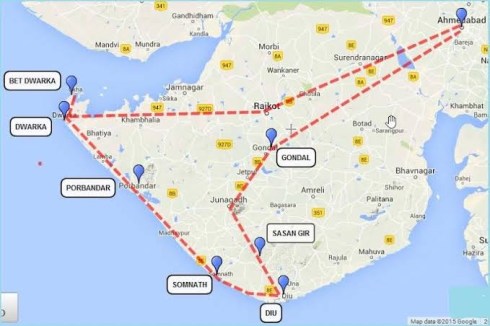
  • Rajkot – Somnath – Dwarka is almost an equilateral triangle. Rajkot – Somnath is 197 Km takes 3 ½ – 4 Hrs and Rajkot to Dwarka is 250 Km ~ 41/2 – 5 Hrs (Road is under construction in some parts).
  • If your flight lands on time you can be in Somnath before 6 PM.
  • If you are coming Via Ahmedabad, you can take the night train 22957 Ahd – Veeraval Express that departs Ahd at 10.10PM and reaches Veraval at 6AM. Veraval is 5 Km from Somnath. There are many trains from Ahd – Somnath / Veraval both at day & night.
  • Somnath to Dwarka is an excellent road of 250 Km that can be easily covered in 4 hrs including a breakfast stop enroute.
  • Rajkot – Bangalore 6E 6508 leaves Rajkot at 14.20 and lands at Bangalore at 16.35.
Where to stay and how to travel locally

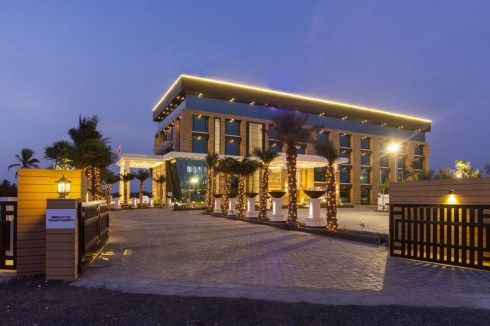
In Somnath stay at the Sarovar Portico. Lovely new hotel with spacious rooms, nice restaurant. Located close to the Somnath temple – 10 min drive. Sarovar Portico, Bypass Road, Prabhas Patan, Dist Gir, Somnath – 362268
Dwarka, you have many options –Hawthorne Suites & Lemon Tree are a little far from the main temple. Booking.com can help you with many options that are 1 Km from the main temple. Also check out a hotel that is centrally located and opening soon after renovation called Guruprerna. We had dinner at their restaurant Sharanam, and it was very good.

Hotel Guruprerna, Opp Bhadrakali Temple. Dwarka – 9427207612 / 8980724314

Cab pick-up at Rajkot airport or Somnath station

  • Hiren Sindhav – 87809 64411 (Rajkot Based)
  • Soyab – 8160554705 / 97148 71691 (Somnath Based)

Planning your day and visiting the key sights

SOMNATH

  • If you are driving from Rajkot to Somnath you may want to include Junagadh & Gir in your plan – it is on the way.
  • Our train from Ahd reached Veraval at 6 AM and we were in our room by 6.30 AM. Veraval is India’s largest Seafood processing & export centre. So be ready for a strong smell of fish as you drive to your hotel.
  • All the sights in Somnath can be easily covered in 1 day. We started our day at 8 AM and by 12.30 had covered all that was there to see

Main Somnath temple: 45 Min – 2 Hrs

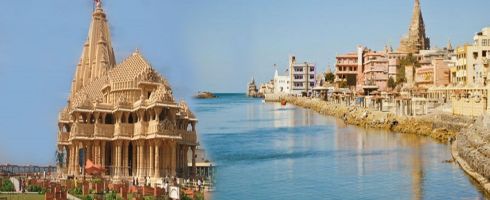
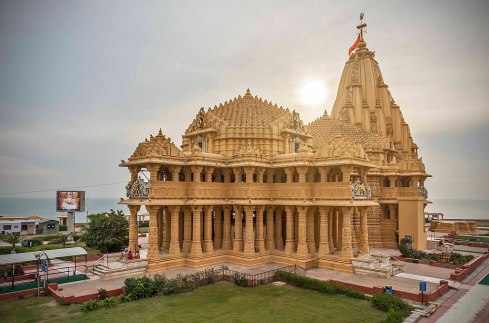
  • By the seashore this beautiful temple has a history of over 2000 years. Invaders and barbarian tyrants demolished and looted the temple again and again – but every time Somnath resurrected.
  • The origin of this Jyotirlinga is associated with the Moon God hence the name Somnath. It’s considered the 1st amongst the 12 Jyotirlingas. Auspicious to visit on Monday and a Full Moon night.
  • It’s not a large temple and is a new construction. Current temple is well maintained and can easily be covered in less than 30 minutes. There was no Q on the day we visited.
  • The temple is open all day long from 6 AM – 9.30 PM. Aarti is at 7 AM, 12 Noon and 7 PM. The temple is lit up at 7 PM – that’s a beautiful sight. Evening 8 – 9 PM there is a paid light & sound show
  • Only wallets are allowed inside – you need to deposit your Phone and Handbags in two different lockers
  • There is no entry fee / no special ticket for tatkal Q etc.
  • We visited the temple at 8.30 AM and then again at 6 PM
Triveni Sangam: 10 Min

  • Walking distance from the Somnath temple
  • The significance of the Triveni Sangam dates back to thousands of years ago when the rivers Hiran, Kapila and the Saraswati met here. Considered a place to do prayers for your ancestors. A dip here can get you Moksha.
  • Quick glance – the place was not very clean

Geeta Mandir : 45 Min – 1 Hr

  • Nice energised and tranquil complex on the banks of the Hiren river and houses a few temples. Located 2 Km from the Somnath temple.
  • The Gita Temple is located near the Golokdham region of Lord Krishna of Prabhas Tirtha. The priest claims that Lord Krishna was brought here by the Pandavas after he was shot by an arrow at Bhalka Tirth
  • The marble columns on the pillars of the Geeta temple are inscribed with 18 chapters of the Gita. The architecture is made in marble stone.
  • The current structure of Gita Mandir was built in the year of 1970 by Birla Group
  • This is a beautiful place so plan to spend some time here. It is normally crowded, we were lucky as it was almost empty.
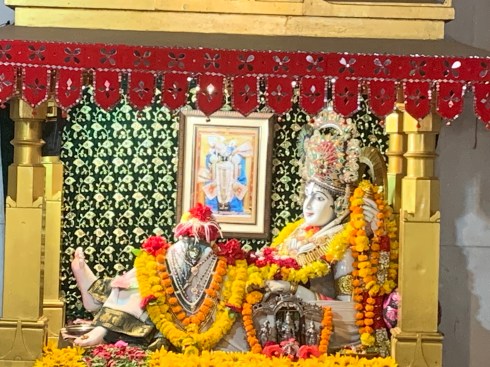
Bhalka Tirth: 15 – 30 Min

  • This is the place where Lord Krishna was shot by a hunter named Jara.
  • Bhalka Teerth houses a beautiful Krishna temple in a pose with his feet outstretched.

Few other places one can visit include the Pathan Museum, Pandav Gufa, and an ancient  dilapidated Sun Temple.

We were back in the hotel by 12.30 for Lunch and after a well needed nap, we set off again at 4.30 PM

Parasuram Mandir: 15 – 30 Min

  • The temple looks like a new one but behind the main temple is a sunken old temple which is the original Parasuram temple.
  • The ambience is very calm and meditative here.
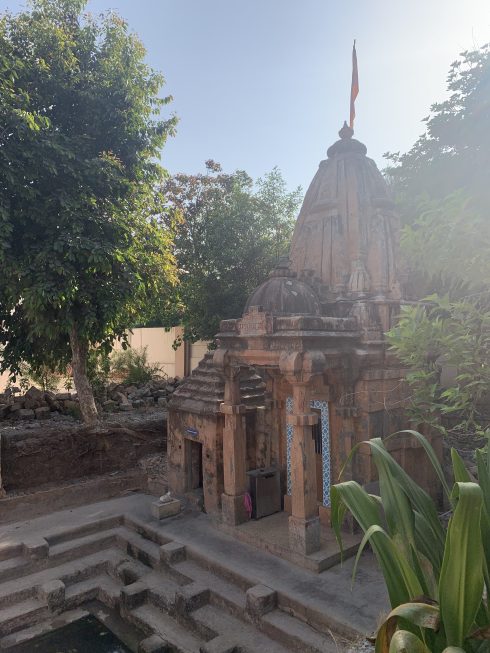
Old Somnath Temple built by Rani Ahilyabhai: 15 – 30 Min  

  • Situated opposite to the famous Somnath Temple. Dedicated to Lord Shiva, Ahilyabai Temple was built by Maratha queen Ahilyabai Holkar in 17th century
  • It is said that Ahilyabai Holkar was deeply moved by the ravaged state of the temple and took on herself the task of reconstructing it. It is also said that the location of the Swayambhu Linga came in Ahilyabai’s dreams, post which she started the construction immediately. Many Hindus believe that this temple contains the original Jyotirlinga which was buried assuming that the original temple would be raided.

Main Somnath Temple for eve 7 PM Arti: 2 Hrs  

  • We ended our trip at Somnath by spending two hrs at the main temple. The Arti at 7 PM is very energising and you can keep walking in and out – so I had multiple darshans of the Lord.
  • The temple is lit at 7 PM and the grass gardens are lovely. The sea breeze is pleasant and it was almost a full moon night.
  • There is a sound and light show from 8 – 9 for which you need to buy tickets. So the temple lights are switched off at 8 PM.
  • There are Prasad counters in the garden area from where you can buy dry prasad packets
  • We were back in our hotel by 8.30 for dinner.
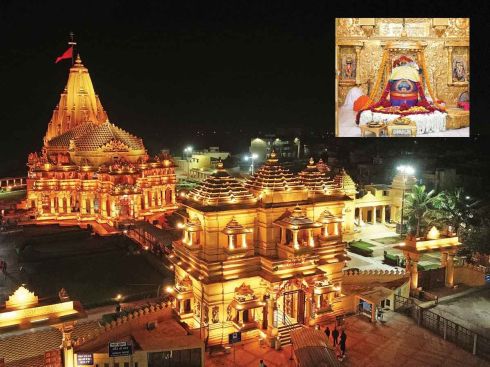
DWARKA

We left Somnath at 5 AM. The road to Dwarka is an excellent highway and you can zip at 120+ kms. At around 7.30 we stopped for breakfast at a place called Hotel Krishna Park and were served fresh Poha / Puri Sabji.

Nageshwar Jyotirlinga: 30 Min

  • We reached Nageshwar Jyotirlinga at 9.15 AM. There is some confusion between Jageshwar (Kumaon) and Nageshwar being a Jyotirlinga. Most online resources seem to consider Nageshwar to be in the list of 12 Jyotirlingas. But when I visited Jageshwar in 2016 the priests claimed that it was one of the 12 Jyotirlinga’s
  • The temple structure looks modern. There is a massive Shiva Statue in front of the temple. It’s not crowded and by paying 200 Rs we were allowed to enter the sanctum sanctorum and offer Arti to the Lord. This was indeed very satisfying.
  • A minute’s drive from here is Gopi Talab. According to locals, after leaving Mathura, Lord Krishna never went back. The Gopi’s of Mathura came to Dwarka to meet Krishna. After several Ras Leela’s with Lord Krishna, they offered their lives to the land. Hence the name of the lake is “Gopi Talab”.  

Beyt Dwarka: 2 Hrs

  • A short drive from Nageshwar is Beyt Dwarka. It’s a 35 Sq Km Island. Most of Dwarka from Krishna’s era is submerged – this is said to be one of the few parts that survived.
  • You need to take a 15 min ferry to reach the island. Boats are overloaded and there are no life jackets – tickets cost Rs 20/- . Private Boats are available for Rs 4000/-. A sea bridge connecting the island with the mainland is under construction.
  • Take a Guide – it helps. Our guide was Harshad – 98986 66486. He did a good job showing us the place.
  • The main temple was destroyed during the Kutch earthquake and most of what you see was rebuilt (It still looks ancient and dilapidated)
  • The main Idol of the Lord – Dwarkadhish at Beyt Dwarka disappeared for thousands of years. This was hand made by Rukmani. Afterwards it was found by Mahaprabhu Shri Vallabhacharyaji and installed. The Idol has mesmerizing power and locks you. You will not find a photo of this idol anywhere. We were lucky to get it from the guide who knew the priest
  • The guide made us happy by saying that we were special, this was lord Krishna’s house and Sudama had come here. Dwarka was his office. Most people come here after visiting Dwarka.
  • 70% of the inhabitants of the island are Muslims. Its crowded and not well maintained
  • Beyt Dwarka also has some nice beaches. The best is Dunny Point which is surrounded by sea in 3 sides.
  • Some people claim that this is a site for scuba diving, but we could not find any diving clubs.
  • On the way back the Private Boats take you back for Rs 100/-. That avoids the crowds.
  • The last boat back to the mainland is at 5.30 PM. Temple is closed in the afternoon from 1 – 5. During the the day the is closed 11 times for short durations for Naivedyam. So, plan your trip accordingly
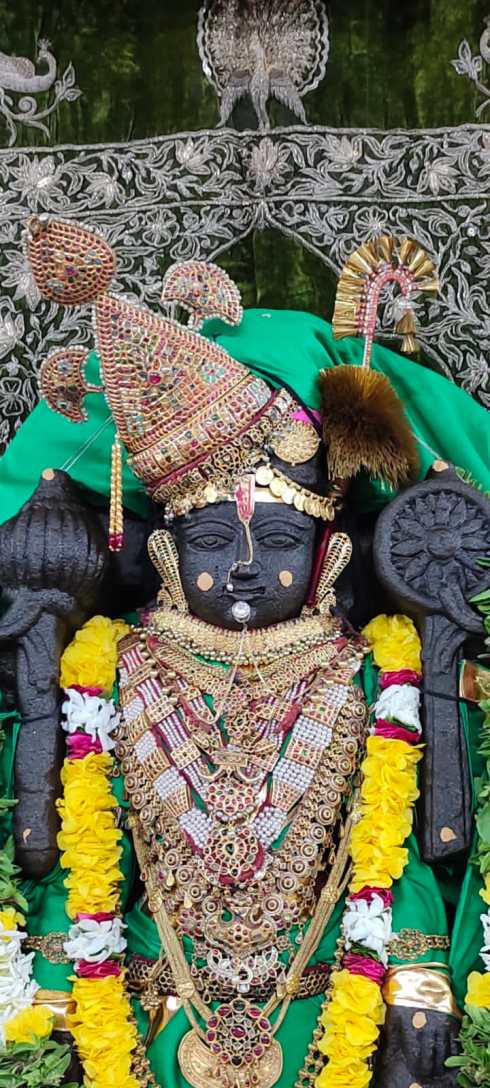
Rukmani Temple : 15 Min

  • You will cross this temple on the way to Dwarka. While Mathura & Brindavan is all about Radha – Dwarka is all about Rukmani – the 1st queen of Krishna. Cursed by sage Durvasa Rukmani was separated from Lord Krishna for 12 years.
  • Rukmani hence has a separate temple to herself on the outskirts of Dwarka. The temple has a tall shikara and intricate carvings which are eroded because of proximity to the sea. This temple probably belongs to the 12th century, contemporary of the main Dwarkadish temple in Dwarka.
  • When you visit the temple, the priest will wait for a batch of people and then tell you the story. It is a small temple, but it has a personality of its own.

By now it was 1.30 and on the way to our room we stopped by at the New Srinath dining hall for lunch. It was crowded, the place was not clean, and the food was very oily. You can skip this place. Suggest you go to Sharanam restaurant which is diagonally opposite.

Bhadkeshwar Mahadev temple: 15 – 30 Min

Evening 4.30 we headed to this temple which is by the sea. This is a small ancient temple where the Lingam is almost 5000 years old. It is believed that this temple was constructed by Shankaracharya. The path leading to the main shrine gets submerged during high tide in the rainy season.

Main Dwarkadish Temple: 1 Hr.

  • Dwarka is a small town, and you can reach the Dwarkadish temple easily from anywhere. A short Auto ride costing 30 – 40 Rs or walk for 10 – 15 min. The temple is located on the Sangam of the Gomti river with the Arabian sea. Temple timings are 6.30 AM – 1 PM and 5 to 9.30 PM
  • At the main temple you need to deposit your Phone and bags – only wallets are allowed inside. No entry fee / no special ticket etc.
  • Tushar Bhat a Priest of the temple was our guide, and he did a good job Most importantly he helped us to avoid the Q and find a nice peaceful corner from where we could view the main sanctum peacefully and uninterrupted. He can be contacted at +91 98257 14232.
  • The original temple was built by Lord Krishna’s grandson Vajranambha and the architect was Vishwakarma. The main shrine of the five-storied building, supported by 72 pillars, is known as Jagat Mandir. Archaeological findings suggest it to be 2,000 – 2,200 years old.
  • The Dwarka Mutt is one of the four mutts established by Sri Adi Shankaracharya within this temple.
  • It is sacred to take a dip at the Gomati Ghat opposite to the Dwarkadhish Temple. The water is sparkling clean.
  • The Dhwaja or the Mast Flag atop the main Temple is unique and sacred. The Flag is made of 52 yards of cloth. 52 small flags are woven individually in each yard of cloth. The flag is changed 5 times a day
  • Aarti Timings 
    • Mangala Aarti – 6.30 – 7 am,
    • Shringar aarti – 10.30 – 10.45 am & 11.30 am,
    • Sandhya Aarti – 7.30 – 7.45 pm and
    • Shayan Aarti at 8.30 – 8.35 pm

Sudama Bridge: 30 Min

A minutes’ walk from the main temple is the Sudama bridge on the Gomti river. It gives a nice view of the temple and the Ghats. It’s a nice photo op place in the evening. There are benches along the river where you can sit and soak in the beauty and energy of the place.

It was 7.30 PM by the time we finished our walk along Sudama bridge and headed back for a light meal at Sharanam and then back to our room. It was a long and satisfying day.  

Heading back to Rajkot & Bangalore

  • The drive from Dwarka to Rajkot is a bit patchy at places because of construction. We left at 6.30 AM and reached Rajkot by 11 AM. This route you cross the Reliance Jamnagar refinery complex. The earliest breakfast joints you get are near Jamnagar so it’s almost 9.30 before you can have breakfast. Jamnagar also has a nice Marine Life Park.
  • Rajkot is a lovely city famous for its tea shops. Also visit the famous Peda shop Jay Siyaram. If you skip breakfast and want an early lunch the best Thali place in Rajkot is Grand Thakkar (Opens at 11.30 AM)
  • Flight 6E 6508 departs Rajkot at 14.20 and lands in Bangalore by 16.15

By the grace of God and our Master the trip went off very well. Everything happened with meticulous perfection. The weather was perfect, the drivers were excellent and the perfect guides miraculously appeared in front of us. There was hardly any crowd and we had excellent Darshan at all the places.
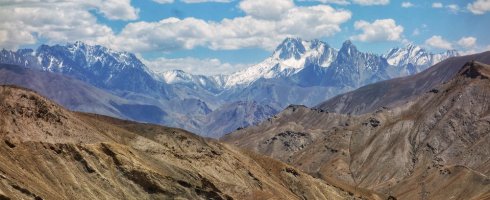
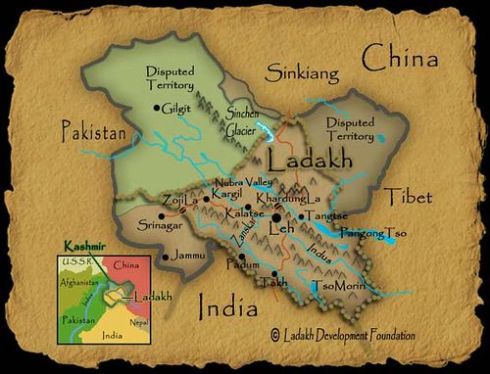


A Comprehensive Ladakh Travel Guide

28 Sep

For long I have had the perception that Ladakh was a land far far away with hostile environment and rough weather – a Holiday destination only for the tough & rugged. After this trip, I am glad I was proved wrong.

This BLOG is based on my 12 day solo trip to Ladakh in Sep 2021. It has all that you need to plan your trip. I need to thank Akarsh Pall of I Am Adventure (98118 29449) who helped me plan this trip. He is passionate, committed  and has extensive knowledge of Ladakh – without his help I would not have had a wonderful immersive experience to learn so much about Ladakh.

Why Ladakh – A Few Compelling reasons

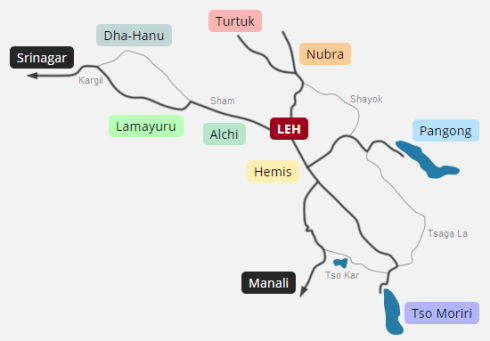
  • EasyAccess – Fly into Leh or drive from Srinagar (You can also drive from Manali)
  • Language, No problem – everyone knows Hindi / English
  • Food, No problem – even in the remotest of places you will get piping hot Rice / Dal / Roti / Sabji and even Curd. Add to this Pizza / Pasta / local delicacies and of course the roadside Maggi.
  • Excellent roads – In 12 Days I would have travelled over 1250Km , over 90% of the roads were in excellent condition thanks to the BRO
  • Very Affordable – Excellent homestay at 1000 Rs / day. You can choose your accommodation from basis backpacker dorms & tents to Luxury 5 star hotels
  • Very Safe – In the middle of a remote road on our way from Dah to Leh a young muslim girl in hijab stopped us for a lift. In which part of India would a girl dare to take a lift from an unknown vehicle.
  • Lovely people – The Ladakhis are very nice people. They are warm and helpful. Never agitated always equanimous, following the middle path

________________________________________________________________

And most importantly, A Lot to experience – Ladakh has craggy snow capped mountains, glaciers, scenic river valleys, lakes, treks, orchards, meadows, deserts…. a lot of sightseeing a lot of adventure. The only thing it doesn’t have is dense forests

________________________________________________________________

Given the volumnous information I want to share I will structure this BLOG under 3 Sections

  • An Overview of Ladakh
  • How to manage Acute Mountain Sickness (AMS)
  • Planning your Trip – Travel TIPS

An Overview of Ladakh 

  • The word LA in Ladakhi means PASS – so Ladakh is the land of high mountain Passes. Khardung La, Fotu La, Chang La, Taglang La, Baralacha la …. etc. This is rugged mountain land, a cold desert where the altitude varies from 3000 – 5900 Metres. This is where the Great Himalayas originates. It is also the place of origin of the Karakoram and the Zanskar range of mountains.
  • Ladakh is huge – 59,146 Sq Km. That is bigger than Punjab & Harayana. The UT has two Districts – Leh & Kargil. Total population is less than 3 Lacs. Leh is predominantly Buddhist and Kargil is Shia Muslim. Leh is the 2nd largest district of India (Kutch is the largest & Jaisalmer the 3rd)
  • It is one of the coldest and most sparsely inhabited regions of the world. Yet it has a high density of armed forces. We have hostile neighbours and a long stretch of LOC with China and POK. At any point in time there are over 50,000 battle ready armed forces in Ladakh. Siachen & Galwan the hotspots of recent times are in Ladakh.
  • Ladakh was an independent country till 1834. It was part of the silk route and there is a lot of mingling of cultures. A strong Tibetian influence – The Ladakhi language is a modified Tibetan form and both share the same script. It also has influence from Iran ( Indo Iranian – Dard), Baltistan and people from Central Asia including Uighur’s. Interesting to note that the Balti’s a sect of Muslims in Gilgit – Baltistan follow the Persian Navroz New Year. The great general Zorawar integrated Ladakh with the kingdom of Jammu.
  • Its not just the land of lofty mountains but also the land of many rivers. The mighty Indus (Still called Sindhu in Ladakh) originates near Kailash and flows thru Ladakh before entering Pakistan at Batalik. There are many more rivers cutting deep gorges and creating fertile valleys – Zanskar, Shyok, Suru, Drass, Nubra, Shingo are some of the larger rivers – most of which are tributaries to the Indus
  • Ladakh is also the land of pristine high altitude lakes – Pangong Tso, Tso Moriri, Tso Kar etc. You may have guessed that the word Tso means lake in Ladakhi


Given the size of Ladakh how much time will it take to cover everything

If you want to do justice and see all that Ladakh has to offer you must plan a 4 – 6 weeks trip. Or multiple trips of 2 weeks. Most people try to cover the key sights of Leh / Nubra / Pangong in 5 – 6 days. But that is just touching the tip of the iceberg. Dont do that – coming to a far away land spend time with the locals, immerse yourself with the culture and go back with knowledge and deep experiences of a lifetime.

This Link has a detailed explanation of all the regions of Ladakh and what they have to offer. Read at leisure. It will help you plan your trip. https://travelthehimalayas.com/kikis-guide-to-ladakh. 

How to Manage AMS (Acute Mountain Sickness) 

This is the first question that people travelling to Ladakh have. The city of LEH is at 11,500 Feet, Khardungla Pass is ~ 18,000 feet. During your trip you will be travelling between 9500 – 18000 feet. That is serious High Altitude and you need to plan to avoid AMS. I had learnt my lesson during my travel to Kailash Mansarovar and took all the necessary precautions this time – Within 24 hrs of landing I was fine and Ladakh felt like being in Bangalore.

  • Dont Take Diamox – Let the body adjust naturally. This was the best advise that Akarsh gave me. I was inclined to take Diamox – but he insisted against it.
  • If your travel plan can be from Srinagar that is ideal. Drive from Srinagar to Leh on NHI and on the way cover Sonmarg / Drass / Suru Valley / Dah – Hanu and then reach LEH. This is the best way to acclimatise as you ascend slowly and your body adjusts.  (Srinagar – Sonmarg : 84 Km, Sonmarg – Drass : 60 Km Enroute you cross the Zojila Pass 3530 M, Drass – Kargil : 55 Km , Kargil – Leh : 230 Km)
  • If you are flying into Leh then take the first 36 Hrs very easy. Do Nothing. Eat light. Drink a lot of stream water (Not Bisleri). Avoid Oily food / Rajma / Eggs – stick to Dal Chawal / Curd / Roti Sabji
  • Do a lot of deep breathing – better to start doing this months before your trip to Ladakh
  • Dont exercise or walk briskly – don’t do Yoga / skipping … any strenuous activity.
  • Your first getaway from Leh should be to a place of lower altitude. So head to Kargil / Drass / Suru Valley / Dah – Hanu etc. These are all places at 9000 – 10000 feet. Dont try going to Pangong ( 14,500 feet) or Tso Moriri (15,000 feet) on Day 2 of your trip – that is a recipe of disaster. Getting to Nubra Valley also means crossing Khardungla which is at 17900 feet.

If you are not Obese, your fitness levels are decent and you follow the above guidance I can assure you that your chances of getting impacted by AMS are rare

Planning your Trip 

What is the best time to travel to Ladakh ?

April 15 – May 15th and Sep 10th – Sep 30th is ideal. From Oct – March Ladakh is very cold and tourists may find many attractions closed. Roads / High altitude passes may also be closed. In Sep the crowds start diminishing and by Sep end you may get to see snow in the high passes. The fruit season may just be getting over and if you are lucky you may spot Apples in the orchards but the Apricot season may be over. Mid April is spring when the flowers in the valleys bloom. It will still be cold and there will be a lot of snow but Ladakh will be fresh, welcoming the seasons first tourists .

June – July – Aug is peak season and you may be disappointed with crowds everywhere. Ladakh is a place you want to enjoy in solitude. The tourist traffic in Ladakh is exploding – 2021 saw well over 300K tourists an all time high  – This inspite of COVID and no foreigners. The Govt is gearing up for 1 M tourists in the next 3 – 4 years. So dont delay your trip – visit Ladakh before it becomes Simla or Nainital.

How many days trip should I plan 

You first need to decide how many days you have at hand. You can work with your travel planner to maximise based on this. Here are some basic guidelines that may help you

  • I used a Hub & Spoke model.  Made LEH my Hub and retained a lovely homestay there for the entire duration of my trip. Explored the region by making 1 – 2 day trips
  • Did not do any long tiring day trips and was not on the road for more than 6 hrs any day
  • This ensures that you are not tired and you can get your laundry done at the homestay
  • Dont rush – enjoy the beauty of the place, talk to the locals , stay at homestays and villages, eat local food and get a cultural immersion.

Approximate Indication of time & distance from LEH 

Section – 1 : Kargil / Drass / Suru Valley / Dah – Hanu (Budget 2 – 3 days) 

  • Leh – Kargil : 216 Km  – 4 1/2 Hrs  – NH 1 Excellent road, Kargil – Drass : 60 Km  – 1 Hr – NH 1
  • On the way to Kargil stop by at the Lamayuru monastery with its moon like rock formations. You can Explore the Kargil War memorial at Drass, There are Apple & Apricot orchards on the way to Drass at Karkichoo valley. Spend the night at Drass and visit the Tiger hill. Mushko Valley & Minamarg are the hubs for trekking to Gurez & Amarnath

  • Kargil is the District HQ – nothing much to see there, but from Kargil you can explore Suru valley – best time to do that is in April – May when the flowers are in full bloom
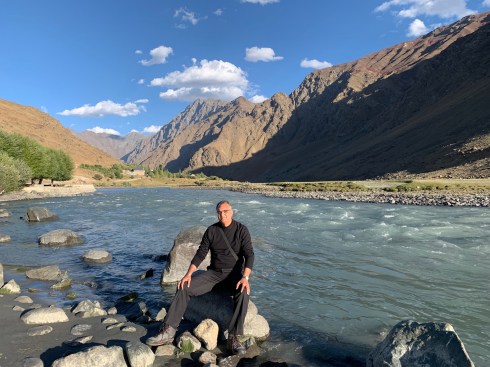
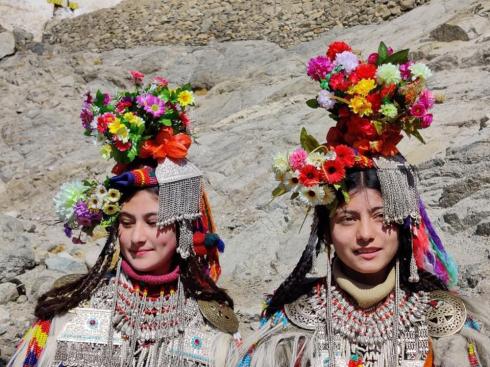
  • As you finish this circuit and head back to Leh take a different more scenic route along the Indus via the Aryan Villages of Dah – Hanu. You can stay in a small hotel by the Indus River called the Aryan Residency or live in a Camp by the river. There are 3 villages here which claim to be descendants of Alexanders soldiers. They do dress up and put up a show if you are in a group (Not FREE)

If you leave Kargil by 9 AM  you will reach the Aryan Village by lunch time – that gives you 1/2 a day to explore the place, sit by the raging Indus River and enjoy the peace and solitude. The next day after breakfast if you leave by 9 AM you can reach Leh by 3 PM  – with a stopover at Alchi monastery and lunch at a beautiful restaurant called Alchi village.

In a landscape that is vastly craggy brown mountain this sector is the green patch. Depending on time available one can also cover Zanskar from Kargil. Remember this is the place of the world famous Chadar trek on the frozen Zanskar river.

Section – 2 : Turtuk/ Nubra / Pangong Tso plan for 3 nights 

After you completed the 1st Phase of your travels take a 1 day break at Leh and enjoy the local sights and restaurants, then head to Turtuk.

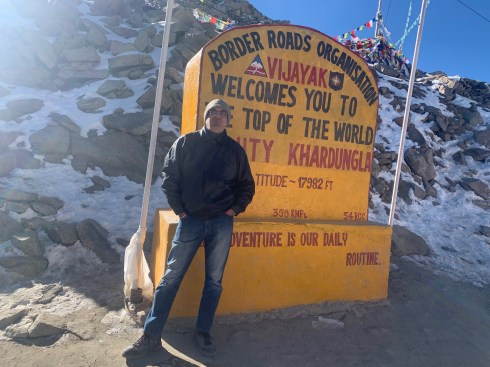
To reach Turtuk you need to cross the famous Khardungla Pass. When we were kids that was the answer to a quiz question – Khardungla pass was the worlds highest motorable pass. It no longer is – but at 17982 feet it is impressive.

Khardungla pass is 39 Km from LEH. Start early to avoid the army convoys. You want to reach early and cross the pass early – don’t spend more than 15 Min at Khardungla. We left LEH at 7.15 AM and were at Khardungla by 8.15 AM It was empty. We were lucky to see snow in mid Sep – it normally starts snowing in early Oct and has over 6 feet of Snow from Nov to March.

As you descend from Khardungla you see many wild Yaks grazing and after a few hours reach a white sand desert called the Nubra Valley. On our onward journey we did not stop at Nubra and headed straight to Turtuk. On the way you see many army camps – this is the way to Siachen & Galwan. We reached Turtuk at 2 in the afternoon. This was the longest travel day for us

Turtuk is a Balti village. Most of Gilgit Baltistan is in POK. Turtuk and the adjoining villages were annexed from POK by the Indian army in 1971. Many claim that Turtuk is the Northern most Indian village – but there is Takshin and Thang beyond Turtuk. The last inhabited village is Thang from where you can see the Line of Control. I spent the night at Turtuk and enjoyed local Balti cuisine. The village is clean and is full of home-stays, restaurants and small museums. Its a pretty green village with streams and flowers and orchards. The Shyok river flows by from here to Pakistan.

At Thang do try and meet Gubba Ali. He has an emotional story to tell of 1971 when as a 5 year old he was separated from his parents who were in the next village in POK. The army did not proceed further as cease fire had been declared and the Pakistanis did not allow his parents to come back.

You need a local to take you for a morning walk down some pretty streams and trek up to a monastery for some fresh air and lovely views. Turtuk is a lovely place – dont do a rushed day trip from Nubra, spend a night here. 

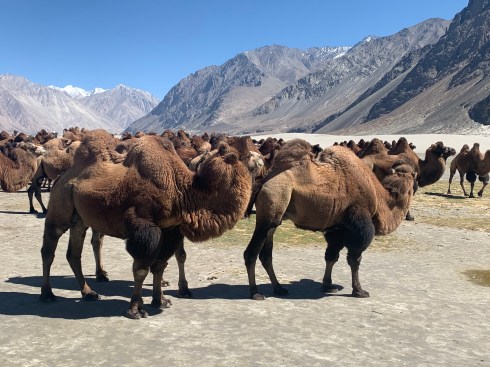
The next morning we left Turtuk after breakfast and a morning trek at 10.30 AM and reached our resort at Nubra by 2 PM. On the way we stopped by to meet the rare double humped Bactrian camels from Central Asia. The camels look healthy, strong and well fed.

Please note they head home for lunch at 1 and are back only by 4 PM – so time your travel accordingly. Along Nubra Valley there are many places where you can also indulge in ATV rides.

At Nubra we stayed at a nice resort owned by the Ex Mla of Ladakh. Osay Khar is a beautiful resort in the lap of nature with 21 modern cottages, an organic garden and a sprawling Apple orchard. They also rear their own cows. The owner Tsetan Namgyal is a wonderful man and his family offers you great hospitality. Incidentally Tsetan is royalty – his sister is married to the King of Ladakh. I am thankful to Tsetan for spending so much time and showing us the neighbourhood.

The drive from Nubra to Pangong Lake is about 6 hrs. There are sections where the road is not in great shape. Leh – Pangong – Turtuk is a bit like a triangle so it saves time to cover Pangong Lake from Nubra rather than going back to Leh.

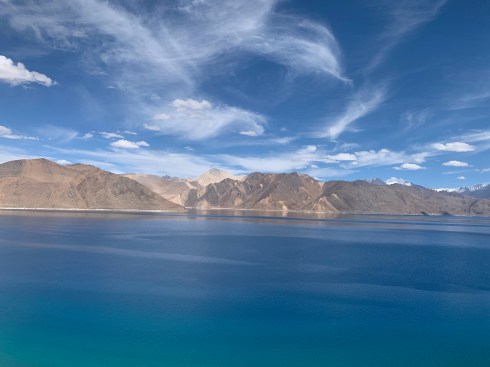
Pangong Lake is at 14,500 feet. Its a the worlds highest saline lake. Its also 135 Km long and over 100 feet deep – 1/3rd in India rest in China Occupied territory.  The lake is serene and eerie. Inspite of being saline it freezes in winter. It is spotlessly clean and the water is sparkling. There is no permanent accommodation here. There are tented camps – some are canvas tents and some are log house rooms. Tents are decent – Western bathroom with running water. Electricity from a generator is provided from 6 – 10 PM and hot water at 8 AM for an hr.

Most people tend to do a day trip to Pangong Lake from LEH. I would advise against this. 10 hrs of driving can be very tiring. The Lake is best enjoyed late evening and early morning. I was lucky to be here on a full moon night. Try and time your travel to a New Moon or Full Moon. Yes it is freezing cold in the tent and with 3 layers of sweaters, a thermal and 3 blankets I was shivering. The camps shut down in October as it becomes very cold.

Service is good and hot fresh food – Roti / Rice / dal / Soup / Kheer is provided. Tea / Coffee / Maggi / Snacks is also provided.

The next day we left Pangong at 8 AM after a hot breakfast and headed back to Leh Via Changla Pass – another high altitude Pass. the journey was smooth and we reached LEH at 12.45 right in time for lunch at the Gyalson Homestay – the lovely place which was my HQ.

All about LEH 

LEH was my hub. The Kushok Bakula Rimpochee Airport  is the 23rd highest commercial airport in the world at 10,682 feet. Its a small airport that is undergoing expansion. The flight to Leh from Delhi is scenic – remember on the Delhi – Leh route choose seat F (Window) and on the Leh – Delhi sector choose seat A. This will ensure you get the best views.

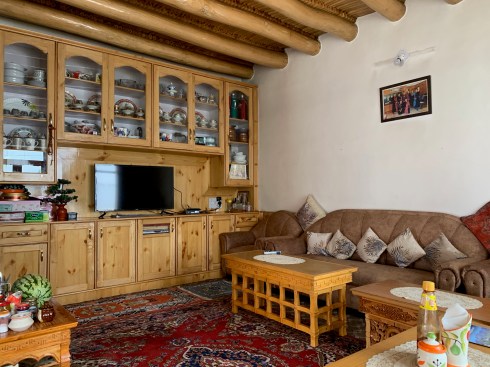
I stayed at the Gyalson Guest-house – a very comfortable and homely place. It is the home of a lovely Ladakhi family. Rooms are clean, hot water is available 24 by 7 and you get freshly cooked meals – with organic vegetables from the kitchen garden. It is also very affordable. (Contact Paale – 80823 46464). A big thanks to Megha & Yashwant for guiding me to Gyalson and also helping me plan the trip.

Located on Changspa Road the main hub of Leh its a short 10 min walk from the Leh Market. The Shanti Stupa is also a 10 min walk and can be seen from the balcony of the room.

Leh is a small town – but unlike other hill stations the roads are flat. There is no public transport – so your rented vehicle is your mode of transport. There is a wide variety of restaurants and shops in leh and you can get almost everything you get in a big city. Idli / Dosa / Pizza / Pasta / Local Cuisines …. you can feast at the local restaurants and cafes. many are vibrant with live music. Here is a list you may find handy of the 15 Best restaurants in Ladakh.  15 Best Restaurants & cafes in Ladakh. Inspite of its remote locations costs are very affordable.

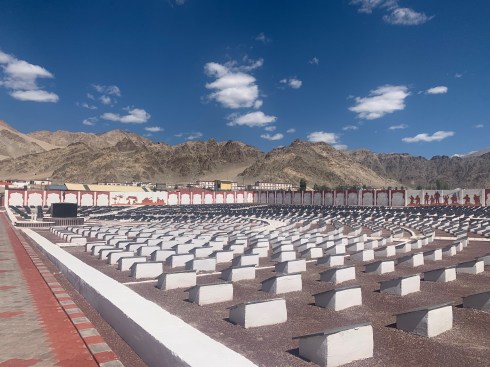
The key sights of Leh can be covered easily in 2 days. Shanti Stupa looks beautiful when lit at night. the Pathar Sahib Gurudwara has a lot of history associated with it and the Hall of Fame is a wonderful war museum and memorial. Dont miss the Light & Sound show at Zorawar Fort and Hall of Fame. Magnetic Hill, Leh Palace, Stok Palace, Central Museum, Sangam of Indus & Zanskar, Ghats of the Sindhu river, a few monasteries – that’s about all that there is to see in Leh

So what did I miss out this trip?

Tso Moriri is another beautiful lake. Less frequented by Indians. Thats another 1 night trip from Leh. Further ahead of Two Moriri is the village of Hanley which is home to a rare observatory that houses one of the worlds highest telescopes. Star gazing from here is supposedly out of the world. But this is a long long way away. Suru Valley is a must visit in Spring and one should plan a trip to Zanskar.

So I guess another 2 weeks are needed to cover Ladakh.

A Few More Points to help in your travel

  • The 3 most important accessories for this trip are Sunscreen lotion SPF 50, a Nice big floppy hat and sun glasses. At this altitude days can be very hot and the sun rays can be scorching.
  • Carry a lot of water – a good sipper with inbuilt filter is good to have – as you drive you can fill your bottle from the fresh streams.
  • Airtel Post paid connections work. The network is decent in most places. BSNL has the best coverage. In Pangong only BSNL works.
  • Innova’s and Mahindra XUV’s are the only vehicles you will find on the road. Dont overload your car with 6 – 7 passengers. Try to be max 3 – 4 / vehicle. There are no mechanics / repair shops Enroute so ensure that you have a good Vehicle
  • Most tourists are youngsters who rent a bike from LEH. A lot of young couples who come in groups. A lot of women groups. I spotted very few families ( maybe it was Sep and school time) – and some teenagers but no one below the age of 12 or above the age of 60.
  • Carry your medicines – after LEH you will not find any chemists / big shops
  • Ladakh is the biggest producer of Apricots – so if you want to drink fresh fruit of the land drink Apricot juice.
  • You will not find Bars / Pubs in Leh or in other locations. Liquor may be available on request. Best avoided. At Pangong Lake I was sitting with a bunch of youngsters from Jaipur who were enjoying a few drinks and the camp incharge advised them to stop. A few days back two youngsters in their 30’s had suffered cardiac arrest after drinking.
  • If you kids want luxury stay – yes there are some high end hotels , you may want to indulge in some of them during your travel. Luxury Hotels in Ladakh 
  • Credit card / Google Pay works in Ladakh – lots of ATM’s. But carry cash – outside of LEH cash is preferred. Your cash usage is limited if your travel planner has booked all your rooms. On a 12 day trip I did not need more than 10K in cash.
  • There are many monasteries – they are huge. I visited two of them Lamayuru & Aichi. They all feel the same. I could not sense the energy and vibes in the monastery that one feels in the ancient Chola temples.
  • The Inner Line permits that were needed till recently have been eliminated. Indians can travel to almost all of Ladakh without permits.
  • And last but not the least – Is Ladakh a destination for honeymooners ? No it isn’t

And one more thing. Ladakh is home to many regiments & battalions. Many a Braveheart has given up his life in the struggle to protect the motherland. Do visit the memorials and museums of the brave soldiers and understand the challenges that they face in the peak of winter when the temperature easily drops to (-) 20 degrees or lower.


RiverMist – A rare boutique resort in the lap of W Ghats

4 Jul

A picturesque verdant valley surrounded by misty hills. The energising sound of a young gushing river only 9 kms from its source. The scream of peacocks and the racket of crickets. Peace and solitude with hardly a soul in site. You may think this is a place far far away in the Himalayas…. 

RiverMist is a rare find. Its just 295 Km (6 hrs drive)  from Bangalore (Madugundi, Sunkasale, Mudigere) just 30 km from Horanadu. Its a small boutique resort spread across 25 acres with 10 rooms that opened in Jan 2021. RiverMist is the brainchild of two passionate young men Srijith & Satish from the Tech sector. They travelled every weekend for 2 years all the way from Bangalore to identify the right spot and then it took them 2 more years to custom design this beautiful place.

At 4950 feet RiverMist is located in a valley that is flanked by the Kudremukh National park on one side and the Charmadi Ghats home to the Ballalarayana Durga on the other side.

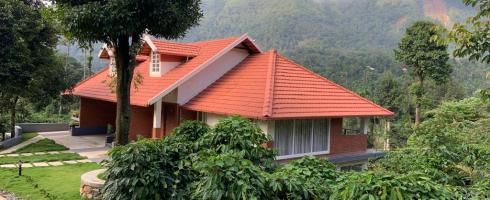
See the buildings with red tiled roof – That is RiverMist 

What did we like best about this place?

The RIVER. It reminded me of Alfred Tennysons “The Brook”. A gushing stream that runs along the periphery of this 25 acre property. It’s only a 2 min walk from your room. The source of this river (Netravati) is just 9 kms from here. So its a young stream and it forms a small waterfall as it dances along RiverMist. It may look small and narrow but be careful because the water is powerful – especially after the rains. The river forms a small pool and you can take a dip in the water. You can also go for a 1km river walk with the resort guide – but take your aqua shoes and be careful, its slippery.

The river water is sparkling clean and you can drink directly. (TDS 10 – 15 , Bangalore water TDS 250 – 300, TDS – Total Dissolved Solids)

What else can I do at the Resort?

You can do a 1 hr nature walk with a guide thru the dense forest. (Beware of leeches). And a 30 min walk by yourself around the resort where you can cross the shallow part of the river barefoot and feel the fishes nibbling on your feet. When the weather is good candle light dinners and barbecues by the river can be organised. They also have board games and TT to keep you entertained in the evening.

But then there is a lot to see around the resort

The Annaporneshwari temple at Horanadu is just 30 Km away and the ancient Kalasa Shiva temple where sage Agastya is said to have meditated is 24 Km away. Both are a must visit. Close to the Kalasa temple is a Hanging bridge on top of the Bhadra river. Here the river flows softly and silently between towering hills.

Amba Teertha

And just a little bit away the same Bhadra river is raging ferocious as it scoops out rocks like wax in a series of rapids. Getting here is offroad and you need a 4 wheel drive. (Please note you need a proper SUV not a Mini SUV)

Rani Jhari view point 

A short drive from the resort and then a 10 min easy hike leads you to a place of unparalleled beauty and views. A great place for sunset viewing. Most days are cloudy and misty – so you need to be lucky to view the sunset. Close to this place is also the Kodagai falls.

Drive by Maidadi road and stop at the View point from where you can on a clear day see Dharmasthala. When we visited the whole place was engulfed with mist

This area is also a paradise for trekkers. The Ballalarayana Durga trek is a full day affair and needs Govt permission. Many trekking companies organise this trek.

A few more points about RiverMist to help you plan your stay. 

Which room should I choose 

Its a small resort with 10 rooms – 3 Luxury rooms with Jacuzzi, 3 Premiums Rooms , 3 Deluxe rooms and 1 family room over two levels that can accommodate 8 people

Only the Luxury & Premium rooms have balconies and amazing views facing the misty hills. This should be your preference. We stayed in a Premium room – the rooms are large and the bathrooms are larger. Balconies are also very spacious.

How about Connectivity

There is no mobile network. Remember you are in the midst of nowhere. Wi Fi works 80% of the time.

You need an SUV for the last 3.5 Km

The last 3.5 Km needs a 4 wheel drive SUV. So if you come by car you park it on the main road at a safe designated  area and the then RainyMist folks take you by their SUV / Jeep. Travelling around this place to see the views also you need a SUV. This remote area where people know only Kannada. So its best to rent a jeep from the resort for your local travel.

The food is good

Food and service is very good. They serve both Veg & Non veg. All meals are a decent buffet spread unless you are the only one staying there. No alcohol is served – but you can carry your drinks. The people at the Resort go out of their way to make you comfortable. Its a very warm ambience. Room service food is served. One of the few Resorts where you can get Coffee at 6 AM served in your room

Do I eat all meals at the resort or are there restaurants around

There are a few small homestay but no restaurants in a 30 km radius. So all your meals are at the RainyMist. The rate you pay is inclusive of all meals.

The SPA is coming up in Phase – 2 

Currently there is no Spa – that is planned. The swimming pool is also under construction and should be up and running soon.

Are there animals..

Dont be afraid of the Elephant Trumpet at night RiverMist is close to the elephant corridor. And its common to hear Elephants. You will almost always see Elephant dung. Bisons and peacocks are also in plentiful. Please note that as of now Pets are not allowed.

A place so far way are there power cuts – will we get Hot water

The whole place runs on Generators. the power line is coming soon. We stayed for 3 nights – we had no problems – power never went and the water was nice and hot 24 by 7

Do they have driver rooms

No separate driver rooms are available, but check while booking if they can accommodate with the staff.

So how long should I plan my stay at RiverMist and how do I cover the sights

A minimum of 3 days to cover all the sights and enjoy the beauty of this place.  Here is the suggested itinerary.

Day 1 : Depart Bangalore at 6 AM and reach River Mist by 12 Noon. Breakfast stopover at Kunigal – Dhruvatare. Evening visit the river and walk around the resort.

Day 2 : Enjoy the misty morning and after breakfast head out with this plan.

  • Drive past maidadi road and stop at View Point
  • Ancient 2500 year old Kalasa Shiva Temple
  • Hanging bridge on Bhadra River
  • Horanadu Temple
  • Amba Teertha ( Sandwich Lunch that you packed in the morning)
  • Reach the resort by  3 PM
  • Evening relax at the resort

Day 3 :

  • Nature walk in the resort
  • Breakfast
  • Tea Gardens
  • Rani Jhari & Kodagai Falls
  • Back to resort for lunch
  • Evening do a resort walk by yourself

Day – 4 : Depart after breakfast at 9 AM and reach Bangalore by 3.30 PM

What is the best time to visit.

We visited in 1st week of July. We were lucky to have excellent weather. It rained at night and drizzled in the eve but the days were beautiful. I guess the best time to travel would be Sep – Feb but you can travel all year round. In summer you may miss the mist and the river flow may be a trickle. Nov – Dec – Jan may be cold.

Any other points?

It would be nice to go as a group to RiverMist. That way you can have fun in the evening. With just 10 rooms you can form your own Covid Bubble group and take up the full resort. The 8 bed jumbo room is perfect for the kids.

RiverMist Contact details 

Address: Madugundi, Sunkasale PO Mudigere, Karnataka 577121

Mobile: +918762797979

Mobile: +919482979797

Email:reservations@rivermistresorts.com

WWW.Rivermistresorts.com

Some more views from our trip in July 2021….


On the Beach homely Resort – Sai Radha Heritage, Udupi

15 Apr

COVID messes up your travel plans. My daughter wanted to go to a beach after a year of online classes. The only place we could explore visiting without the hassles of testing was the Karnataka coast. Gokarna – Managalore / Udupi are all 9 – 11 Hr drives from Bangalore. To avoid the long drive we decided to break journey at Chickmagalur.

Here is the summary of the trip. Karnataka is a beautiful state. The road trip below can easily be a 5 – 7 days trip covering the hills, temples and beaches. Without the hassles of COVID testing.

Discovering Sai Radha Heritage

Unlike Goa the Managalore coast does not have any luxury 5 star beach resorts. After a lot of enquiry we settled on Sai Radha Heritage which seems to be the best option. The great thing about the place is the location – its right on the beach. And the beach is great – clean soft sand, warm water, and private.

The property has a few rooms facing the beach and the rest in a building adjacent. Wherever you stay the beach is a 1 min walk away. Rooms are spacious and nice, service is excellent, and rates are very reasonable. Its a great place to visit as a group and Oct – Feb would be the best time. I would strongly recommend this place. Its a great property and the owners are in the process of upgrading the facilities.

Sai Radha Heritage is easily accessible from the highway and its a 20 min drive to the Udupi temple & Manipal. The whole area is clean & well maintained, broad roads, no potholes, no garbage.

Here is a list of things that you could cover after spending the morning & evening at the beach.

Udupi Krishna temple is on everyones list. But right next to it are two ancient Shiva temples that precede the Krishna temple – the Chandramouleshwara Temple and the Anantheshwara temple. The usual norm while visiting the Sri Krishna Temple is to pay visits to the adjacent Ananteshwara and Chadreshwara Temples before stepping into the temple of Lord Krishna.

Popular beliefs say that King Rama Bhoja, a devout follower of Lord Parashurama, had installed the statue of Lord Ananteshwara (Lord Shiva). Another belief says that the Chandreshwara temple was built on the same spot where the moon God Chandra performed a great penance in order to get rid of the curse of Daksha Prajapathi. Both these temples are highly energised places.

There are interesting legends on the Sri Krishna Temple regarding why the Lord faces West in this temple and he can be seen only through a nine holed grill. The temple was consecrated by Madahvacharya and there is a interesting story on how he found the statue which is believed to have been worshipped by Rukmani in Dwarka

Click on these link for more information

History of Udupi Temple and why the main Statue faces West

How the name Udupi Originated – History of the Chandramouleshwara Temple 

We visited the temple at 7 AM and it was the perfect time for some Udupi breakfast after the Darshan. Inside the temple complex is a pocket sized restaurant called Nagaari canteen. Dont miss this.

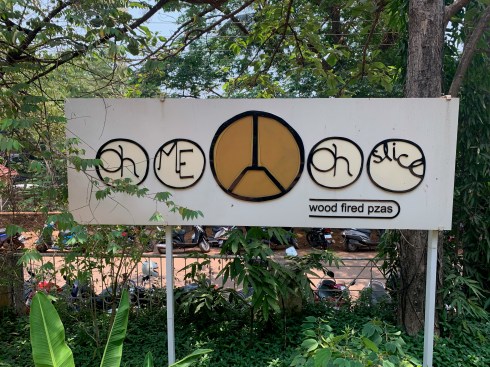
Talking of food there are two other places you must visit while at Udupi. A nice restaurant called Saffron that is housed in a swanky complex adjacent to the Samanvay Boutique hotel. Pure veg  – they serve Indian, Continental, Italian dishes. The other hotel you must explore is at Manipal – its an open air restaurant that serves great Pizzas. Its called Oh Me Oh Slice

While everyone heads to the famous Malpe Beach and Sea Walk Malpe for boating and activities, its worth exploring  Mattu Beach

Mattu Beach is a calm and secluded beach, 11 km from Udupi town and very near to the Srikrishna temple. You can take a stroll along the long and clean seashore. The white sands and the blue sea gives you ample shots to capture in the lens. End your day at the beach by witnessing the beautiful sunset. Remember to carry your own refreshments as there are hardly any shops or eateries in the area.

Kudumari Falls – Situated in the Chaktikal village in Kundapura these falls cascade from a height of around 300 metres, and are a sight to behold. Surrounded by lush greenery, one has to trek for around 4 km through the forest to reach the falls. The trek is made of rocky terrain and will offer you scenic views. It is best to avoid visiting the falls during monsoons as water levels are dangerously high and the trekking route is not safe during the time.

Swarna river banks – This is a stunning place to spend your evening at leisure. The Swarna River is located in Manipal which is very close to Udupi at a distance of around 8 km. The sunset and sunrise from the river banks are indeed an amazing sight to catch with sun rays imparting a shimmer to the waters. The riverside is perfect for a session of yoga or meditation. One can also visit the nearby Hiriadka Baje Dam built across the river.

Malyadi Bird Sanctuary in Kundapur. Malyadi is a small village with both resident and migratory birds visiting the site. The place is an abandoned clay quarry which is being preserved and promoted by the combined efforts of the locals and the government. Golden Plover, Wood Sandpiper, Red and Green shank are a few of the many migratory birds sighted here. Many of these birds arrive during the winters and leave before the first monsoon rains. Resident birds like Pond Heron, Cattle Egret, Reef Heron can be found in plenty here.

Sasthana Kodi backwaters – Head to the lesser known Sasthana Village for a leisurely backwater experience. The place is situated at a distance of 20 km from Udupi town. These backwaters formed by the rivers Kodi and Sita are enchanting and attract many tourists from the state and nearby areas. Local traditional boats are available for cruising through the serene waters while enjoying the scenic landscapes of Udupi.

Bangalore to Udupi – Plethora of temples 

As we drove from Bangalore to Udupi it was like a tour of some of the greatest ancient temples of S India. You cross the giant statue of Bahubali and then on the way to Chickmagalur there are these amazing Hoysala temples – while most visit Belur & Halebid there are many more. On the 4 hr journey from Chickmagalur to Udupi you will see signs for Hornadu (Annapurneshwari Temple) and just bypass Sringeri. From Udupi the Kollur Mookambika temple is less than 30 Km and Kuke Subrahmanya is not far away. Most would also cover Dharmasthala and Murudeshwar as part of this circuit.

Driving thru W Ghats – take a break

I am not comfortable with long 10 hr drives. The roads are excellent, I would suggest you break journey along the way as you explore this area.

On our way to Udupi we stayed at Vismita County, which is at the edge of Chickmagalur on the road leading to Udupi. Its a very nice property with Villas, large rooms with jacuzzi / pools etc. Food and service is excellent. Its a relatively new property – 3 years old.

The drive from Vismita to Udupi is 4 hrs – if you plan to stopover at Sringeri or drive by Horanadu I suggest you spend a few days at Kolavara Heritage.  Its a lovely homestay very close to Sringeri & Agumbe. Kolavara can also be the base for your day trip to Jog Falls

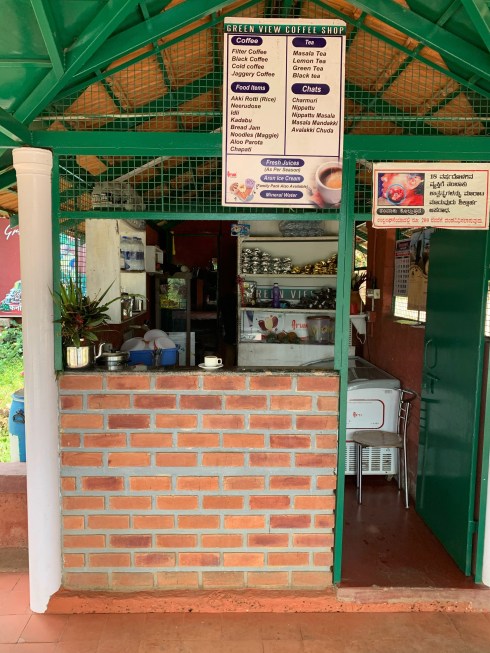
If you are the type of person who needs a break every 90 minutes while driving then stop at this small place called Green View Coffe Shop. Good coffee and spotlessly clean restrooms. Its about 90 Min from Chickmagalur on the way to Udupi.

On our way back from Udupi to Bangalore we stayed at the iconic Taj. A great vintage property with lovely huge rooms and a lot of greenery. The brand beckons but in reality there are many more nicer places in Chickmagalaur at a fraction of the cost compared to the Taj.

And while you are stopping at Chickmagalur here are things you can do


Shiva Tandava Stotram – Learn to Chant

21 Mar

Shiva Tandava Stotram

Shiva Tandava Stotram is the most popular Shiva Stotram composed by Ravana, a Sanskrit scholar par excellence and a great devotee of Lord Shiva. Shiva Tandava Stotram is one of his many works.It is believed that Ravana composed the hymn in praise for Shiva, and pleading for moksha. The stotra has 16 syllables per line of the quatrain, with laghu (short syllable) and guru (long syllable) characters alternating. The poetic meter is iambic octameter by definition.  Alliteration and onomatopoeia create rolling waves of resounding beauty in this example of devotional poetry.

In the final stanza of the poem, after tiring of rampaging across the earth, Ravana asks, “When will I be happy?” Because of the intensity of his prayers and ascetic meditation, of which this hymn was an example, Ravana received from Shiva powers and a celestial sword called Chandrahas.

_______________________________

I have made it easy for every person to learn this highly energising songs. Listed below are the words in Sanskrit and the exact pronunciation in English. Word by word meaning and the explanation of each stanza is enclosed. This is a beautiful chant and you can appreciate it better if you understand the meaning. I owe my gratitude to Muthulaxmi Rao for spending time and explaining this beautiful song word by word. I have also enclosed the YouTube links for the same

_______________________________


जटाटवीगलज्जलप्रवाहपावितस्थले
गलेऽवलम्ब्य लम्बितां भुजङ्गतुङ्गमालिकाम् ।
डमड्डमड्डमड्डमन्निनादवड्डमर्वयं
चकार चण्डताण्डवं तनोतु नः शिवः शिवम् ॥१॥

Jata Tavi Galla Jala Pravaha Pavita Asthale
Galela Lambya Lambitam Bhujanga Tunga Malikaam
Damad Damad Damad DamanniNada Vad Damar Vayam
Chakara Chanda Tandavam Tanothu Na Shivam Shivam

Jata Tavi – Matted hair like a forest, Galla Jala – water pouring out, Pravaha – Flow Streaming forth, Pavita – Purifying, Sthala – Ground. Galela Lambya – Long Neck that is supporting the serpents, Lambitam – Hanging, Bhujanga – Snakes, Tunga – Big, Malikaam – Garland, Damad Damad – Sound of Damroo , Tanothu – Please bless me.

The sacred Ganges is pouring out from his matted locks which are dense like a forest. The sacred water is purifying the place on which it falls. On that holy place Shiva is dancing the great Tandava dance. His neck is supporting the serpents that are hanging down and adorning him like garlands. His Damaru is constantly weaving out the sound Damad Damad and filling the space all around. O Lord please bless us and extend this auspicious Tandava Dance with all beings.


जटाकटाहसम्भ्रमभ्रमन्निलिम्पनिर्झरी_
विलोलवीचिवल्लरीविराजमानमूर्धनि ।
धगद्धगद्धगज्जलल्ललाटपट्टपावके
किशोरचन्द्रशेखरे रतिः प्रतिक्षणं मम ॥२॥

Jata Kataha Sambhrama Bhramanni Limpa Nirjhari
Vilola Veechi Vallari Viraja Mana Muurdhani
Dhagad Dhagad Dhagajwalla Lalata Patta Pavake
Kishora Chandra Shekhare Rathi Pratik Shanamava Mama

Jata Kataha – Matted hair like a big cauldron, Sambhrama Bhramanni – Revolving and whirling around , Limpa Nirjhari – Goddess Ganga as a waterfall flowing from his locks, Villola Veechi – Undulating moving waves, Viraja – Resplendent, Murdhani – Forehead, Dhagad Dhagad – Throbbing pulsating sound of fire blazing on his forehead, Dhagga Jwala – Embers, Lalata – Forehead, Patta – Flat , Pavaka – Pure/ Shining / Bright, Kishora Chandra Shekhara – Young crescent moon on the top of His head, Rathi – Delight, Pratik Shanam – Every Second, Mama – Through my being

His matted hair like a cauldron is whirling and going round and round as he dances his Tandava. And from these matted locks comes gurgling the goddess Ganga. The strands of his matted hair which are like creepers are waving while dancing like the waves of an ocean. His forehead is brilliantly effulgent. The throbbing sound of a raging fire can be heard – Dhaggad Dhaggad (His 3rd Eye). A young crescent moon is shining on the peak of his head. O Lord as you dance every second a rare ecstasy is surging every moment thru my being.


धराधरेन्द्रनन्दिनीविलासबन्धुबन्धुर
स्फुरद्दिगन्तसन्ततिप्रमोदमानमानसे ।
कृपाकटाक्षधोरणीनिरुद्धदुर्धरापदि
क्वचिद्दिगम्बरे मनो विनोदमेतु वस्तुनि ॥३॥

Dhara Dharendra Nandini Vilasa Bandhu Bandhura
Sphurad Diganta Santati Pramoda Mana Manase
Kripa Kataksha Dhorani Niruddha Dhurdhara Apadhi
Kvachit Digambare Mano Vinoda Metu Vastuni

Dhara – One who supports the earth, Dharendra – Montain King, Nandini – Daughter of the mountain king, Vilasa – Sport, Bandhu – Friend, Bandhura – Charming, Sphurad – Trembling, Diganta – Horizon at remote distance, Santati – Continuous/ Uninterrupted, Pramaoda Mana – Delight , Manase – Belonging to me, Kripa – Grace/ Compassion / Tenderness , Kataksha – Side glance, Dhorani – Uninterrupted Tradition ( Like a Thoran – series), Niruddha – Restrained / Witheld , Dhurdhara – Irresistable, Apadhi – Distress / Calamity, Kvachit – Short span of time, Digambare – Sky clad / ever free, mano – Mind, Vinoda Metu – Divine Entertainment , Vastuni – Many Things

In this beautiful cosmic dance he is accompanied by Nandini, the daughter of the mountain king – the one who supports the earth. She is always his companion in his various divine sports. The entire horizon as far as the eye can see is trembling with the force of the Tandava. The subtle waves are entering the mind and creating wave after wave of ecstasy. This great Shiva whose side glance can restrain even the most irresistible calamities. He is sky clad and when in his mind the desire to play the Divine sport materialises it results in the great Tandava


जटाभुजङ्गपिङ्गलस्फुरत्फणामणिप्रभा
कदम्बकुङ्कुमद्रवप्रलिप्तदिग्वधूमुखे ।
मदान्धसिन्धुरस्फुरत्त्वगुत्तरीयमेदुरे
मनो विनोदमद्‍भुतं बिभर्तु भूतभर्तरि ॥४॥

Jata Bhujanga Pingala Sphurat Fana Mani Prabha
Kadamba Kumkuma Drava Pralipta Dig Vadhu Mukhe
Madanda Sindhura Sphurat Tvag Uttariya Medure
Mano Vinodam Adhbhutham Bhibarthu Bhuta Bhartari

Jata – Matted hair, Bhujanga – Serpent, Pingala – Reddish brown colour, Sphurat – Trembling, Fana – Hood of the snake, Mani Prabha – Radiant Jewel, Kadamba – Flowers, Kumkuma – Red colour Vermillion, Drava – Melted Liquified, Pralipta – Smeared, Dig – Directions, Vadhu – New Bride, Mukhe – face, Madanda Sindhure – Intoxicated Elephant, Sphurat – Trembling, Tvag – Skin, Uttariya – Cloth on upper body, Medure – Thick, Mano – Mind, Vinodam – Entertainment, Adhbhutam – Marvellous, Bhibharthe – Mind is carried away, Bhuta – Living Being, Bhartani – Sustainer

The reddish brown serpents adorning his head are throbbing with their raised hoods. This is making the jewels on their hood shine and glisten with radiance. This beautiful red colour like liquid saffron is smearing all the directions of the Sky as far as the eye as can see. It looks so beautiful like the face of a new bride adorned with sindoor. His upper garment is flying in the breeze and shaking like the thick skin of an intoxicated elephant as he dance the marvellous Tandava. As I watch this my mind is experiencing a marvellous thrill and is carried away by The sustainer of all beings


Slow Chanting

Om Namah Shivaya
Sadashivam Bhajamyaham ( 2 Times)
Om Namah Shivaya

सहस्रलोचनप्रभृत्यशेषलेखशेखर
प्रसूनधूलिधोरणी विधूसराङ्घ्रिपीठभूः |
भुजङ्गराजमालया निबद्धजाटजूटक
श्रियै चिराय जायतां चकोरबन्धुशेखरः ||५||

Sahashra Lochana PrabhrutyAshesha Lekha Shekara
Prasuna Dhuli Dhorani Vidhusara Angri Pitha Bhuh
Bhujanga Raja Malaya Nibaddha Jata Jutaka
Shriyai Chirai Jayataam Chakora Bandhu Shekara

Sahasra – Thousand, Lochana – Eyes, Prabhriti Ashesha – Starting from this to that – all encompassing, Lekha – Line / streak, Shekhara – Crown of the head, Prasuna – Fresh Flower / Newly born, Dhuli – Dust, Dharani – Uninterrupted series, Vidhusara – Dust coloured, Angri – Foot, Pitha – Throne, Bhuh – Earth, Bhujanga Raja – King of snakes, Malaya – Garland, Nibaddha – Tied, Juta Jata – Matted Hair, Shriyai – Beauty & Auspiciousness, Chirai – Long lasting / eternal, Jayatam – taken place, Chakora – rare bird that feeds on moonlight, bandhu – Friend, Shekhara – Top of the head.

The devas and Indra with their thousand eyes forming an unending Q are being entertained by the great Tandava dance. They are being blessed by the dust that is coming from the great dance. His matted hair is bound by the serpent king like a garland. The shining moon on the top of his head which is a friend of the Chakora bird is radiating the deep beauty and auspiciousness of Shiva.


ललाटचत्वरज्वलद्धनञ्जयस्फुलिङ्गभा
निपीतपञ्चसायकं नमन्निलिम्पनायकम् |
सुधामयूखलेखया विराजमानशेखरं
महाकपालिसम्पदेशिरोजटालमस्तु नः ||६||

Lalata Chatwara Jwallat Dhanunjaya Sphulinga Bha
Nipeeta Pancha Sayakam Naman Nilimpa Nayakam
Sudha Mayukha Lekhaya Virajamana Shekharam
Maha Kapali Sampade Shiro JathalaMastunaah

Lalata – Forehead, Chatwala – Levelled ground prepared for sacrifice/ Yagna, Jwallat Dhanunjaya – Sparkling embers of the blazing fire, Sphulinga – Embers, Bha – Shining, Nipeeta – Drink / Absorb, Pancha – 5, Sayaham – Arrows, Namann – Bow / Pay Obessiance, Nilimpa Nayakam – Chief God of Kama, Sudha – Amrit, Mayukha – Ray of light, Lekha – Line / stroke, Viraja – Sitting , Shekaram – Peak / Crest, Maha – Large , Kapali – Lord Shiva, Sampada – Prosperity, Shiro – Head, jata – Matted hair, Astu – So be it.

The blazing fire on his forehead is radiating lustre and energy. (Referring to His 3rd eye). This fire engulfed and absorbed Kama and his 5 arrows (The lord of Love). Finally Kama the Chief God of love bowed down in obeisance to the great Lord on whose head is shining the crescent moon. May we also receive the grace, blessings and prosperity from the Great Kapali.


करालभालपट्टिकाधगद्‍धगद्‍धगज्ज्वलद्_
धनञ्जयाहुतीकृतप्रचण्डपञ्चसायके ।
धराधरेन्द्रनन्दिनीकुचाग्रचित्रपत्रक
प्रकल्पनैकशिल्पिनि त्रिलोचने रतिर्मम ॥७॥

Karala Bhala Pattika Dhaggad Dhaggad Dhaggajwallad
DhanunjayAaahuti Kritta Prachanda Pancha Sayake
Dhara Dharendra Nandini Kuchagra Chitra Patraka
Prakalpana Aika Shilpini Trilochane Ratheer Mama

Karala – Terrible / Gory, Bhala – Forehead , Pattika – Flat, Dhaggad Dhaggad – Sound of burning embers, Dhanujaya – Fire, Aahuti – offering to Fire, Kritta – Performed, Prachanda – Terrible, Pancha – 5, Sayaki – Arrows, Dhara – One who supports the earth, Dharendra – Montain King, Nandini – Daughter of the mountain king, Kuchagra – Front of the bosom, Chitra Patra – Varigated leaves, Prakalpana – Praising, Aika – One, Shilpini – Artist, Trilochane – 3 Eyed, Ratheer mama – Enjoying me

The terrible surface of his forehead is throbbing with the sound of the raging fire. This was the fire that consumed Kama. The fire to which we offer our prayers. His dancing steps are drawing various pictures on the bosom of Mother Earth – who in turn is the daughter of the mountains. He is an artist par excellence. My mind is delighted with the wonderful spellbinding dance of the 3 eyed Lord Shiva.


नवीनमेघमण्डली निरुद्‍धदुर्धरस्फुरत्_
कुहूनिशीथिनीतमः प्रबन्धबद्धकन्धरः ।
निलिम्पनिर्झरीधरस्तनोतु कृत्तिसिन्धुरः
कलानिधानबन्धुरः श्रियं जगद्धुरंधरः ॥८॥

Naveena Megha Mandali Niruddha Dhurdhara Sphurat
Kuhu Nishithini Tamah Prabanddha Baddha Kandharah
Nilimpa Nirjhari Dharas Tanotu Krutti Sindhurah
Kala Nidhanah Bandhurah Sriyam Jagad Dhurandharah

Naveena Megha Mandali – Fresh new cloud mass, Niruddha – Restrained, Dhurdhara – Irresistible, Sphurat – Trembling, Kuhu – New Moon, Nishithini – Midnight, Tamah – Darkness, Prabandha Baddha – Tied, Kandarah – Nexk, Nilimpa – Godess, Nirjhari – Waterfall, Dharasta – Bearing the mountain / Womb, Tanotu – Spread, Kritthi – Skin, Sindhurah – Elephant, Kala – Small part of the moon – the last part 1/16th, Nidhanah – Containing, Bandhurah – Curved / Pleasant, Sriyam Jagad Dhurandarah – Holding the universe together.

The great dance has restrained the unrestrainable orb of newly formed clouds. Has bound the darkness of the night and the curved moon around his neck. The bearer of the Goddess Ganga and one wearing the elephant hide please extend the auspiciousness and welfare from this great Tandava to all.


Slow Chanting

Om

प्रफुल्लनीलपङ्कजप्रपञ्चकालिमप्रभा_
वलम्बिकण्ठकन्दलीरुचिप्रबद्धकन्धरम् ।
स्मरच्छिदं पुरच्छिदं भवच्छिदं मखच्छिदं
गजच्छिदान्धकच्छिदं तमन्तकच्छिदं भजे ॥९॥

Prafulla Neela Pankaja Prapancha Kalima Prabha
Valambi Kantha Kandali Ruchi Prabaddha Kandharam
Smara Chidam Pura Chidam Bhava Chidam Makha Chidam
Gajja Chida Andaka Chidam Tamantaka Chidam Bhaje

Prafulla – Expanded/ Blooming, Neela – Dark Blue, Pankaja – Lotus blooming in mud, Prapancha – Universe constantly expanding, Kalim – Darkness, Prabha – Light, Valambi – Support , Kantha – Throat, Kandala – Girdle / Cheek, Ruchi – Relish, Prababdha – Bound, Kandhara – Nexk, Smara – Kama , Chidam – Destroyer, Pura – Asuras , Bhava – Samsaram, Makha – Daksha’s yagna , Gaja – Gajasura, Andaka – Asura, Tamantakam – Yama

The dark black lustre of the universe (Poison drunk by Lord Shiva) looks like a blooming blue lotus, resting within his throat like a girdle. This poison he himself has restrained by his own will. I worship the destroyer of Kama, The Tripura Asura’s, Gaja, Andaka, the destroyer of worldly delusions. I worship the one who controls and restrains Yama. I worship my Lord Shiva.


अखर्वसर्वमङ्गलाकलाकदम्बमञ्जरी_
रसप्रवाहमाधुरीविजृम्भणामधुव्रतम् ।
स्मरान्तकं पुरान्तकं भवान्तकं मखान्तकं
गजान्तकान्धकान्तकं तमन्तकान्तकं भजे ॥१०॥

Akharva Sarva Mangala Kala Kadamba Manjhari
Rasa Pravaha Madhuri Vijrumbhana Madhu Vratam
Smarantakam Purantakam Bhavantakam Makhantakam
Gajaanta Kaandha Kaantakam Tamanta Kaantakam Bhaje

Akharva – Mutilated, Sarva – All, Mangala – Auspicious, Kala – Small part / Division of time, Kadamba – Tree / Flower, Manjhari – Cluster of blossom, Rasa – Nectar, Pravaha – Flowing, Madhuri – Sweetness, Vijrumbha – Opening mouth wide, Madhu – Honey / sweet, Vrata – In the service of / Command, Smara – Kama, Antakam – End, Pura – Asuras, … name of Asuras as in the earlier stanza.

He is the infinite source of auspiciousness for the welfare of all. He is the source of all Arts, which he manifests like a cluster of blossoms. From his Tandava is surging forth the nectar of Art in various forms. I worship the destroyer of Kama, The Tripura Asura’s, Gaja, Andaka, the destroyer of worldly delusions. I worship the one who controls and restrains Yama. I worship my Lord Shiva.


Fast Chanting

Om

जयत्वदभ्रविभ्रमभ्रमद्‍भुजङ्गमश्वसद्_
विनिर्गमत्क्रमस्फुरत्करालभालहव्यवाट् ।
धिमिद्धिमिद्धिमिध्वनन्मृदङ्गतुङ्गमङ्गल
ध्वनिक्रमप्रवर्तितप्रचण्डताण्डवः शिवः ॥११॥

Jayat Vada Bra Vibhrama Bhramad Bhujangama Shvasad
Vinirgama Krama Spurat Karala Bhala Havya Vaat
Dhimid Dhimid Dhimid Dhvanan Mridanga Tunga Mangala
Dhvani Krama Pravartita Prachanda Tandavah Shiva

Jayat – Victory, Vada – Peak, Bra (Bru) – Eyebrow, Vibrama Bhramad – Revolving / Moving to & fro, Bhunjangama – Sepent, Shvasad – Hissing sound from breath, Vinigrama – Spreading out, Krama – Steady Progress, Sphurat – trembling, Karal – Dreadful/Terrible, Bhala – Forehead, Havya – Anything offered as Oblation, Vaat – Exclamation while performing sacrifice, Dhimid Dhimd – Sound of drums, Dhvanam – Resonance, Mridanga – Drums, Tunga – Big, Mangala – Auspicious, Dhvani – Melodious sound, Krama – Step by step process, Pravartita – Established/ set in motion, Prachanda – terrible,

As he dances his eyes and eyebrows are moving to and fro expressing his mastery over all the worlds. The fast movements is making the rolling serpents hiss and spew out hot breath. It looks like a raging fury. The terrible 3rd eye is throbbing like an altar. The Mridangam is constantly bellowing with the auspicious beats of Dhimd Dhimid. And in this beautiful but ferocious manner Shiva is dancing his Tandava.


स्पृषद्विचित्रतल्पयोर्भुजङ्गमौक्तिकस्रजोर्
गरिष्ठरत्नलोष्ठयोः सुहृद्विपक्षपक्षयोः ।
तृणारविन्दचक्षुषोः प्रजामहीमहेन्द्रयोः
समप्रवृत्तिकः कदा सदाशिवं भजाम्यहम् ॥१२॥

Drushad Vichitra Talpa Yoh Bhujanga Mauktika Srajor
Garishta Ratna Loshta Yoh Suhrid Vipaksha Paksha Yoh
Trinara Vinda Chakshu Sho Praja Mahim Mahendra Yoh
Samapravruttika Khada Sada Shivam Bhajamyaham

Drushad – Behold / To see, Vichitra – Manifold / Varigated / Many colours, Talpa Yoh– Of the Bed, Bhujanga – Snake, Mauktika – Pearls, Srajor – Garland made of pearls, Garishta – excessive, Ratna – Jewel, Loshta – Lump of earth like clay, Suhrid – Friend / Ally, Vipaksha – opponent, Paksha – Supporter, Trinara Vinda – Grass & Lotus two views, Chakshu Shoh – Two Eyes, Praja – Subject, Mahim – Earth, Mahendra – Great King Indra, Samapravruttika – Equal moving forward, Khada – When

When will I stop differentiating and start seeing a hard ground a comfortable colourful variegated bed as the same. When I will see a garland of serpents and that of pearls as one and the same. When will I stop differentiating between a Jewel and a lump of clay. When I will feel the sameness in a relationship between a friend & a foe. When will I feel the sameness in Vision between a Grass-like Eye (representing ordinary look) and a Lotus-like Eye (representing beautiful look). When will I feel the sameness in the soul of an ordinary Subject and the King of the World And when will I Worship Sadashiva with the Equality of Vision and Conduct.


कदा निलिम्पनिर्झरीनिकुञ्जकोटरे वसन्
विमुक्तदुर्मतिः सदा शिरस्थमञ्जलिं वहन् ।
विमुक्तलोललोचनो ललामभाललग्नकः
शिवेति मन्त्रमुच्चरन्कदा सुखी भवाम्यहम् ॥१३॥

Kada Nilimpa Nirjhari Nikunja Kotare Vasanh
Vimukta Durmatis Sada Shirashtham Anjalim Vahanh
Vimukta Lola Lochano Lalama Bhala Lagna Kah
Shiveti Mantram Uchharan Kada Sukhi Bhavamyaham

Kada – When , Nilimpa – Godess, Nirjhari – Waterfall, Nikunja – Thick bush / Thicket, Kotara – Cave / Gap in Thick Bush, Vasanh – Dwell / Stay Put, Vimukta – Free from sinful mental disposition, Durmatis – Bad Conduct, Sada – Always, Shirastham Anjalim – Bowing down head in respect, Vahanh – Carrying, Vimukta – Liberated, Lola – Moving, Lochana – Eyes, lalama – Mark on forehead, Bhala – Forehead, Lagnaha – Sureity.

When will I dwell in the hollow of a tree by the dense woods with the River Ganga flowing by and be free from all sinful mental dispositions. And constantly worship Lord Shiva by keeping my hands on the forehead. When will I be free from my lustful desires (rolling of eyes) and worship Lord Shiva by applying the sacred ash on my forehead. When will I be happy chanting the Mantras of Shiva?


इदम् हि नित्यमेवमुक्तमुत्तमोत्तमं स्तवं
पठन्स्मरन्ब्रुवन्नरो विशुद्धिमेतिसंततम् ।
हरे गुरौ सुभक्तिमाशु याति नान्यथा गतिं
विमोहनं हि देहिनां सुशङ्करस्य चिन्तनम् ॥१४॥

Idam Hi Nityam Evam Uktam Uttamotamam Sthavam
Pathan Smaran Bruvan Naro Vishuddhim Eti Santatam
Hare Gurau Subhaktim Aashu Yati Naanyatha Gatim
Vimohanam Hi Dehinam Su Shankarasya Chintanam (3 Times)

Imam Idam – This, Nityam – Daily/ Continuously, Evam – In this manner, Uktam – Told / Uttered, Uttamotamam – Best of best, Sthavam – Praise , Pathan – Read, Smaran – Remember, Bruvanna – telling, Nara – Human, Vishuddhim – Purification, Eti – he gets, Santatam – Continuously, Hare – In Shiva, Gurau – Spiritual Perceptor, Subhakti – Great devotion, Aashu – fast, Yati nanyata Gatim – Advance towards, Vimohanam – Confusion, Dehinam – Human, Su Shankarasya Chintanam – Meditate deeply on Shiva

And thus the greatest Hymn of Shiva has been chanted. Those who contemplate on Shiva and chant this regularly with purity of mind in an uninterrupted manner will quickly advance towards him. There is no other way or refuge. The delusion of that person will be destroyed by deep contemplation and meditation on lord Shiva.

Slow Chanting

Om Namah Shivaya

YouTube Links to Chant along 

Explore Dandeli from the friendly Amara homestay

10 Feb

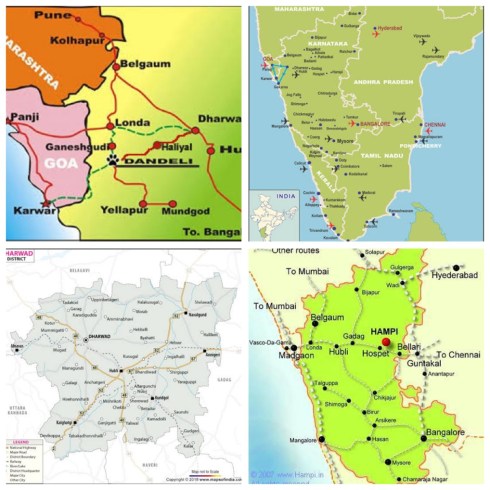
Most people associate Dandeli with white water rafting. Yes – its true that in S India this is probably the only white water rafting spot, there is a lot more to explore in this beautiful place. This area is located in the North West of Karnataka, bordering Goa and close to Maharashtra. Vast expanse of thick W Ghats evergreen forests bustling with wildlife, energising streams and waterfalls, simple good people  – and all of this in an environment that is clean, Eco friendly and sparsely populated. The Blue Triangle in Picture 2 is the place I am referring to.

We explored all of this in 4 days from Amara Homestay. A great discovery that stands out on 3 areas

  • A genuinely warm and friendly homestay that believes and implements Eco Tourism – where the concept of Atithi Devo Bhava is practised to perfection
  • Great location – the only homestay in the heart of the Kali Tiger Reserve
  • Outstanding Veg food – made fresh and served piping hot. Wide variety that is wholesome and tasty

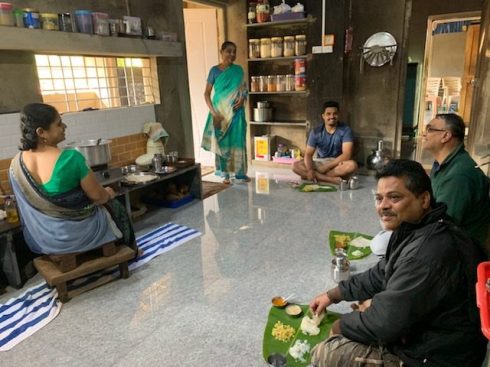
The Hegde’s own a 10 acre farm that has been part of the family for the last 500 years. Currently 4 generations live together happily. While farming is the core occupation, they started the homestay business about 12 years back. This is the best place to soak in the atmosphere of a N Karnataka Brahmin Havyaka community and relish Malnad Veg cuisine.They speak Konkani & Havyaka Kannada. We relished Kottai Idli, Kadabu, Rice Ajwain Patta, Tambli, Brahmi & Kokum juice and many more delicious dishes. Recipes from Archana (Click here for Recipes)


Everything here is fresh and natural. The food is grown locally in the farm – fully organic no chemicals, the water is natural spring water rich in minerals, milk is from their cows, the spices are ground fresh every day


Thats what keeps the locals healthy and strong. In the 4 days we spent here I did not see a single hospital or pharmacy store. On enquiry I learnt that there are no allopathy doctors in these villages. Everyone relies on grandmothers home made Ayurvedic potion and for serious issues like a snake bite there is an Ayurvedic doctor in the village

Getting here is easy

06589 Bangalore Mirajpur train leaves SBC at 9 PM and reaches Alnavar Junction at 6.30 AM. The ride from Alnavar to Amara is about 90 Min. You will reach your destination before 9AM and a hearty breakfast awaits you. The return journey on 06590 Mirajpur Bangalore is equally convenient – the train leaves Alnavar at 8PM and reached Bangalore at 6.30AM. Train operates every day.

This is not Dandeli 

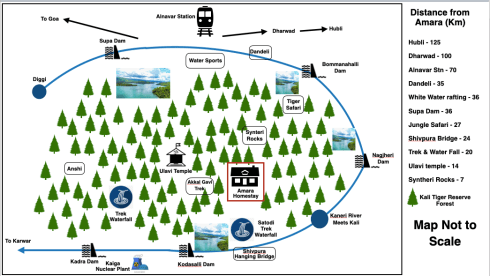
While everyone refers to this area as Dandeli – you are actually not in proper Dandeli town. Amara is located in Gund Village inside the Kali Tiger reserve forest. It is very conveniently located to all the major attractions that are 20 – 30 kms from there. Here is a not to scale visual representation of the area you will cover


This is Kali River territory

The Kali river is a short 184 km river. But it is ferocious. It originates from an underwater spring on the Goa – Karnataka border. Numerous springs and streams from the hills add to its flow. The heavy rains in the W Ghats adds to its charm and intensity.  The word “Kali” is not a reference to the Godess but to the black stones on the riverbed that gives the pure water a black colour. The river flows mainly through thick jungles and is not accessible for most of its course. In a short span of 50 Kms it has 5 dams and the 2nd largest backwater catchment area in Asia. Two of the dams store water for the Kaiga Nuclear reactors. The river then finds its way to the Arabian Sea along the Karwar coast.

This is also a Tiger Reserve 

The forest area around here was notified as the Kali Tiger reserve about 8 years back. Post that no new homestay / construction activity is allowed. Existing homestay continue to operate with limited capacity. Amara is the only operating homestay from within the Kali Tiger reserve.


Planning your time here – sights to see 


Ajit who runs the day to day operations at Amara put together a plan for us to maximise coverage of the sights. Each day we covered two areas.

Morning 9 AM  – 1.30 PM  session 1 , followed by lunch and a brief siesta and then the 2nd session from 3 PM to 6.30 PM. Our man Friday was Uday – the driver + Guide who went out of the way to show us the sights of the place and also spot a black panther and leopard.

Day – 1 : Morning session, Trek to a beautiful waterfall thru thick forests

These are sights which only the locals know. The drive was about 45 minutes and then a 1 hr trek ( up & down) to a beautiful waterfall that originates from an underground spring, the rivulet then joins the Kaneri river – one of the main tributaries of the Kali river. This waterfall is full of water all 12 months. On the trek we spotted many snakes peeping out of their holes. Take a change of clothes as you will enter the waterfalls and get drenched

Day – 1 : Post Lunch session, Boat ride to the Supa Dam backwaters and beautiful islands, Sunset viewing 

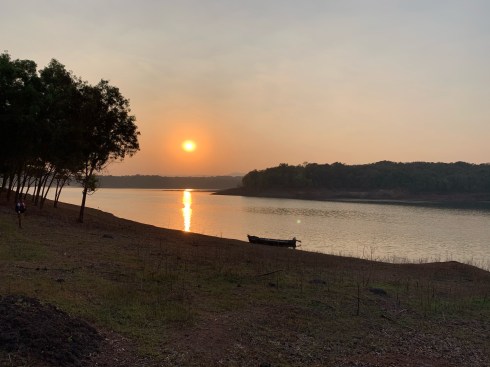
A nice drive thru dense forests we reach the vast expanse of backwaters of Supa Dam dotted with beautiful islands. The place is vast and not a soul in sight. But yes we spotted numerous birds and at least 20 of the rare Hornbills. The islands are calm and serene and a great place to view the sunset. On the way back Uday ensured that we started late and were driving around 7 PM – thats the time when you get a chance to spot the animals, we were lucky in spotting a rare Black Panther crossing the road.

Day – 2 : Morning session, Whitewater rafting

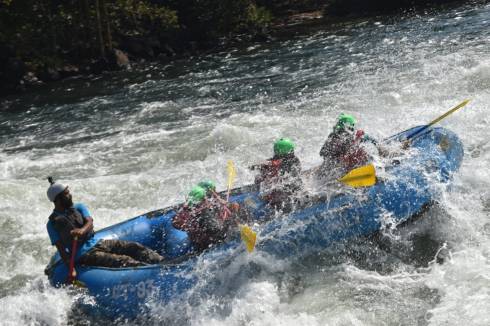
The white water resort that offers multiple activities is about 35 Kms from Amara ( 75 min drive). It was not crowded even on a Sunday. We took the 30 min, 1 km option for Rs 450/- which gets you a feel of a level 3 Rapid. We went by the same rapid  3 times. A longer option is a 8 Km rafting session across multiple rapids that takes a few hrs. This is priced at Rs 1450. Compared to the Rishikesh experience this was a cakewalk – very safe, so go for it. If you are wondering who took this photo – Rs 1400 extra gets you a professional photographer to shoot you as you tumble down the rapid and the guide on his iPro gives you a video of your rafting session. As expected this area is clean but commercial and crowded. Take a change of clothes. 

Day – 2 : Post Lunch , Syntheri Rocks 

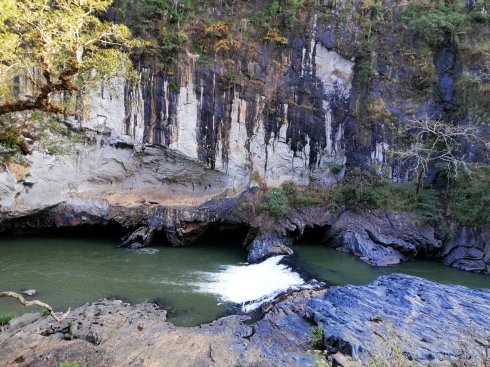
This is a nice view point located about 7 Km from Amara. The drive is less than 30 minutes. Its a walk down 200 steep steps to view the Kaneri river cut thru a steep cliff.

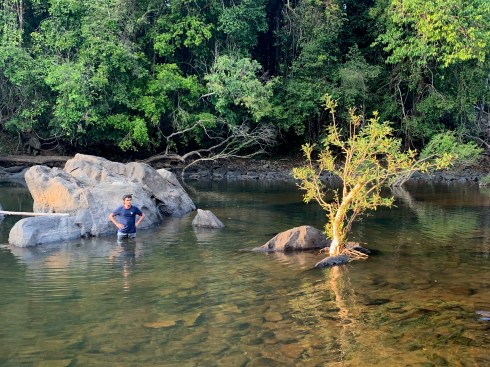
On the way back we stopped at an isolated location in the Anshi Forest and trekked thru dense jungle to the Kaneri river. The water level here during the rains rises by over 20 feet covering all the rocks, but now it was nice and calm. A great way to spend a few hours in the scenic beauty of the river surrounded by forests.

Day – 3 : You have two options 

Option – 1 : Dudhsagar 

My colleagues headed to Dudhsagar which is a full day trip. You drive to the Goa border and then the contact picks you up by jeep from there. You can then trek 26 Km (up and down) or drive all the way to Dudhsagar (1 Km trek). The 26 Km trek can be thru dense forests or along the rail track. If you decide to trek, it can be very tiring. You leave by 5.30 AM and get back at 9 PM, remember to carry water / snacks – there is no food on the route. Best time to Visit Dudhsagar is Sep – Nov immediately after the rains.

Option – 2 : Nature walk – Visit to the River etc

I stayed back and soaked in the atmosphere of the homestay. Spoke to the family members had meals in their house. Morning was spent in nature walk spotting birds and rare plants followed by a walk thru the Hegde’s 10 acre farm. Thats when you realise that life in a farm is hard work. You need to be multifaceted to manage the work all year around. They are so self sufficient that even 70% of their LPG needs are met from their Gobar gas plant.

In the evening we visited a neighbouring farm who are lucky to have the river flow along their border. How lucky can you get. I enjoyed my solitude sitting by the river and listening to the gurgling rapids.

Day – 4 : Jeeva Samadhi of Chinna Basaveshwara & trek to Akkal Gavi Caves 

The Jeeva samadhi of  the youth saint Chinna Basaveshwara is at Ulavi – 14 Km from Amara. This is a very famous site for the Lingayat’s of N Karnataka. A few Km from here is a trek to the Akka Nagamma caves. This is the place where Akka Nagamma hid her son (Chinna Basaveshwara) from the soldiers of the sultan who were trying to kill him (Around 1100 AD). The trek is a long one – but not difficult. There are 3 sets of caves. While there is a proper trail and steps – this is again thru dense forests.

You come back from the trek have lunch, a short nap and then by 4.30 you are ready to leave, to catch your train at Alnavar. On the way you may want to explore Shivaji’s fort (we did not) – but we did stop by the Crocodile park – that was disappointing.

So what we could not cover this trip 

  • The Jungle safari at Potoli gate Tiger reserve that operates between 6 – 8AM & 4 – 6PM
  • Shivpura Hanging bridge and Satodi Falls trek – Great place for sunset viewing
  • Diggi Hills – the source of the Kali River

I am sure I will come back to complete the list. Our friendly guide assured us that there were many more offbeat places to see which only the locals knew about. Best time to travel is April & Oct / Nov. April the hills are full of flowers and Oct / Nov the rivers are overflowing.

A few more points as you plan the trip 

  • Take the train – don’t drive from Bangalore – its a long 11 hr drive. You lose 2 days in the process. Train is convenient and you need a local jeep / guide to show you the places
  • Network coverage is poor – this is BSNL land. While Amara provides BSNL Wi Fi you will not get coverage on your Airtel / Voda / Jio phones.
  • The rooms are clean, functional & basic. Each cottage has a twin bed and a single bed + a mattress to accommodate a 4th person. Soap & towel are provided by Amara. Carry your toiletries. You get hot water and nice views.  Remember this is a homestay not a hotel
  • This is not a place for wild parties, loud music and liquor. Food is pure Veg. Respect the communities way of life.
  • The treks can be steep, carry good shoes. Carry change of clothes – the waterfalls and rafting will make you wet. Pack a rubber waterproof sandal – the river bed and waterfall area is rocky – good to have a footwear.
  • Carry water / snacks on the treks – there are no shops around these places. Carry your medicines.
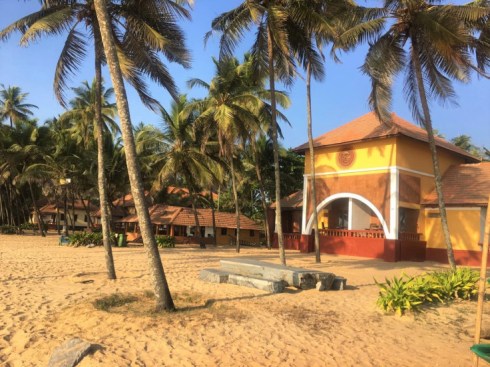
  • Dont forget to pack your binoculars – lots of birds to watch
  • This place is not at an altitude – but the dense greenery and rivers make it cold. Max temperature is 35 degrees. Nov – Feb can be cold. Minimum temp in Jan can be 6 – 7 degrees. Carry some warm clothes and socks. Especially if you are planning early morning trips
  • This is a place you will feel like visiting again and again – a group of friends from Pune have visited Amara over 20 times.
  • Most people who visit them are from Maharashtra / Belgaum / Hubli / Dharwad – Bangaloreans are yet to discover this place
  • Roads are in great condition – they are almost empty so people go fast. While its not hilly terrain many roads are curvy and zig zag. Restrooms are a challenge – that’s why you do morning and evening sessions and head back to Amara for lunch.
  • Carry something for the Hegde’s – the 4th generation kid Atharva is very cute and you will feel bad if you don’t carry some goodies for them. Remember they treat you like family – so you better reciprocate
  • This place is real Value for money – Rs 1600/- per person / day inclusive of all meals (Breakfast / Lunch / Dinner / Tea/ Coffee / Fresh Juices / Snacks). You rent a jeep that can accommodate 8 people – for Rs 2800/day , driver cum guide extraordinary comes free
  • Go as a group of 6 – 7 people, thats more fun

And one more thing…. 

The word Amara has two meanings, it means immortal – it also stands for the initials of the owners Ajit – Mangala – Ramchandran. Ajit has a Masters in Hotel Management and his wife Rachna in Fine Arts. The family is an ideal, happy, contended family. They are good people who work hard, lead a simple life and serve you like family.When you travel to a place like this staying in a homestay is such a great learning experience, dont miss that.

So do spare a few days and go visit them – Amara Homestay, PO Gund, Via Dandeli. https://dandeliamara.com


4 Generations of the Hegde family 


Some more Views from the trip …..

Everyone concentrating on breakfast


That is Kottai Idli and the freshest coconut chutney, the red liquid is jaggery syrup made at home


A view of the room 


The waterfall we visited on Day 1


Backwaters of Supa Dam


Helping accumulate the Arecanut 

Piping hot Neer Dosas being made on a 100 year old metal Tava by Mangala Ji 


Skill at work 

Explore Wayanad from the comfort of Tranquil Resorts

1 Feb

Sometimes its good to be landlocked with no train and airport connectivity. The beauty of Nature is preserved. Wayanad is the perfect example of such a place. Its as close to Bangalore as Ooty & Coorg but attracts less than 10% of the crowd. So if you are looking to soak in the best of un – trespassed nature nestled amidst the gorgeous western ghats – then head to Wayanad.

Wayanad is one of those holiday destinations that promise a little bit of everything – peace and tranquillity, stunning landscapes, nature and wildlife, trekking and camping adventures, history and culture, great food and excellent infrastructure.

We explored Wayanad from Tranquil Resorts (https://www.tranquilresort.com). A wonderful homestay with a great central location. Just 10 rooms in a 400 acres estate that grows Coffee /Arecanut / Exotic Fruits / Avocado and a lot more. It has the size of a resort but the warmth of a homestay. Tranquil has a history that dates back to 1896 and the current owners took over the property in 1994 and transformed it. The pedigree of the family is rich and diverse. Ajay – who runs the place is a great communicator and he can go non – stop narrating stories and anecdotes of family and guests who have visited Tranquil from all over the world. He is an amazing person full of positive energy. The passion with which they run the place would make you feel that they started this Home Stay last month – its been operational for 20 years.

Tranquil has 10 rooms – 5 garden rooms, a Tree Villa & Tree House, A Deluxe room, Luxury Suite and a 2 Bedroom Cottage. The place is warm, rustic and comfortable. The ambience is welcoming – The gardens are blooming with multitude of rare flowers and plants – all nurtured by Nisha (Ajay’s Wife), the dogs are friendly and the food is fresh, tasty and homely

We stayed at the Tree Villa – a huge room that can accommodate 4 and comes with 2 bathrooms and a large sit out. Its in the midst of the plantation surrounded with verdant greenery and great views and at 6.30 AM you can hear a zillion birds and if lucky the trumpet of an elephant. But as a family of 4 for the same price you could also take 2 Garden Rooms.

Its important that you choose the right place to stay. Waynad end to end is a 1 1/2 hr + drive , so if you pick a resort that at the edge of Waynad the drive from Bangalore is going to be very tedious. Also the Lakkadi view points at the Tip of Waynad is one of the wettest regions of the country. Tranquil is perfectly located – close to all the attractions and a 2 1/2 hr drive from Mysore.


Having decided to go to Wayanad and stay at Tranquil,

What can you do in Waynad 


There is a let to do. To cover all the sights may take you a week. The first step is to find a guide – you can do a lot more with the help of an able local. Ajay had patched us to Sabu Abraham – A bird watcher / trekker / nature enthusiast and a good human being. Sabu is associated with the local District Tourism Promotion Council. He was a great asset who helped us cover a lot of ground in the time we spent there (2 Nights) – so do contact him at +91 94479 52186.  You can also visit his website http://www.wayanad-naturetours.com

Trekking 

This place is paradise for trekkers. We climbed a steep hill called Kolagapara, a short drive from Tranquil. Took us 2 hrs – but it was intense and steep all along the way. There is also the Chembara peak which has a lake on the top. As you climb this hill the landscape changes – you see evergreen forests , grass lands and even a lake at the top. Professionals will head to Brahmagiri which is a full day affair. (70 Km from Tranquil). Close to Brahmagiri is an ancient temple Thirunelly

Waterfalls 

We visited the Kanthanpara falls. A very well maintained spotlessly clean picturesque waterfall. This was about 45 min from Tranquil. Two other beautiful waterfalls are Soochipara & Meen Mutty – both are located about about 20 Km from Tranquil.

Edakkal Caves 

A short 10 min drive from Tranquil gets you to Edakkal Caves. This is the only known place in India with Stone Age carvings. that date back to the Neolithic and Mesolithic ages (5000 – 6000 BC). Edakkal is said to have had links with Indus Valley – 400 signs discovered recently establish this linkage. Getting to the caves is not easy. A steep climb along a pathway for 1 Km and then 350 steps gets you to the caves. This place deserves a UNESCO World heritage tag. Its very well maintained

Opening 8.30 AM – Closing 4 PM. Closed on Mondays.

Banasura Sagar Earth Dam 

Second largest Earthen dam in Asia. Located about 1 hr 15 min from Tranquil. They have scenic walking trails and a nice lake.

Gurukul Botanical Sanctuary (https://www.gbsanctuary.org/ourstory.html)

Started on a small scale 40 years back by a passionate German environmentalist – its a place where endangered species of the W Ghats are are nurtured in a natural environment. The Gurukula Botanical Sanctuary is tucked away in the far away hills of the Wayanad forests of Kerala. It sits perched on a hillock by a perennial stream that flows all the way into the Bay of Bengal.

The Sanctuary is a patch of 50 acres of forests land of which some 40 acres are left largely alone for natural succession. About 5 acres is meticulously tended and doubles as a showcase for visitors to visit, explore, interrogate and comprehend. The Gurukula tends its forests on the principles of restoration ecology with careful, conscious human interference. Form the mosses, liverworts, ferns, orchids, lichens to the massive angiosperms, each one is documented, catalogued, tended and known by nature, place, origin, age and stage. You can schedule a trip here by calling them up.

Distance from Tranquil – 1 Hr 45 Min (Near Brahmagiri Trek)

Wildlife Sanctuaries 

The Muthanga wildlife sanctuary is located 25 Km from Tranquil. Booking is first come basis for a jeep ride and you have a good chance of spotting Elephants / Deers / Peacocks…. . Of the 3 sanctuaries in this area ( Bandipur / Muthanga / Kabini – Your chances of spotting wildlife is best in Kabini). Morning sessions start at 7 AM and evening at 3 PM. Weekend can be very crowded

Lakkidi View Point

Lakkidi is one of the highest locations in Wayanad, Vythiri is the nearest town. Three km from Lakkidi is Pookot Lake, a natural freshwater lake spread across 15 acres. It is one of the rarest reservoirs of water in Wayanad. Surrounded by meadows and hills, it is a favourite picnic spot. Lakkidi’s annual rainfall averages from 600cm to 650cm.

There are a few other places worth visiting – Jain Temple at Sultan Batheri, Lav Kush Temple etc. Locals say that a must visit is the Glass temple of Koottamunda situated about 20 km from Kalpetta. It is a famous Jain temple, on the slopes of Vellarimala. It is dedicated to the third Thirthankara of the Jains, Parswanatha Swami. The exquisite beauty of the temple owes a lot to its construction. There are icons of Parswanatha Swami and Padmavathi Devi in the sanctum of the temple. Mirrors are placed in the inner walls of the temple and you can see numerous beautiful patterns of the reflections of these idols in these mirrors.

A few  points about Waynad 

  • The word Wayanad comes from ” Vayal” – Paddy Fields and Nadu – “Land”
  • Wayanad is landlocked – shares borders with Karnataka & Tamil Nadu.
  • The altitude varies from 700 – 2100M. But the drive is not hairpin drive.
  • Given this altitude the weather is pleasant all year around – max temp is 32 degrees. lowest temperature in Dec – Jan is 10 – 12 degree. Rainy seasons can be very wet.
  • Given the range of altitude you will find a wide variety of flora and fauna – from deciduous trees to evergreen forests, pine trees and meadows
  • The place is well maintained and spotlessly clean. The roads are great – no potholes. the town of Sultan Bathery was picture perfect with neatly painted shops, flower pots on the pathways and not an ounce of garbage.
  • The town of Sulthan Bathery was formerly called Ganapathyvattam. During the invasion of Malabar by Tipu this town was used by his army as the storeroom or battery for his ammunition. Thus the town came to be known as Sultan’s Battery which later became Sultan Bathery.
  • The total size of Wayanad is only 2132 Sq Km (Thats smaller than Bangalore) of which 900 Sq Km is under forest cover
  • Dont be worried with the demographics of Wayanad – its not like Mirzapur or Meerut, its clean, efficient and beautiful.

Distances

  • Bangalore – Thotada Mane 144 Km (Restaurant break at Srirangapatna)
  • Bangalore – Mysore 159 Km
  • Bangalore – Tranquil Resorts 279 Km
  • Distances can be deceptive – a drive from Bangalore to Wayanad with a stopover can be a tiring 6 – 7 hrs. The Bangalore – Mysore stretch slows you down. Recommend a stopover at Mysore for the night, then you can reach Waynad the next day by 11 AM after a relaxed breakfast at Mysore
  • Once you leave Mysore there is no good restaurant / restroom break. So if you are driving non stop do a stop over near Mysore.
  • I would recommend this lovely place called Thotada Mane, its a few km off the highway. A very nice homely place where they serve fresh Veg food in a nice green ambience amidst fields. Clean restrooms. Make note of the timings – they are normally open from 8.30 – 3.30 and closed on Mondays.

A Few points about Tranquil 

  • Network connection is great – your 4G works very well, rooms have TV.
  • Room rates are inclusive of Breakfast & Dinner.
  • Bird watching and walking around the Plantation – Budget for 2 hrs
  • The garden rooms are located in the main building adjacent to the owners house. These rooms face the garden and share a common verandah. Rooms come with two speerate twin beds. The bathrooms are very spacious
  • Tranquil serves Beer – but other liquor you need to get from local stores. Remember you can’t carry liquor from Karnataka to Kerala. The Govt stores have a premium counter with no Q
  • Get your emission test, carry your Car documents – the Cops may trouble you at the border
  • Waynad is the place to buy spices – great quality at excellent prices. So visit a wholesaler and stock up on Pepper / Cashews / Turmeric / Kokum / Coffee etc
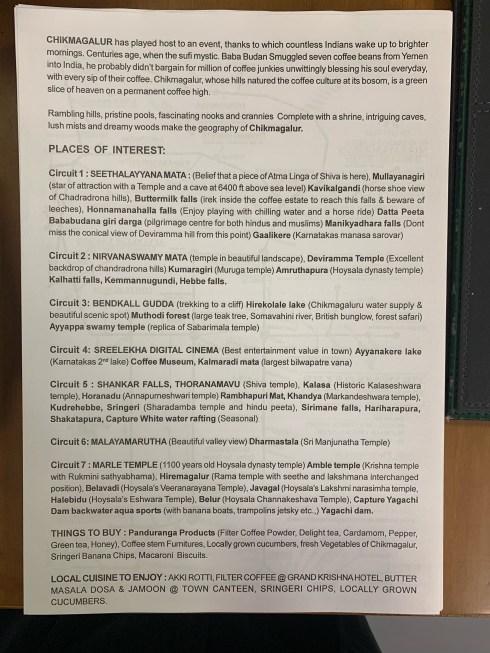
 

Exotic flowers – we spotted the rare Dutchman’s Pipe and a leaf that is like sandpaper


The full moon was brilliant from our room, and thats freshly plucked Coffee beans being spread for drying.

A Coffee shrub with densely packed Coffee beans and views from our Trek.

IBNII @ Coorg – A Jewel in the Crown

3 Dec

Coorg is home to some of the finest resorts not just in India but globally. Given its close proximity to Bangalore we end up going every 3 years and our past stay at Evolve (Earlier Orange County), Taj and Tamara was wonderful. This trip we discovered  IBNII – a wonderful luxury Eco Resort, and I feel it may just pip the others to win the Jewel in the Crown tag.

So what makes IBNII unique?

Blending with nature 

120 Acres of dense evergreen foliage and only 34 cottages that are almost camouflaged. The structures at IBNII seem to disappear into the landscape or flow into the contours. The design is aesthetically done. IBNII means a dew drop – and the creators of this property have treasured every drop of nature in their premise.  I believe the brief given to the architect was that no tree was to be chopped while building the property, so the designers found niches and built the structures around them. You will see this design philosophy across the entire property – from the flying coffee shop, cascading pools to the hidden Spa.

Nature First

The spirit of IBNII is Eco Consciousness. Even if it threatens commercial viability. One of the first things constructed was a check dam to store all the water from the rains and make IBNII self sufficient. The water body created is so large it feels like a large lake with a wide variety of fishes.
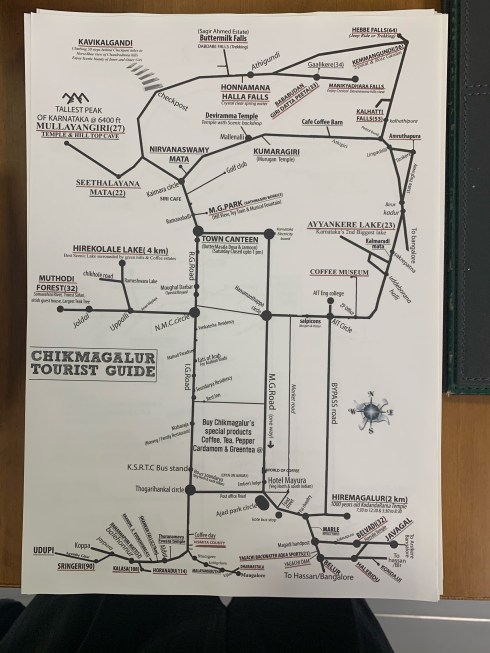
They have some very interesting concepts. Firstly to avoid radiation there are no cell towers – all of you have is good strong Wi Fi. Food wastage at the restaurant is penalised – so please be careful and fill your plate only with what you can eat.
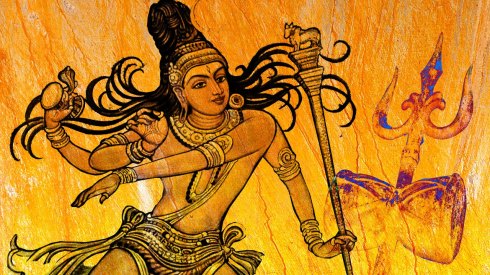
A Healthy Lifestyle 

Fresh air, greenery, lovely cool climate – add to that a healthy lifestyle. Cooking does not include Sugar and even for tea/coffee you are given sugar cubes only if you insist (Normal is jaggery syrup). Maida is sparingly used, white bread is not recommended. No preservatives, no colours and no baking soda. Thats why you will not find Chinese food in the menu here. They have a small organic farm from where ~ 50% of their daily needs are met, and efforts are on to expand the farm.

One rate that’s all inclusive 

Many resorts fleece you on dining costs. At IBNII that rate you pay includes all meals – breakfast, lunch & dinner. And the evening tea/ coffee at the coffee shop is also free. Now thats a deal. The restaurant serves an excellent variety of multicusine food across all meals. And most importantly service is fast and efficient.

A lot to keep you busy 

On our 2 night trip we did not feel the need to step out of the property. ( although we did find time to visit an ancient Shiva temple built by sage Agastya at Guhya on the banks of the Cauvery). From morning to evening there is a lot happening to keep you busy. I missed the trekking and fishing – but those I was told are getting added soon. It would be nice to have some cultural entertainment during dinner – music / dance performance etc, probably because of COVID that was not possible.


How do I choose my room?

There are only 35 rooms here. 22 are pool villas (Kopi Luwak), 12 are wooden cottages (Arnetta) and the exclusive royal Presidential Suite (Poinsettia). Rooms are beautifully done up with excellent views. the bathrooms are large and spacious and built with separate doors for all sub units

Point to note there are only 2 family rooms, these are two adjacent Wooden Cottages with a connecting door. While individual Wooden Cottages are Couples only the Pool Villas can accommodate an additional adult or children. The family units are not listed on the website so when you call ask for them (The rooms we stayed was 210 – 211)

A few more points to help travellers 

  • Location – Its bang on the highway. So no last mile problems. The drive from Mysore is 2 1/2 hrs. Good roads all through
  • The electrical buggy drops you and picks you up during check out. the rest of the time you walk. The walk ways are cemented and broad and run almost 9 kms thru the property. A walk to the restaurant / coffee shop etc is 5 – 10 min and not steep.
  • Morning coffee is served only at 7 AM – but you have a complicated high end coffee machine in the room. If you can figure out how to use it then problem solved.
  • I did not use the Spa but it seemed well equipped – in addition a wellness centre is coming up.
  • You can pick up pure organic Turmeric / Coffee / Pepper / Honey ( seasonal) that they grow at IBNII. Its very reasonably priced
  • The service at IBNII is efficient and subtle. Food menu consists of Veg & Non Veg
  • Drivers stay for free and the food is charged very nominally – I think it was less than 250 Rs / day for all 3 meals.
  • For more details https://www.ibnii.com

And finally some inputs / critical appreciation to the founders of IBNII and resort owners at Coorg….. 

While we enjoyed the trip my daughter mentioned on the return journey ” All the resorts we have visited in Coorg look and feel the same

IBNII is a an example of a great product that is missing a distinct positioning and packaging. Thats the same with most of the amazing resorts at Coorg. The owners have spent upwards of 500 – 1000 Crores in building up these fabulous properties, but they all seem to be almost 90% same. The unique branding opportunity is missing. Ananda in Rishikesh has a clear positioning – Ananda Spa, Swaswara in Gokarna has a unique positioning – healthy food and wellness , Shreyas in Bangalore is about Self Discovery & wellness targeted at the solo traveller. IBNII needs to find a positioning like this and build services to deliver the promise. Its an opportunity to make the property unique and sought after in India.

Coorg is such an amazing place it can establish itself like Bali or the French Riveria on the global tourism map. This requires working with the local authorities to create more experience led activities. If you don’t want Coorg to become an Ooty or Simla price it accordingly.

Experiencing nature – Trekking (not the run of the mill tracks but offbeat), experiencing the beauty of the Cauvery river, Bird watching, building a mini botanical garden …. there is a lot that can be explored to attract serious tourists from across the globe who will come and spend a week or more.

Gitanjali – A Warm & Cozy Homestay @ Mysore

30 Nov

When I was telling a friend that I have travelled far and wide but was yet to explore Mysore, I was reminded of this beautiful poem by Rabindranath Tagore. Writing on Gitanjali its a nice coincidence that I quote from this great poet.

Ekti sishir bindu (the glistening dew drop)

I traveled miles, for many a year,
I spent a lot in lands afar,
I’ve gone to see the mountains,
The oceans I’ve been to view.
But I haven’t seen with these eyes
Just two steps from my home lies
On a corn of paddy grain,
A glistening drop of dew

For most Bangaloreans Mysore is a convenient lunch stopover on the way to Coorg / Ooty/ Kabini / Waynad etc. The Palace, Zoo and Brindavan gardens is probably all that we have seen. But there is a lot more to Mysore and one of these days I plan to spend some time and explore the bye-lanes of this beautiful and historic, traditional city.

When I do that I will be staying at the Gitanjali Home stay. We spent a night here on our way to Coorg and fell in love with the warm and cozy place. Nestled on the verdant green foothills of Chamundi Hills, it is just 4 kms from the heart of Mysore city. Gitanjali is a 10 Acre property that was owned by the family. They have now built their house in 1.5 acres and the rest have been sold as 1/4 acre plots – almost all of which are vacant.

The entire area is lush green and on a late Nov morning at 6 AM it was a refreshing sight as I went out for a stroll, to be greeted by numerous birds. I believe a birdwatcher who stayed here spotted  80 varieties of birds that come visiting. We met at least 10 of them in 10 minutes.

So what’s special about Gitanjali?

  • Its a genuine homestay. The owners and their parents live here. You are welcomed by them, you socialise with them and they serve you the food they cook at home. It feels warm and nice and their hospitality is excellent.
  • Food is fresh, tasty and homely. The spread was decent and included all that you needed and more. Mainly Veg but included one Non Veg Dish. We had dinner and breakfast and were treated to some Kodava specialities.
  • There are 4 rooms – ideal to accommodate 2 people/room. So if you come as a group you can book the whole place. The rooms come with 2 single beds but are large enough to accommodate a third one.
  • All the rooms share a large common verandah that has a hammock and a swing and comfortable chairs where you can sip coffee and admire the landscape

  • Rooms have 24 hrs hot water (solar) and power backup. They are equipped with AC & fan and lots of hooks / storage.
  • Rooms are clean , spacious and very comfortable. Bathroom is large and airy. Bedsheets and curtains are done up tastefully. There is an eye for detail and this is the only place I found a small scissor next to the tea bag/ milk sachet with the kettle. 
  • Being nature lovers they have done their bit for Eco Conservation and responsible tourism. The organic garden and zero pesticide usage has helped in fresher air and more birds and insects. They have implemented a well researched rain harvesting system that can harvest a million litres of water from the rooftop.
  • They have been running this place efficiently for 16 years and the professionalism shows.
  • Its the perfect place to stay for a few days and explore Mysore or make it a transit point when you are headed beyond Mysore

A Few more points 

  • Cell phone signal is good and the homestay provides you with free Wi Fi
  • You can park your car but there are no driver rooms. Our driver easily found a clean affordable accommodation near the Mysore Zoo (Shradana Lodge)
  • Not a place where you may want to drink / party and make noise – this is families home and they have Sr Citizens staying with them
  • There is an excellent Spa close by which has a tie up with Gitanjali, you can book a session and visit them
  • And they have two adorable dogs.
  • Inspite of being. homestay its not cheap and many a Tim you may find the Radisson next door to be cheaper. Prices are inclusive of only breakfast

For more details reach out to Yamuna at +91 8212474646 or +91 9886117919 or visit https://www.gitanjalihomestay.com/

Family guide to Trekking around Bangalore

9 Oct

So what if COVID has impacted all your travel plans. Bangaloreans are lucky to be surrounded by beautiful nature spots in their backyard. A mere 50 – 100 km from the city is a paradise of hills, lakes, cliffs, waterfalls, rivers to explore. Almost all of which is an easy 6.30 – 3.30 day trip.

Trekking is a great outdoor activity that you can undertake with friends and family during this COVID season. Trekking can be fun – but one wrong step can cause a serious accident. Take the help of a specialist. Not only do they guide you on the safe techniques to climb up and down but they also know the best places to park the car, camps for picnic & restroom breaks. It really takes a lot of your head when you have an able guide in your midst. My initial trips in the past were solo trips but the last few months I have been taking the help of Nandish & Vani who have been my guide for all the treks. I have recommended them to many of my friends who have enjoyed the experience. So when you plan your trek do reach out to them, Nandish +9731140126

I am listing down the treks that I have done from the toughest to the easiest.

Savandurga

  • Location – Off the Bangalore Mysore Road, 50 Km from Bangalore, Take the Magadi Road from Ramanagara and head towards the reserve forest. Elevation 1226 M
  • Level –  I found it Very Difficult (9/10) Skandagiri, Savandurga and Madhugiri are the 3 toughest treks in and around Bangalore. Steep slopes, barren rock, long trek. To be done with care and precaution, many accidents have happened in these treks.
  • Time to Trek – 2 – 2 1/2 Hrs up and 1 hr 45 min down
  • Landscape – Its located in a reserve forest close to the Arkavathi river and the Manchanabele Dam. Savandurga is the largest monolithic hill in Asia so the climb is mainly on barren steep rock. No green cover, no water bodies. 70% of the climb is on steep inclines. Gets very hot during the day.
  • Other Points – There is a temple popular with the locals at the base and a small Nandi on the Top. Has remnants of a fort that was built by Kempegowda and later used by Haider & Tipu, before the British took it over. Used to house prisoners. Dont use your snow boots/ Himalayan Quecha trek boots for these rocky climbs. Use rubber soled Reebok / Nike shoes with grip. carry lot of water and some healthy snacks with you. Breakfast spot – A2B or Malgudi Vattika

Madhugiri

  • Location – Off the Tumkur Road, 100 Km from Bangalore, Take a right turn from the highway below the underpass before Dobaspet. Elevation 1200 M
  • Level –  I found it Difficult. (8/10). Steep slopes, barren rock, long trek. To be done with care and precaution. One stretch is steep and windy, need to be extremely careful. Some part has steps and railings.
  • Time to Trek – 2 Hrs up and 1 hr 30 min down
  • Landscape – The road leading to Madhugiri is beautiful and green with hills, lakes and forests all around.
  • Other Points – Its named Madhu Giri because of the huge honeycombs that were present on the hill. Its a large monolithic hill. It houses one of the 9 forts surrounding Bangalore. Fort is in ruins. No restaurants close by, you need to come to main Tumkur Road for lunch, so carry water, snacks, fruits with you. Breakfast stop on Tumkur Highway – Sree Rathnam

Channarayadurga

  • Location – Off the Tumkur Road, 100 Km from Bangalore, Take a right turn from the highway below the underpass before Dobaspet. On the way to Madhugiri, beyond Devrayanidurga. Elevation 1188 M
  • Level –  Difficult. (7/10). Steep slopes, barren rock. To be done with care and precaution.
  • Time to Trek – 1 1/2 hrs up and 1 hr down. No steps.
  • Landscape – The road leading to this trek is beautiful and green with hills, lakes and forests all around. As you trek up there are nice green spots. 50% of the trek is up steep rock and the rest has greenery.
  • Other Points – Channarayadurga is a village.  It is one of the nava-durgas (‘nine-forts’) around Bengaluru. This 1139m hill was fortified by Channapa Gauda, a chief of Madhugiri in about the middle 17th century and was later taken by the Marathas. It was also under the control of the Mysore Rajas during whose regime the name of the place was changed to Prassannagiri. In one of the inscriptions, dated 1766, the hill is called Channarayanadurga. The ruins of this majestic fort is inquisitively structured with ancient temple, dungeons, granaries and other ancient structures. Breakfast stop on Tumkur Highway – Sree Rathnam

Shivaganga 

  • Location – Off the Tumkur Road, 70 Km from Bangalore, near Hospet take a left. Height 1300 M
  • Level –  Moderate (6/10). Steps for most of the trek, last stretch is steep with jagged rocks. Lots of monkeys angling for food and your bags. carry a stick to chase them away.
  • Time to Trek – 1 1/2 hrs up and 1 hr down. Most of the Trek has steps and there are temple stops on the way.
  • Landscape – Rocky and breezy. there are halting points on the way that give you a breather.
  • Other Points – Many temples Enroute and a small temple at the top, very windy. Famous for a suicide drop point – Shanthala, named after a queen who committed suicide by jumping from there. Hill is shaped like a Shiva Lingam and is also the source of an underground water body. Juice and snack outlets at the top. Breakfast stop on Tumkur Highway – Sree Rathnam

Nandi Hills

  • Location – After Devanhalli airport take a left turn. 75 Km from Bangalore. Elevation 1478M
  • Level –  Moderate (5/10). Steps for most of the trek, very green trek.
  • Time to Trek – 1 hr up and 45 min down. Most of the Trek has steps.
  • Landscape – Green trek, nice breeze. There are multiple paths to trek up.
  • Other Points – Lots to see on the top including a beautiful stepwell and an ancient Chola temple. At the foothills of the trek – there is an ancient Shiva temple that is very large and well maintained – Bhoganandeeshwara temple. Mayura Restaurant at top – but service and food is bad. Visit Nandi Grand at the turning from Highway for breakfast / lunch.

Antarganga

  • Location – On the Old Madras Road near Kolar. Altitude 1712 M
  • Level –  Easy (4/10). Steps for most of the trek, very green trek. But the challenge is not the trek – the fun part is squeezing yourself past the rock crevasses once you go to the top.
  • Time to Trek – 1 hr up and 45 min down. 1 Hr at the top. Most of the Trek has steps.
  • Landscape – Green trek, nice breeze.
  • Other Points – Your guide will be a small kid from the local village. May need permit. Temples at the foothills. Antar-Gange literally means Ganga from Within/Ganga of the deep in Kannada. It is a huge field of boulders and rocks. Located at an altitude of 1712 m above the sea level, the boulders are amassed one on top of the other to appear like a cave. This network of cave formations makes this place famous for cave exploration and easy trekking. There are two ancient temples in Kolar close by which you must visit – The Kolaramma temple (Durga) and an ancient Chola age Shiva temple. Stop by for breakfast at Nandi Grand or Mayyas

Haddina Kallu (Eagle Stone Hill) 

  • Location – On the Mangalore highway towards Hasan
  • Level –  Easy (4/10). Steps for most of the trek, very green trek.
  • Time to Trek – 1 hr up and 45 min down. Hanuman temple at the top.
  • Landscape – Green trek, nice breeze.Towards the top there is some garbage. Avoid that and move to the hill top that is green and empty. You may have to cut thru forest and shrubs.
  • Other Points – Locals walk without footwear. Some people may insist you do the same. But you can bypass the initial entry part and walk up the hill from the side. New restaurant called Paakshala that serves excellent food, spotlessly clean bathrooms is located very close to the trek point on the highway. Cut in median allows you to access the restaurant easily.

Ramadevara Betta (Vulture Sanctuary) 

  • Location – On the Bangalore Mysore Highway off Ramanagara. Take a right turn under an arch near Ramanagara town. Elevation – 3000 feet
  • Level –  Easy (4/10). Initial part has 400 steps leading to an ancient Rama temple. (name ramanagara comes from the fact that Rama is supposed to have lived here in the area of the temple). After the temple a short 15 min trek to the hill top. Amazing views from the top. Very green trek.
  • Time to Trek – 1 hr up and 45 min down.
  • Landscape – Green trek, nice breeze.Nice Temple with a small clean lake that has water all the time. Lots of flowers.
  • Other Points – Locals claim that this was the place Lord Rama spent some time on his way back from Lanka. The small Rama Temple and lake next to it is very serene. Add Sholay shooting spots to this trek – Its a short few min drive from here. This is the Ramgad of Sholay fame. You will ned help to get there walking through some tough shrubbery and undergrowth. A nice camping site is close by where you can stop for a picnic lunch. Claimed to be a Vulture Sanctuary none are visible now. Breakfast at A2B or Malgudi Vattika. Pack your picnic lunch

Muthurayanabetta

  • Location – Muthurayanabetta is about thirty-five km from Bangalore near Ravgudlu, Off the Kanakpura road, the green and irregular countryside is an idyllic destination for a quick weekend getaway. Light trek up Muthurayanabetta that stands like a tower on the edge of a panoramic landscape is also a wonderful destination for camping.
  • Level –  Easy (3/10). Very green trek, perfect for a warm up family trek
  • Time to Trek – 45 Min up and 30 min down. Its a nice green trek.
  • Landscape – Green trek, nice breeze. Small temple at the top. Lots of water bodies and flowing plants as you walk up.
  • Other Points – NASA is a food court enroute where you can stop for breakfast / restroom.

Avani 

  • Location – Old Madras Road, 20 Km after Kolar take a right turn and drive a few km thru villages. About 80 km from Bangalore
  • Level –  Easy (3/10). Rocky terrain , clean track. This is pilgrimage route for the villagers who believe that Sita spent some time here.
  • Time to Trek – 1 Hr up and down
  • Landscape – Rocky boulders. Surrounding is green fields and water bodies. Small temple at the top.
  • Other Points – Stop by for breakfast at Nandi Grand or Mayyas. Avani is known for the Sita temple situated on a hill. This temple is one of the few temples dedicated to Sita in India. There is a belief that the sage Valmiki was residing here. Avani is also known as the Gaya of the south and has ancient temples known as the Ramalingeshwara, Lakshmaneshwara, Bharateshwara and Shatrugneshwara, dating back to the period of the Nolamba Dynasty and later renovated by the great Cholas


Narayangiri Hills 

  • Location – Mysore Road – take a right turn at Ramnagara and head towards Jalamangala. Its a scenic drive through mango orchards and farms. After about 20 Km from the Mysore Highway you start seeing many hillocks. The Narayangiri hill is adjacent to a large lake. Distance from Koramangla 80 Km.
  • This hill is 3800 feet in height.There is a small temple at the top of Lakshmi Narasimha which is open to only on weekends
  • Level –  Easy (3/10). Nice track – road for car being made ( earlier it was a trek up the hill) – about a 1000 easy steps after that. Takes 45 minutes to get to the top if you walk all the way. Cars / Bikes can go upto the steps now.
  • Time to Trek – 1 1/2 Hr up and down
  • Landscape – Green and pleasant. Lovely views. No crowd – totally empty ( we visited on a weekday)
  • Other Points – Stop by for breakfast at Kadamba. The last mile from Jalamangala you may have to ask the locals. No shops close by.

Other Treks around Bangalore that I am yet to do. 

  • Makalidurge  – Near Devanhalli, Requires permission from Forest Department
  • Skandagiri – Near Nandi Hills one of the toughest treks
  • Channagiri – Near Nandi Hills
  • Chunchi Falls – Kanakpura Road

Plan your treks with Nandish  – 9731140126

Get in touch with this passionate couple to plan your day treks around Bangalore or to venture beyond to Coorg, Kudremukh, the W Ghats, Dandeli … . They deliver a lot of value and are great with kids.

Before I sign off one last point I want to reiterate – Treks can be fun but you got to be serious, being foolhardy and one wrong step can put you in serious trouble.