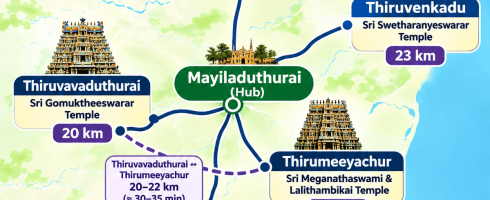
I recently did a nice trip with Mayiladithurai as a hub with my good friend. Mayiladuthurai is a district HQ and was formerly known as Mayavaram. It was earlier part of Thanjavur and later Nagapattinam district before it was carved out as a separate district in Dec 2020.
This is the heartland of TN, Cauvery Delta and Chola territory – every 20 Km you will find ancient temples that are over 1000 years old. So let’s start exploring.
How to reach Mayiladuthurai
Located about 40 Km South of Chidambaram it’s a 7 hr drive from Bangalore. There is a direct train from Bangalore.
- Train 16232 (Mysuru → Cuddalore Port): Departs Mysuru at 16:15 and KSR Bengaluru at 19:00, arriving at Mayiladuthurai Junction (MV) the next morning at 06:45 (departing 06:48)
- Train 16231 (Cuddalore Port → Mysuru): Departs Cuddalore Port at 16:30, arrives at Mayiladuthurai Junction at 17:47 (departs 17:50), and reaches KSR Bengaluru at 05:35 and Mysuru at 08:35 the next morning.
Where to Stay
It’s a small town and the best place to stay is Krishna Residency. Nice clean rooms, and good restaurants next door. The Coffee shop attached to the hotel opens at 5 AM – they take only cash. Hotel also prefers cash but they grudgingly take GPay. Nice AC Room costs ~ 2800/Night for double occupancy inclusive of breakfast.
What Can I cover
This is temple land so every 20 Km you will find amazing ancient temples. Kumbakonam the land of 1000 + temples is close by so you can get lost. We covered the following
Mayuranathar temple – Mayiladithurai. It’s a 5 min walk from the Hotel. You can cover this on day 1 evening
- Name Origin: Translates to “the town where the peacock danced,” rooted in Hindu mythology where Goddess Parvati worshipped Lord Shiva in the form of a peahen.
- Rare Iconography: Features Lord Shiva performing the rare Gauri Thandava (instead of Ananda Thandava), a 25-faced Maha Sadashiva murti, and a unique tradition where Lord Murugan receives his Vel directly from Shiva rather than Parvati
- Spiritual & Mythological Significance: Houses 16 Shiva lingams (where 16 circumambulations on a full moon equal the Tiruvannamalai Girivalam) and includes a shrine for Aadhi Mayuranathar, commemorating Parvati’s penance as a peahen.
- Architecture & Administration: Rebuilt in stone in the 10th century by Chola queen Sembiyan Mahadevi, the sprawling complex features a 160+ foot nine-tiered Rajagopuram and is managed by the Thiruvaduthurai Adheenam
- On the 1st Monday of the Karthigai month you can witness the Shankha Abhishekam, we were lucky to be there that day
After visiting this temple you can proceed to the Dharmapuri Adheenam. A centre of Shaiva Siddhanta that is close by – 10 min drive.
Day – 2 : We cover 3 Temples
Gomukteshwarar temple. 20 Km from our hotel, 30 Min drive through paddy fields. Excellent roads – Budget 1 Hr for this temple
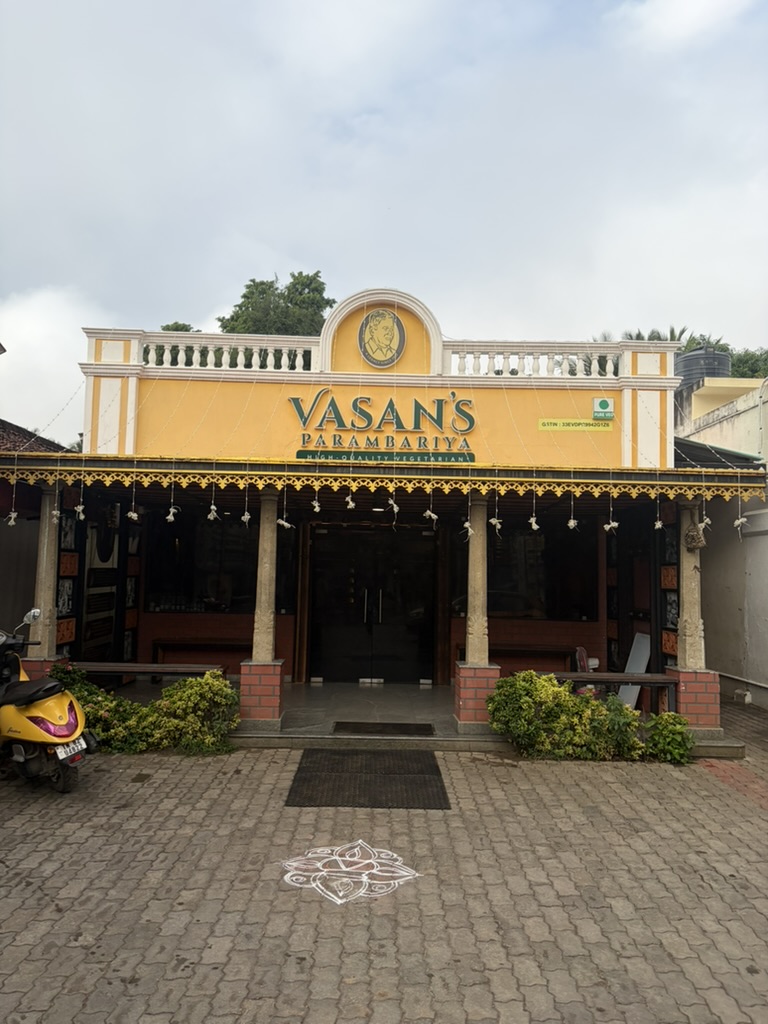
After a nice breakfast at Vasan’s we headed out to Thiruvavaduthurai. Located between Mayiladuthurai and Kumbakonam to visit the Gomukteshwarar temple.
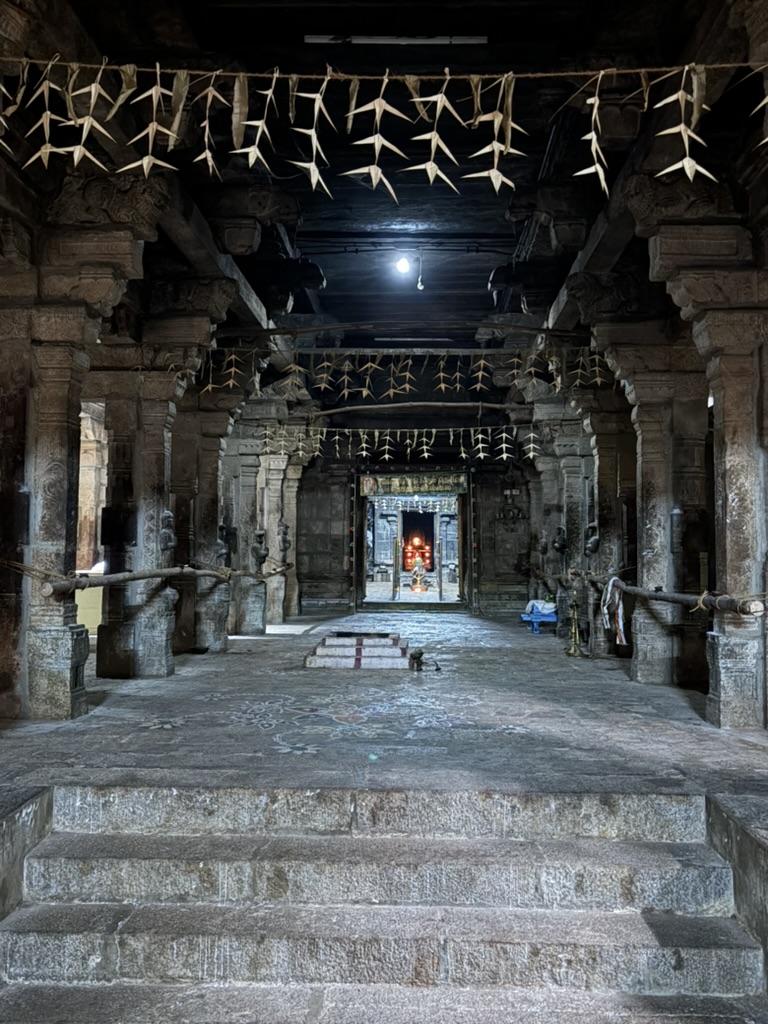
Revered as one of the 275 Paadal Petra Sthalams praised in 7th-century Thevaram hymns, the temple is famous for its colossal Nandi statue, its deep connection to the Siddhar saint Thirumoolar, and as the headquarters of the Thiruvaduthurai Adheenam. The temple is large and empty …. Not a soul. Enjoyed the place.
Interesting points about this temple
- Liberation of the Sacred Cow (Gomukthi). According to legend, Goddess Parvati was cursed to take the form of a cow (Go). She bathed in the temple tank and poured her milk over the self-manifested (Swayambhu) Shiva lingam here until Lord Shiva liberated her from the curse—giving the town its name (Thiru-a-vadu-thurai, the sacred place where the cow worshipped) and Shiva the name Gomuktheeswarar.
- Saint Thirumoolar & the Thirumandiram. The 6th-century mystic and Siddhar Thirumoolar meditated beneath the temple’s sacred peepal tree (Padar Arasu) and composed the Thirumandiram—a foundational 3,000-verse Tamil Shaiva Siddhanta scripture. A dedicated shrine in the outer courtyard marks his Jeeva Samadhi (final resting place)
- Childhood Miracle of Thirugnana Sambandar. When the child-saint Sambandar needed funds to support his father’s Vedic rituals, Lord Shiva sent a Bhootagana (celestial attendant) to place an inexhaustible purse of gold coins upon the temple’s altar (Balipeedam)
- Colossal Viswaroopa Nandi. Standing nearly 14.5 feet tall, the temple’s primary Nandi is one of the largest in Tamil Nadu. Notably, you will not find smaller Nandi statues perched on the temple’s outer compound walls; legend holds that all the temple’s Nandis merged into this single giant form to protect devotee Thirumaligai Thevar from an invading royal army
- Three Suns & No Navagrahas. Unlike most South Indian temples, there is no separate shrine for the Navagrahas (nine planetary deities). Instead, the temple uniquely features sculptures of Three Suns(Surya) gracing devotees together
- Early Chola Stonework. Originally a brick shrine in the 7th century, it was rebuilt in granite during the reign of Chola king Parantaka I (10th century) and later expanded by Rajaraja Chola I. It features a five-tiered Rajagopuram, three concentric courtyards (prakarams), and three sacred tanks (Gomukthi, Padma, and Kaivalya)
- Monastic Headquarters. Situated right alongside the fourth precinct is the Thiruvaduthurai Adheenam, one of Tamil Nadu’s oldest and most influential Shaivite monastic institutions, which actively maintains the temple and preserves centuries-old Tamil palm-leaf manuscripts.
Thirumeechiyur : Sri Meghanathaswamy & Lalithambigai Temple
This temple is on the way from Mayiladuthurai to Thiravur … a short detour. From Thiruvavadathurai it was a 20 km drive again through rustic landscape with nice roads – 35 – 40 min.
Budget 1 hour for this temple.
- Deities & Location: Located near Peralam (about 18 km south of Mayiladuthurai), the temple is dedicated to Lord Shiva as Meghanathaswamy and Goddess Parvati as Sri Lalithambigai.
- Birthplace of Lalitha Sahasranamam: It is revered as the sacred site where Sage Agastya first recited the 1,000 names of the Goddess to calm her fierce energy after slaying Bhandasura. Hayagriva had imparted the knowledge of the Lalita Sahasranamam to Sage Agastya at Kanchi Kamakshi temple.
- Unique Goddess Iconography: Goddess Lalithambigai is depicted as a serene empress seated on a Sri Chakra throne; a hollow space beneath her pedestal allows priests to gently chime her anklets after daily rituals.
- Mythological Birthplace: It is believed that Garuda, Aruna, Yama, and Shani were born here and worshipped Lord Shiva at this shrine.
- Architectural & Sculptural Highlights: Rebuilt in stone by Chola queen Sembiyan Mahadevi, it features an elephant-back (Gajaprishta) tower, a dual-expression sculpture of Shiva soothing Parvati, and an eight-armed Durga holding a parrot.
- Annual Solar Phenomenon: Every year between Chithirai 21 and 27 (early May), the morning rays of the Sun fall directly onto the main Shiva lingam.
Thyagarajaswamy Temple in Thiruvarur
Budget 2 – 3 Hrs for this temple. I loved this temple and I plan to keep visiting every time I am in Chidambaram. It’s a 2 Hr drive from Chidambaram.
We came back to the hotel and after lunch and a short nap headed out to Thiravarur. It’s about 40 Km from Mayiladithurai – 1 Hr drive.
The Thyagarajaswamy Temple in Thiruvarur is one of India’s largest and most revered Shaivite complexes, celebrated for its monumental Chola architecture, Asia’s largest temple chariot, a Water Tank as large as the temple complex and deep ties to Carnatic music.
An amazing temple it’s a hidden secret and frequented only by people from Tamil Nadu. But do take time and visit this temple. It’s spotlessly clean and a treat to visit.
According to the legend of Thiruvarur, King Muchukunda Chola helped Indra, the king of the Devas, defeat the demon Valasura, and as a reward, requested the sacred Lord Thyagaraja (Somaskanda) idol that Indra worshipped. (Indra had got this from Vishnu) Reluctant to part with it, Indra had six identical replicas created and challenged the king to identify the original, but guided by divine grace, Muchukunda chose correctly and was gifted all seven idols. Muchukunda brought them back to the Chola kingdom, installing the original idol at the Thyagaraja Temple in Thiruvarur and consecrating the remaining six across neighbouring temples, collectively forming the sacred Sapta Vidanga Sthalams.
Monumental Scale & Shrines: Spanning over 30 acres with 9 gopurams and 5 courtyards, it holds the record for the most shrines in a single Indian temple—including 365 Shiva lingams representing the days of the year and 86 Vinayaka idols.
Vatapi Ganapati Shrine: Houses an ancient Chalukyan-style idol of Vatapi Ganapati (among the 16 Shodasha Ganapatis praised by Carnatic composer Muthuswami Dikshitar.
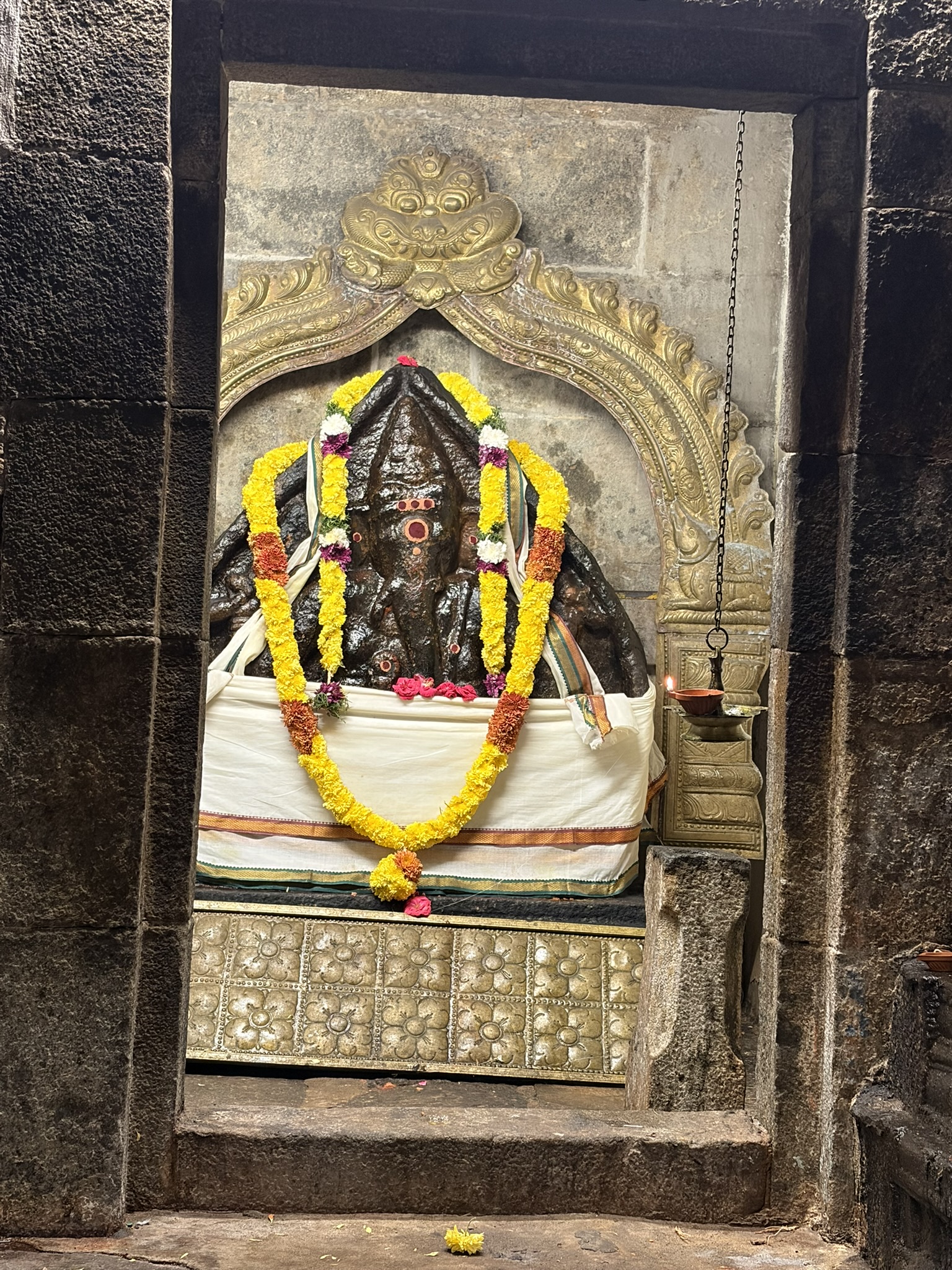
Pancha Lingas (Five Elemental Lingams): Represents the Earth (Prithvi) element among the five Pancha Bhoota Sthalams (via the anthill lingam of Valmikanathar) and also houses dedicated shrines for all Pancha Lingas.
Hata Keshwarar is rarely open and opens the pathway to Patala. We were lucky to be able to visit. In addition to the Valmikinathar the other Lingas are Anandeshwar, Siddheshwar and Achaleshwar.
Twin Primary Shiva Sanctums: Features Valmikanathar (worshipped as a sacred anthill) and Thyagarajaswamy (a Somaskanda idol celebrated for the Ajapa Natanam, whose sacred feet are revealed only twice a year on Margazhi Thiruvathirai and Panguni Uthiram). (Adi Shankara says that this is the site revered as Prithvi and not Ekambareshwarar)
Devi as Kriya Shakti & Jnana Shakti: Goddess Parvati is uniquely worshipped here in two distinct forms representing the twin powers of the Divine Feminine:
- Neelotpalambika (Kriya Shakti – Power of Action): Enshrined next to the main Shiva sanctum, depicted gracefully holding a blue lily (Nilotpal) alongside an attendant carrying baby Murugan.
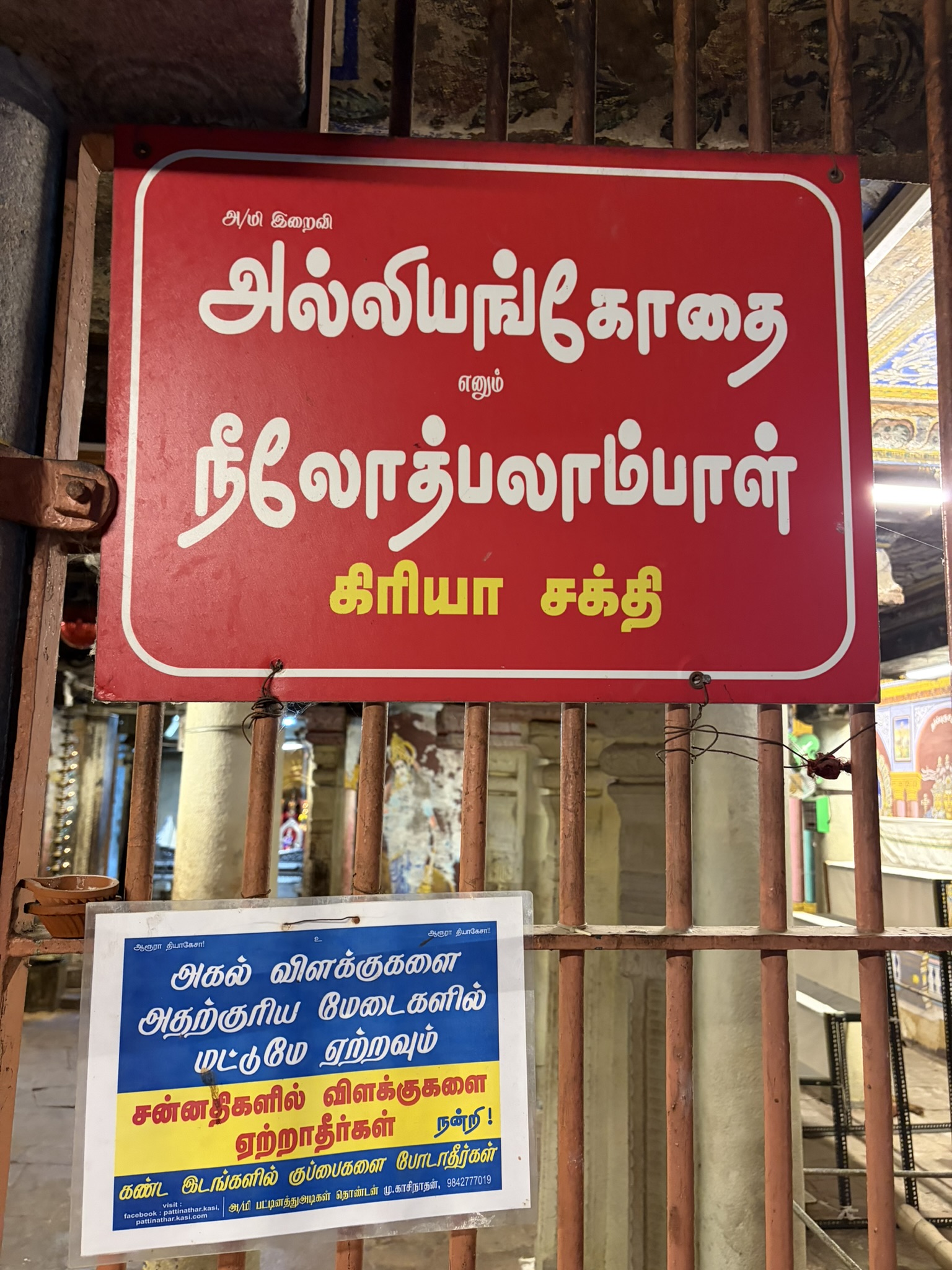
- Kamalambika (Jnana Shakti / Yoga Shakti – Power of Wisdom): Enshrined in a separate, sanctum, celebrated in Muthuswami Dikshitar’s famous Kamalamba Navavarna Kritis.
- Unique Yogic Pose of Kamalambika: Unlike conventional standing Goddess idols, Kamalambika is depicted seated in a rare, serene meditative yogic posture (Utkutikasana / cross-legged penance) with one leg resting over the other, holding a lotus, rudraksha rosary, noose (pasha), and goad (ankusha).
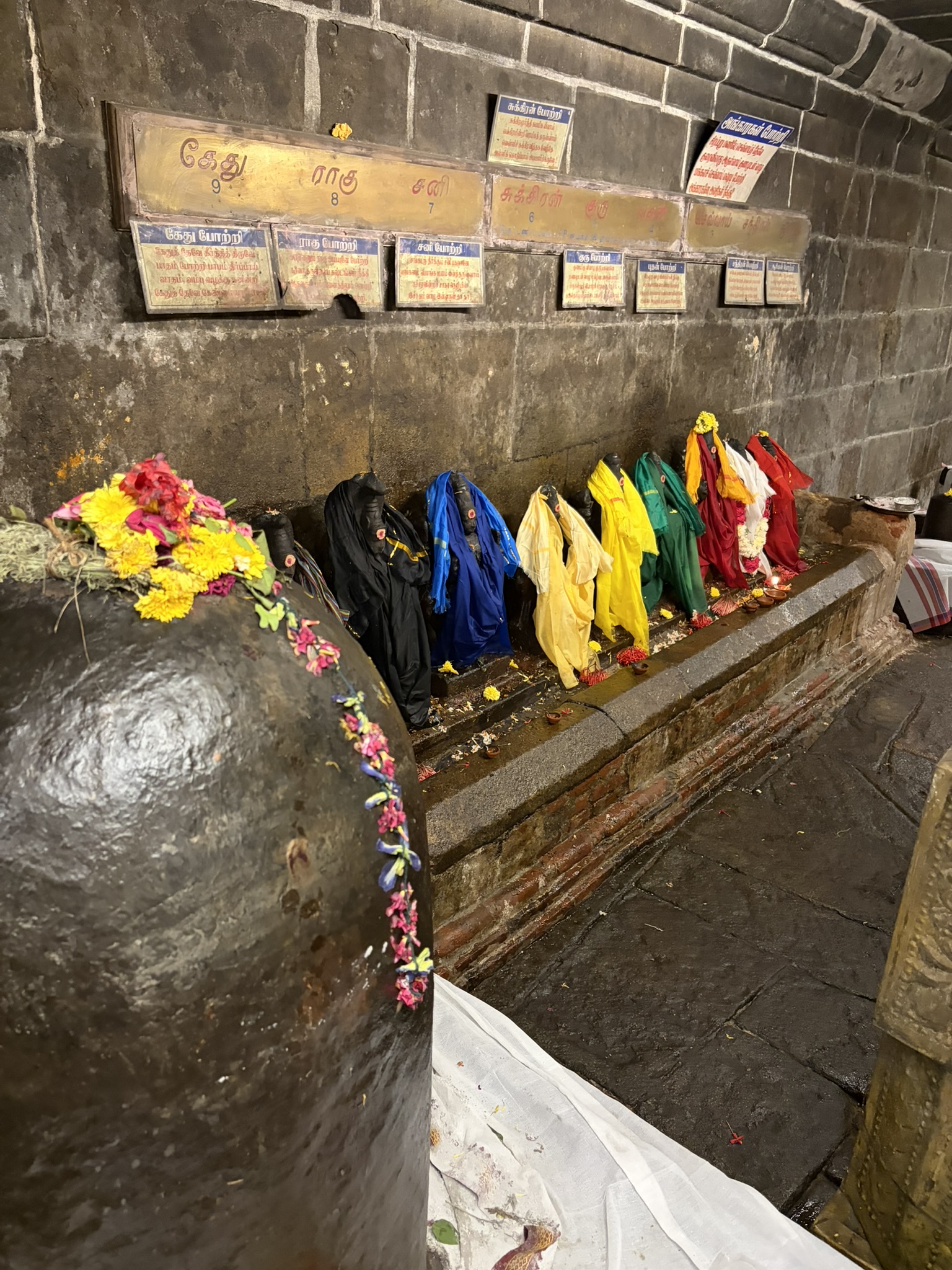
- Straight-Line Navagrahas & Daily Pradosham: All nine planetary deities stand side-by-side in a single straight row facing south, and the 6:00 PM Sayaratchai Puja is observed every evening as a Nitya Pradosham (daily Pradosham)
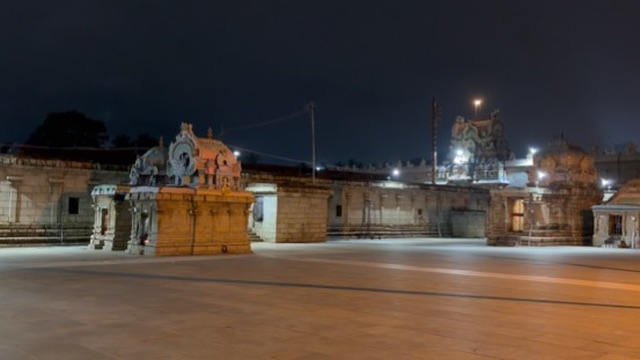
Kamalalayam Tank & Asia’s Largest Chariot: Anchored by the sprawling Kamalalayam tank (with an island shrine at its center) and the 96-foot, 300-tonne Aazhi Ther, the largest temple chariot in India.
Musical & Cultural Heritage: Located in the birthplace of the Carnatic Music Trinity (Tyagaraja, Muthuswami Dikshitar, and Shyama Sastri) and features the stone chariot sculpture of legendary king Manuneethi Cholan.
Day – 3 :
We had planned to visit Thiruvenkadu ( 23 Km from Mayildithurai) and then head to Chidambaram, and spend the evening and next day at Chidambaram. However we decided to skip this temple and headed straight to Chidambaram. Spent a few hours there and headed back home to Bangalore.
For Full Details on Chidambaram visit this link.
The temple at Thiruvenkadu is of importance. It is called Adi Chidambaram.
- Location: Along the Sirkazhi–Poompuhar road near the Cauvery river.
- Connectivity: Located about 10–12 km southeast of Sirkazhi and Vaitheeswaran Koil railway stations, and roughly 55 km northeast of Kumbakonam.
- Primary Landmark: Home to the historic Swetharanyeswarar Temple, one of the nine famous Navagraha temples in Tamil Nadu.
- Navagraha Significance: Serves as the designated shrine for Budhan (Mercury), sought for blessings related to wisdom, education, and speech.
- Temple Highlights: Known as Adi Chidambaram, the complex features three forms of Shiva (Swetharanyeswarar, Nataraja, and Aghoramurthy) and three sacred tanks (Mukkulam).
- Cultural Heritage: Revered in the 7th-century Tevaram hymns and recognized as the birthplace of the 10th-century Tamil saint-poet Pattinathar.
- Temples open by 5.30 AM and close by 11 – 11.30. Again evening open by 5 PM.
Travel TIPS :
You need someone who can talk Tamil. Food is excellent – very reasonable rates. No entry ticket / special darshan needed anywhere. Avoid peak season / special function. Summers can be very hot , OND is wet season. Jan / Feb is the perfect time.


Recent Comments